





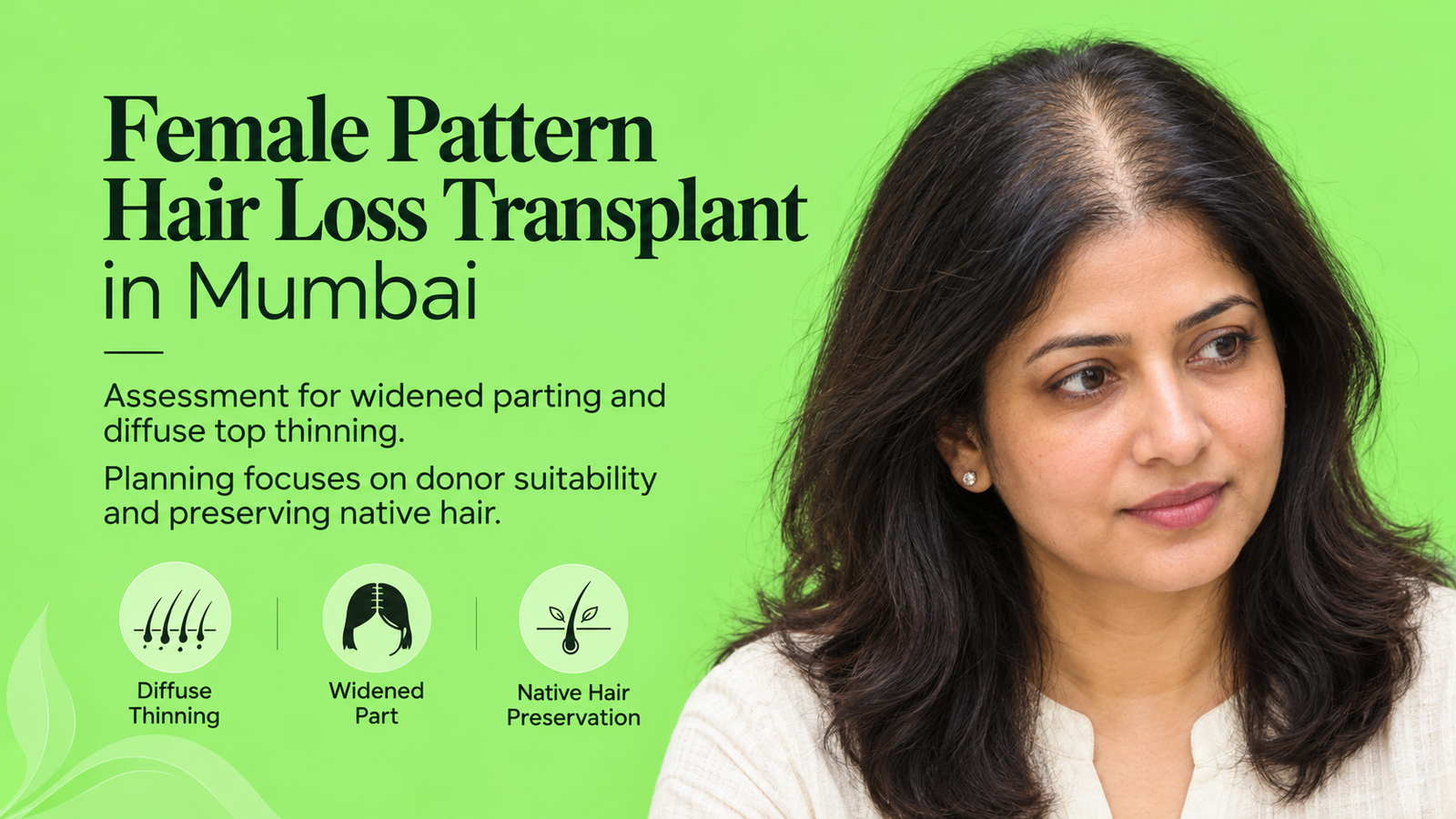
Female Pattern Hair Loss Transplant in Mumbai
Female pattern hair loss can gradually reduce density across the central and upper scalp while much of the frontal hairline remains present.
For women considering transplantation, the key issue is not simply whether the scalp looks thin.
The important questions are whether the diagnosis is established, whether hair loss is sufficiently stable, how much native hair remains, and whether the proposed donor area is genuinely resistant to the same miniaturisation process.
A hair transplant can improve selected areas in suitable women, but female pattern hair loss is one of the conditions in which careful patient selection matters most.
Not every woman with diffuse thinning is a good transplant candidate.
What Is Female Pattern Hair Loss?
Female pattern hair loss is a common form of progressive hair thinning.
Unlike the classic pattern seen in many men, women may retain much of the frontal hairline while noticing progressive thinning through the central scalp, widening of the part line or reduced overall density over the top.
The pattern varies between patients.
Diagnosis matters because diffuse thinning can also occur with telogen effluvium, nutritional deficiencies, thyroid disorders, hormonal changes, medication-related shedding and other conditions.
A transplant should not be planned until the clinical picture is understood.
Why Female Pattern Hair Loss Requires Special Transplant Assessment
Hair transplantation depends on moving follicles from a relatively stable donor region into an area where additional coverage is required.
In female pattern hair loss, potential donor areas can sometimes show miniaturisation as well.
That creates an important limitation.
A scalp may appear to contain plenty of hair from a distance while closer examination shows that a proportion of those donor follicles are becoming finer.
Using an unstable donor region can compromise the long-term value of surgery.
Is Every Woman With Female Pattern Hair Loss Suitable for Transplantation?
No.
A woman may be a stronger candidate when:
- The diagnosis is reasonably established
- Hair loss has shown sufficient stability for surgical planning
- The donor region has acceptable density and calibre
- Donor miniaturisation is limited enough for responsible harvesting
- The recipient area has a defined restoration objective
- Existing hair can be preserved
- Expectations are realistic
- There is enough donor supply for the proposed area and possible future needs
Transplantation may be deferred or avoided when:
- Hair loss is rapidly progressing
- Diffuse shedding is still active
- Donor thinning is substantial
- Scalp disease is uncontrolled
- The expected cosmetic gain would be too limited
- The requested density would consume donor hair disproportionately
- An untreated medical or hormonal contributor requires attention first
Female Pattern Hair Loss Versus General Female Hair Thinning
Not every woman with thin hair has female pattern hair loss.
Diffuse hair shedding or reduced density may also result from medical, nutritional, hormonal or temporary hair-cycle disturbances.
If the cause of thinning is unclear, the appropriate next step is a proper hair-loss assessment rather than assuming that transplantation is required.
Patients with active unexplained shedding may first be directed toward the appropriate Anagen Hairloss Prescription or consultation pathway.
Where Is Density Usually Lost?
Female pattern hair loss commonly produces visible changes through the central scalp and part line.
Depending on the patient, the crown may also become visibly thin.
The exact distribution matters because attempting to treat an entire diffusely thinning scalp can require a large number of grafts while still failing to recreate original natural density.
Surgical planning therefore prioritises where additional hair will create the greatest visual improvement.
Protecting Existing Native Hair
Many female transplant patients still have substantial hair within the area being treated.
That changes surgical planning.
Recipient sites need to be created with awareness of existing follicles, their direction and their distribution.
The objective is strategic enhancement rather than treating the recipient area as though it were completely bald.
This is also why medical preservation of native hair can remain important after transplantation.
Medical Treatment Before or Alongside Surgery
Transplantation adds follicles to selected areas, but it does not stop the underlying process affecting native hair.
For some women, medical management may therefore be recommended before transplantation, after transplantation or both.
Treatment depends on the diagnosis, medical history and individual suitability.
Patients with ongoing female hair loss can also explore the Anagen Hairloss Prescription pathway when medical management is appropriate.
Where supportive procedures such as PRP, iPRF or GFC are discussed, they should be considered adjunctive options rather than guaranteed methods of restoring lost density.
Female Pattern Hair Loss and Hormones
Some women with pattern thinning also have hormonal or endocrine factors that require separate assessment.
Transplantation is not treatment for PCOS, thyroid disease, androgen excess, menopause-related hormonal changes or another underlying endocrine disorder.
Where hormonal hair loss is suspected, stabilisation and medical evaluation take priority.
Female Pattern Hair Loss Versus Density Enhancement
These two pages have different purposes.
Female Pattern Hair Loss Transplant addresses a diagnosis-specific question:
“Can transplantation be used when I have female pattern hair loss?”
Female Density Enhancement addresses a treatment goal:
“I still have substantial hair, but one area looks visually thin. Can selected transplantation improve fullness?”
A patient can fall into both categories, but they should not be treated as interchangeable topics.
How Is a Female Pattern Hair Loss Transplant Performed?
Step 1: Confirm the Hair-Loss Pattern
The recipient area, progression and likely diagnosis are assessed.
Step 2: Evaluate the Donor Area
Density, calibre, miniaturisation and long-term donor stability are reviewed.
Step 3: Prioritise the Treatment Zone
The area where transplantation can create the greatest cosmetic benefit is mapped.
Step 4: Local Anaesthesia
Local anaesthesia is administered according to the planned donor and recipient areas.
Step 5: Follicular Unit Extraction
Suitable follicular units are selectively harvested from the donor region.
Step 6: Graft Sorting
Follicular units are evaluated and organised according to their characteristics and intended placement.
Step 7: Recipient-Site Creation
Sites are created around existing hairs with attention to direction, spacing and native-hair preservation.
Step 8: Implantation
Grafts are strategically placed to improve visual density rather than attempting to reproduce the density of an unaffected scalp.
Step 9: Post-Procedure Care
Instructions are provided for scalp care, washing, activity and follow-up.
How Many Grafts Are Needed?
Graft requirement cannot be estimated reliably from the diagnosis alone.
It depends on:
- Width and length of the thinning zone
- Remaining native hair
- Hair shaft calibre
- Degree of miniaturisation
- Crown involvement
- Donor density
- Cosmetic priorities
- Whether one or more stages are planned
A very large diffuse area may require prioritisation rather than uniform transplantation everywhere.
Recovery and Growth
Transplanted follicles do not produce the final appearance immediately.
The recipient and donor areas go through early healing, and some transplanted hairs may shed before new growth becomes visible.
Growth develops progressively and continues to mature over time.
Because native female hair may continue to miniaturise, ongoing follow-up and appropriate medical management can remain important even after a technically successful transplant.
Female Pattern Hair Transplant Results
Transplant results in female pattern hair loss depend heavily on donor stability, existing native hair and the extent of thinning.
Reviewing female hair transplant results can help patients understand the range of cases that may be suitable for surgical restoration.
Cost of Female Pattern Hair Loss Transplantation
Cost depends on the treatment plan rather than simply the diagnosis.
Variables include:
- Graft requirement
- Recipient surface area
- Existing density
- Donor density
- Hair calibre
- Crown involvement
- Number of stages
- Additional treatment required to preserve native hair
Frequently Asked Questions
Can diffuse female pattern hair loss be transplanted?
Sometimes, but diffuse thinning makes donor assessment particularly important. Surgery may not be appropriate when the donor area is also significantly miniaturised.
Will transplantation stop my existing hair from thinning?
No. Transplantation redistributes selected follicles. Native hair can continue to thin and may require ongoing management.
Can grafts be placed between existing hairs?
Yes in selected patients, but planning must account for the location and direction of native follicles.
Is a widened part line suitable for transplantation?
It can be in appropriately selected cases, but the reason for the widening and donor stability should be established first.
What if the donor area is also thin?
Significant donor miniaturisation may make transplantation unsuitable or substantially limit what can be achieved.
Can PRP or medication replace a transplant?
They serve different purposes. Medical and supportive treatments aim primarily at existing follicles, while transplantation relocates follicles into selected areas. Appropriate treatment depends on diagnosis.
Get Your Female Hair Loss Assessed Before Deciding on a Transplant
A woman with a widening part or diffuse thinning should not book surgery based only on how the scalp looks in a photograph.
The first step is to determine:
- Whether the pattern is actually female pattern hair loss
- Whether the loss is still progressing
- Whether the donor area is stable
- Whether existing native hair should be treated first
- Whether transplantation can create a worthwhile improvement
For an initial assessment, send clear photographs of your:
Front • Top • Both Sides • Back/Donor Area
Anagen can then guide you regarding the appropriate next step—medical treatment, further evaluation, supportive treatment or hair transplantation where suitable.