





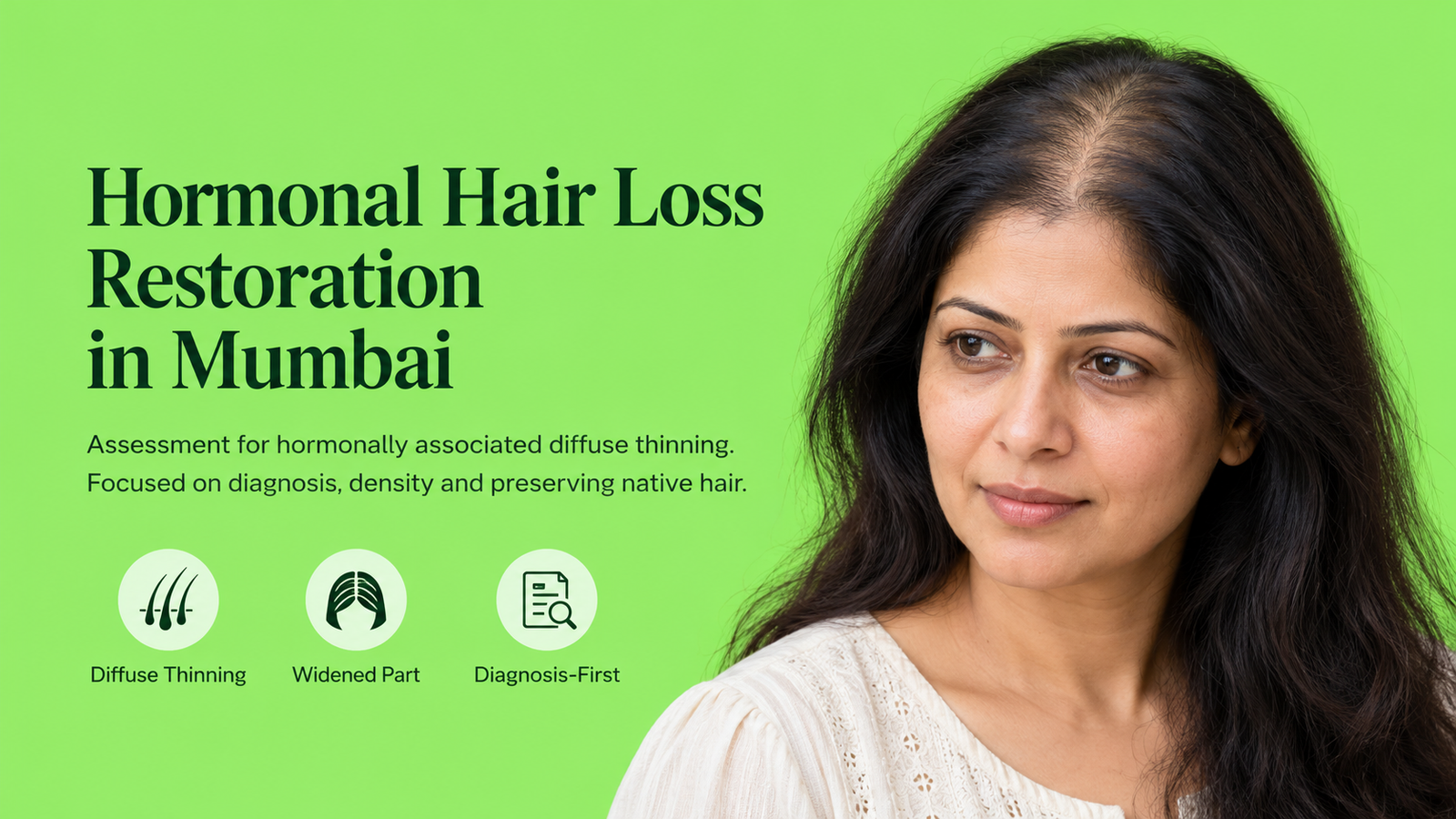
Hormonal Hair Loss Restoration in Mumbai
“Hormonal hair loss” is not one diagnosis.
Women may notice increased shedding or progressive thinning during periods of hormonal change or in association with conditions affecting thyroid function, androgen activity, menopause, perimenopause or polycystic ovary syndrome.
The pattern may also resemble other types of female hair loss.
Because the underlying causes vary, treatment should begin with assessment rather than assuming that the lost hair needs to be transplanted.
A hair transplant can redistribute follicles.
It does not treat an underlying hormonal disorder.
Hormonal Hair Loss Is Not a Single Condition
Hair growth responds to multiple biological signals.
Different hormonal or endocrine conditions may affect hair through different mechanisms.
Examples may include:
- Androgen-related pattern thinning
- Thyroid dysfunction
- PCOS-associated androgen excess
- Perimenopausal changes
- Menopause-related changes
- Post-pregnancy hormonal changes
These conditions should not all be treated as though they were identical.
What Does Hormonal Hair Loss Look Like?
The appearance may include:
- Diffuse shedding
- Widening of the part line
- Reduced central density
- Crown thinning
- Frontal-temporal reduction
- Progressive miniaturisation
The same visual pattern can arise from more than one cause.
This is why appearance alone should not automatically determine treatment.
Diagnosis Comes Before Restoration
Assessment may include:
- Duration and progression
- Menstrual or reproductive history where relevant
- Pregnancy history
- Menopause or perimenopause
- Symptoms suggesting thyroid dysfunction
- PCOS history where relevant
- Medication
- Family history
- Scalp pattern
- Donor-zone examination
Laboratory evaluation may be recommended selectively according to clinical history.
Not every patient needs the same hormone panel.
Thyroid-Related Hair Loss
Thyroid disorders can contribute to diffuse changes in hair growth.
Transplantation does not treat thyroid dysfunction.
When thyroid disease is suspected or known, appropriate medical management takes priority.
PCOS and Androgen-Related Thinning
Some women with PCOS or increased androgen activity may develop progressive pattern thinning.
The priority is to identify and manage the underlying condition where appropriate and then determine whether stable residual hair loss remains.
Perimenopause and Menopause
Hair density can change during and after the menopausal transition.
However, age or menopause alone should not be assumed to be the sole cause.
The scalp pattern, donor area and other medical factors still require assessment.
Stable Versus Active Hair Loss
This distinction is central to surgical planning.
Active Loss
Ongoing shedding, rapidly widening part or progressive miniaturisation may indicate that surgery should be delayed while the condition is investigated and managed.
Stable Residual Loss
A patient who has been medically assessed and has a persistent stable deficit may later be evaluated for transplantation.
Medical Management Before Surgery
If an underlying hormonal or medical condition is contributing to hair loss, that condition should be addressed appropriately.
The objective is to:
- Reduce avoidable ongoing loss where possible
- Preserve native hair
- Establish stability
- Determine whether the donor area is healthy
- Avoid unnecessary surgery during active progression
When Could Hair Transplantation Be Considered?
Hair transplantation may be considered in selected patients when:
- The underlying condition has been assessed
- Hair loss is sufficiently stable
- Permanent residual thinning remains
- Donor hair is suitable
- Recipient goals are realistic
- Native hair preservation is addressed
Surgery treats the residual cosmetic deficit, not the endocrine disorder.
Donor Assessment Is Essential
Potential hormonal or pattern-related hair loss may affect the donor region in some women.
Assessment therefore includes:
- Density
- Calibre
- Miniaturisation
- Distribution
- Long-term stability
Hormonal Hair Loss Versus Female Pattern Hair Loss
These conditions can overlap.
Female pattern hair loss describes a characteristic type of progressive miniaturisation.
Hormonal disorders may contribute to or coexist with pattern thinning but should not automatically be treated as synonymous.
Hormonal Hair Loss Results
Hair transplantation does not treat the underlying hormonal cause of hair loss.
In selected patients with stable residual loss and suitable donor hair, surgical restoration may be considered after appropriate medical assessment.
Cost of Hormonal Hair Loss Treatment
Cost cannot be determined from the phrase “hormonal hair loss” alone.
Depending on diagnosis, treatment may involve:
- Medical assessment
- Prescription management
- Selected laboratory investigation
- Supportive treatment
- Follow-up
- In selected stable cases, transplantation
Frequently Asked Questions
Can hormonal hair loss grow back?
It depends on the cause and the condition of the follicles. Some forms may improve with appropriate management, while others can leave persistent thinning.
Does hormonal hair loss need a hair transplant?
Not automatically. Medical assessment and stabilisation come first.
Can a transplant fix PCOS-related hair loss?
A transplant cannot treat PCOS. It may only be considered later for selected stable residual loss.
Can thyroid hair loss be transplanted?
Underlying thyroid disease should be assessed and managed first. Surgery is considered only for persistent stable loss in suitable patients.
Can menopause cause hair thinning?
Hair changes may occur around menopause, but other causes should also be considered.
Why is donor assessment important?
If donor follicles are also miniaturising, transplantation may be limited or inappropriate.
Suspect Hormonal Hair Loss? Find the Cause Before Choosing the Treatment
If your hair loss appears related to PCOS, thyroid changes, menopause, perimenopause or another hormonal concern, the first objective should be diagnosis and stabilisation.
For an initial hair assessment, send clear photographs of:
Front • Top/Part Line • Both Temples • Crown • Back/Donor Area
Your medical history and associated symptoms may also be relevant.
Anagen can then guide you regarding the appropriate next step—medical evaluation, prescription management, selected supportive treatment or transplantation only when stable permanent loss remains.