





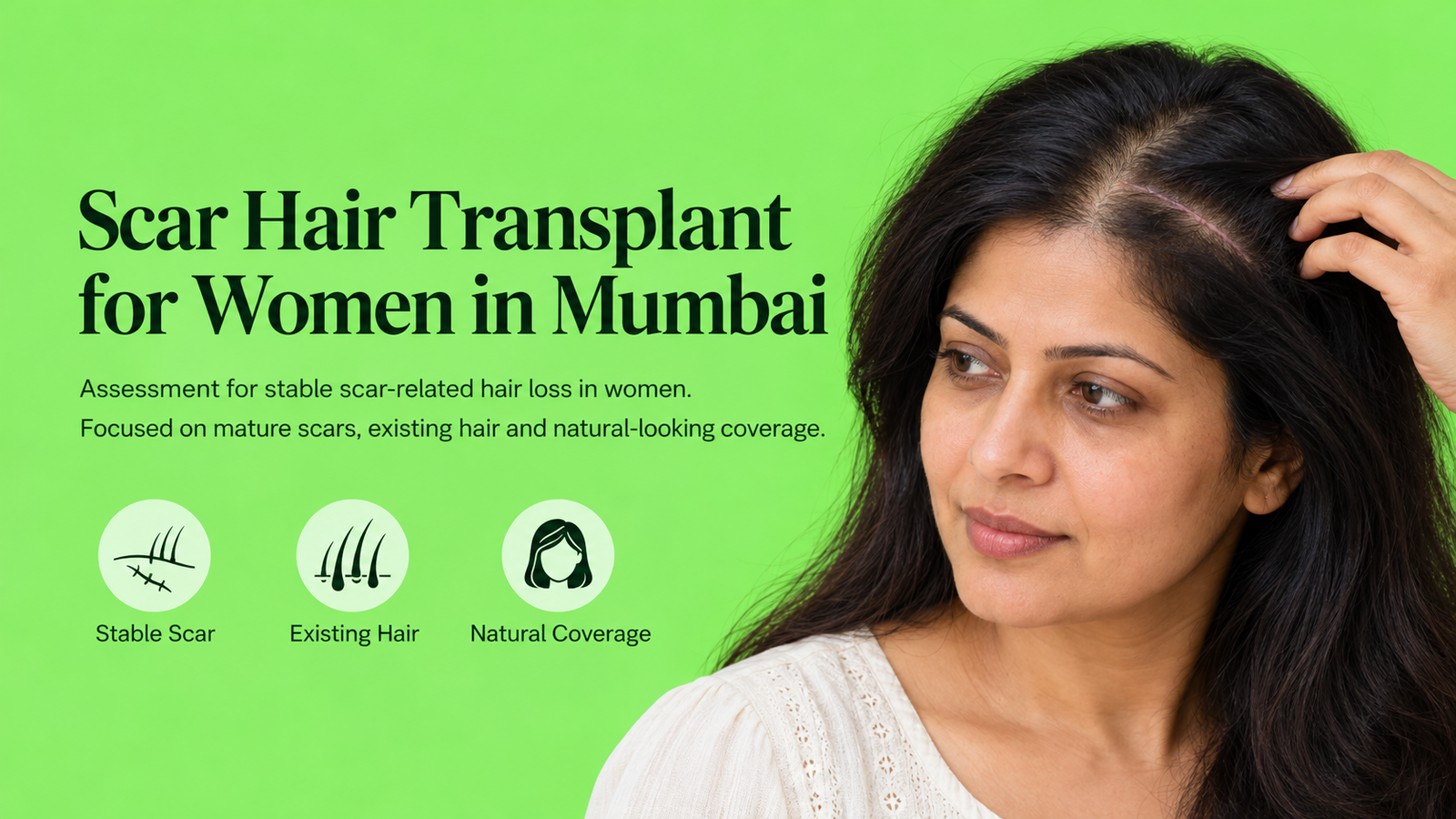
Scar Hair Transplant for Women in Mumbai
A stable scar within the hairline or hair-bearing scalp can remain visible even after the original injury or surgery has fully healed.
Hair transplantation may be used in selected cases to improve camouflage by placing follicles within or around the scar.
The objective is not to remove the scar.
It is to reduce its visual prominence by restoring hair coverage where the recipient tissue can support transplanted follicles.
Scar tissue behaves differently from normal scalp skin.
Its thickness, blood supply, maturity and surrounding hair pattern all influence treatment planning and potential growth.
What Types of Scars May Be Considered?
Selected stable scars may result from:
- Previous surgery
- Trauma
- Burns that have fully healed
- Previous cosmetic procedures
- Stable scalp injury
- Selected postsurgical scars
- Hairline scars
The scar should be assessed individually.
Not every scar is suitable for transplantation.
Why Scar Tissue Is Different From Normal Scalp
Normal scalp contains a well-developed blood supply and tissue environment designed to support follicles.
Scar tissue may have:
- Altered vascularity
- Increased firmness
- Reduced elasticity
- Variable thickness
- Irregular surface texture
These differences can affect how transplanted follicles behave.
Scar Maturity Matters
Hair transplantation should generally be considered only when the scar has matured and the underlying condition is stable.
A scar that is still changing, inflamed or associated with active disease may not be suitable.
Assessment considers:
- Time since injury or surgery
- Colour
- Thickness
- Texture
- Stability
- Tenderness or inflammation
- Cause of the scar
Blood Supply and Recipient Tissue Quality
Grafts require adequate vascular support after implantation.
Because scar vascularity can differ from normal scalp, the surgeon may choose a more conservative approach.
In some cases, staged treatment may be preferable to aggressive single-session density.
Hair Direction Must Match the Surrounding Area
Scar camouflage is not only about getting follicles to grow.
They should also blend with the surrounding hair.
Direction is especially important when the scar crosses:
- Frontal hairline
- Temple
- Crown
- Part line
- Previous surgical incision
Incorrect direction can make transplanted hairs more noticeable rather than less.
Can Hair Grow Through a Scar?
Hair can grow after transplantation into selected mature scars.
However, growth can be less predictable than transplantation into normal scalp skin.
Outcome depends on:
- Scar vascularity
- Scar thickness
- Recipient tissue quality
- Cause of injury
- Donor quality
- Implantation density
- Previous procedures
Complete disappearance of the scar should not be promised.
The realistic objective is camouflage.
Conservative Density and Possible Staging
Attempting to create maximum density in compromised scar tissue may not be appropriate.
A conservative first treatment can allow the response of the tissue to be assessed.
If growth and healing are satisfactory, additional treatment may sometimes be considered later.
How Is Scar Hair Transplantation Performed?
Step 1: Scar Assessment
The cause, age, maturity, location and tissue quality are examined.
Step 2: Donor Assessment
Appropriate donor follicles are identified.
Step 3: Direction and Camouflage Planning
The surrounding hair pattern and visual exposure of the scar are analysed.
Step 4: Local Anaesthesia
Local anaesthesia is administered according to the treatment plan.
Step 5: Follicular Unit Extraction
Suitable grafts are harvested from the donor area.
Step 6: Graft Selection
Follicular units are selected according to the scar location and surrounding hair.
Step 7: Recipient-Site Creation
Sites are created conservatively within and, where appropriate, immediately around the scar.
Step 8: Implantation
Grafts are placed according to natural direction and planned density.
Step 9: Early Post-Procedure Care
The area is monitored carefully during healing.
Scar Hairline Restoration
When the scar crosses the frontal hairline, additional attention must be paid to:
- Fine leading hairs
- Low exit angles
- Natural contour
- Surrounding hair direction
- Visual irregularity
- Scar edge camouflage
How Many Grafts Are Needed?
Graft requirement depends on:
- Scar length
- Scar width
- Location
- Tissue quality
- Surrounding density
- Hair calibre
- Desired camouflage
- Whether treatment is staged
The objective is not necessarily high density.
Even modest hair coverage may reduce the visual contrast of a stable scar.
Recovery and Growth
Early healing may involve temporary redness and crusting.
Growth develops gradually.
Because scar tissue is biologically different from normal scalp, results may vary more than in routine transplantation.
Additional treatment may sometimes be considered depending on first-stage growth.
Scar Hair Transplant Results for Women
Hair transplantation may improve coverage over selected stable scars, although graft growth can differ from normal scalp skin.
Relevant repair and female hair-transplant cases can help explain realistic possibilities.
Cost of Scar Hair Transplantation
Cost depends on:
- Scar dimensions
- Graft requirement
- Tissue complexity
- Previous surgery
- Donor quality
- Hairline involvement
- Number of stages
Frequently Asked Questions
Can hair be transplanted into a scar?
Yes, selected mature scars can receive transplanted follicles when tissue quality and blood supply are suitable.
Will the scar completely disappear?
No. Hair transplantation aims to camouflage the scar, not remove it.
Is graft growth lower in scar tissue?
Growth can be less predictable than in normal scalp because scar tissue may have different vascularity and structure.
How old should the scar be before transplantation?
There is no single universal duration. The important issue is that the scar should be mature, stable and clinically suitable.
Can hairline scars be transplanted?
Selected hairline scars may be treated, but direction, fine hairs and frontal design are particularly important.
Will I need more than one session?
Possibly. Staged treatment may be preferable in some scars depending on tissue response and desired camouflage.
Want to Know Whether Your Scar Can Be Camouflaged With Hair?
Suitability depends on much more than the size of the scar.
Anagen needs to assess:
- Cause of the scar
- Scar maturity
- Thickness and texture
- Location
- Surrounding hair direction
- Recipient tissue quality
- Donor supply
For an initial assessment, send:
1 clear close-up of the scar • 1 wider view showing the surrounding hair • Front/side view depending on the scar location • Back/Donor photograph
This can help determine whether transplantation is worth considering and whether conservative or staged treatment may be more appropriate.