





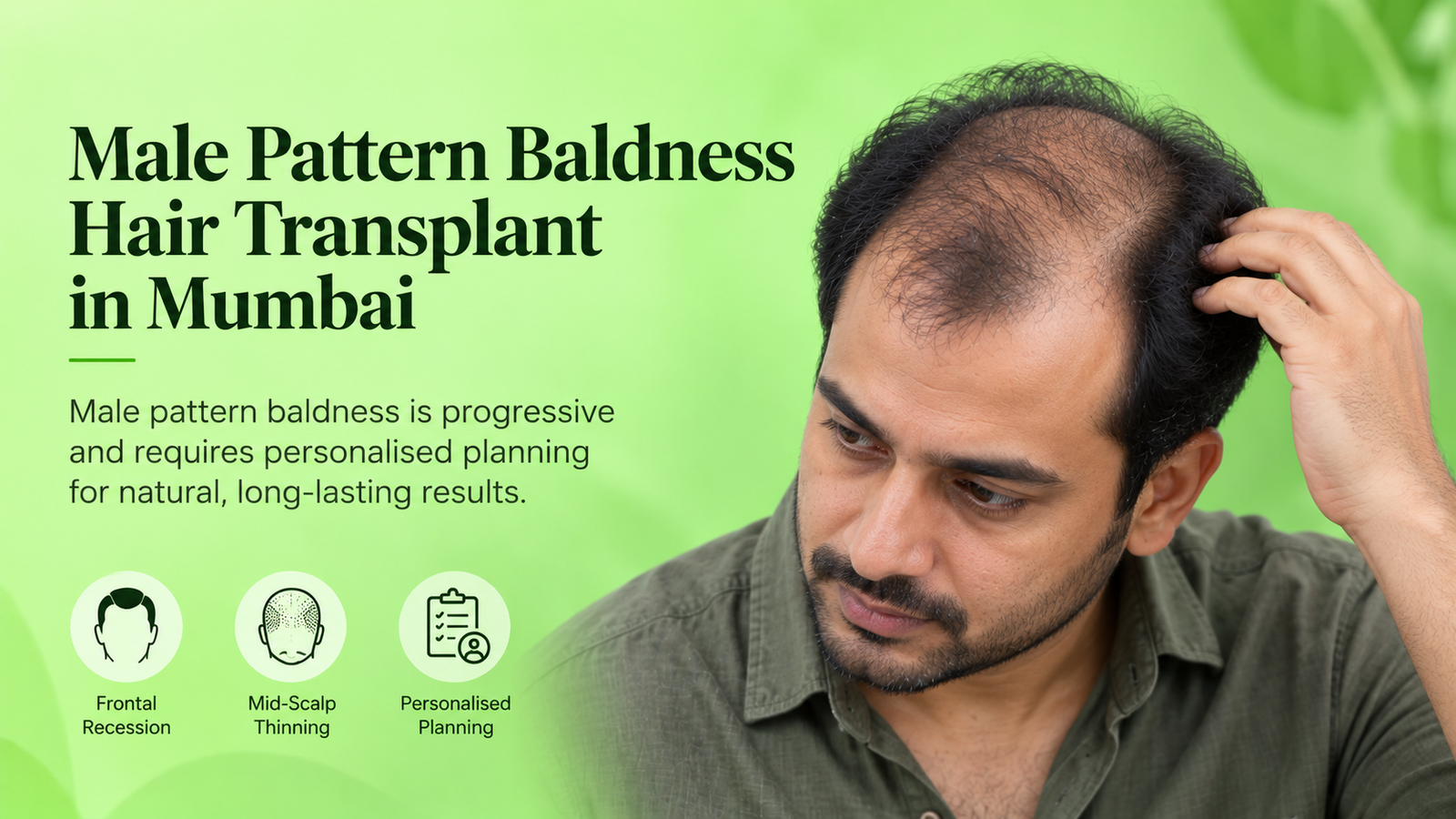
Male Pattern Baldness Hair Transplant in Mumbai
Male pattern baldness is one of the most common reasons men consider hair transplantation. It may begin with a receding hairline, thinning at the crown or gradual loss of density across the top of the scalp.
However, not every man with male pattern baldness needs a hair transplant immediately. The appropriate treatment depends on the diagnosis, age, progression of hair loss, condition of existing hair and availability of healthy donor follicles.
At Anagen Hair Transplant Clinic in Mumbai, treatment planning considers both your current appearance and the possibility of further hair loss. The objective is to restore suitable areas naturally while preserving donor hair for future requirements.
What Is Male Pattern Baldness?
Male pattern baldness, medically called androgenetic alopecia, is a genetically influenced condition in which susceptible scalp follicles gradually produce finer and shorter hairs.
Androgens, particularly dihydrotestosterone (DHT), contribute to follicular miniaturisation in genetically susceptible men. Over time, individual hairs lose calibre and the scalp becomes more visible.
The process may affect different regions at different rates. Some men notice changes around the temples first, while others develop thinning at the crown or across the middle of the scalp.
Unlike temporary shedding, established male pattern baldness is generally progressive. Hair transplantation can redistribute suitable follicles into areas of hair loss, but it does not stop the ongoing miniaturisation of existing susceptible hair.
How Does Male Pattern Baldness Progress?
Early Frontal Recession
The temples gradually move backwards, sometimes creating an M-shaped hairline. The central forelock may remain relatively strong.
Frontal and Mid-Scalp Thinning
Hair behind the hairline loses density. Under bright lighting or when the hair is wet, the scalp becomes increasingly visible.
Crown or Vertex Hair Loss
The crown begins to thin around the natural hair whorl. This region may enlarge independently of frontal recession.
Advanced Male Pattern Baldness
Frontal and crown thinning may eventually connect, leaving a large recipient area with a comparatively smaller permanent donor zone.
The Norwood classification helps describe these patterns, but it does not independently determine whether transplantation is suitable or how many grafts can safely be harvested.
Are You Suitable for a Male Pattern Baldness Hair Transplant?
Suitability is not determined simply by the amount of visible baldness.
A good surgical candidate generally has a sufficiently stable diagnosis, adequate healthy donor hair and realistic expectations about what can be achieved.
Important considerations include:
Age and progression: Rapidly changing hair loss, especially in younger patients, may require medical stabilisation and observation before surgery.
Donor quality: The back and sides of the scalp must contain enough appropriate hair for safe harvesting.
Recipient condition: The scalp should be medically suitable for transplantation.
Existing native hair: Surrounding miniaturised hair may need medical treatment and careful recipient-site planning.
Long-term expectations: The design must remain appropriate even if untreated native hair continues to thin.
Sudden shedding, patchy hair loss, inflammation or scarring may indicate another diagnosis. Such cases require proper medical evaluation rather than automatic surgical planning.
Why Is Donor Hair Assessment Essential?
A hair transplant does not create new follicles. It moves existing follicles from a donor area to a recipient area.
At Anagen, donor assessment includes hair density, calibre, follicular-unit composition, miniaturisation, scalp characteristics and any previous harvesting.
The safe donor area is mapped to estimate how much hair might be available for transplantation without creating obvious donor thinning.
Someone with strong, coarse, multi-hair follicular units may obtain more visual coverage from a given graft count than someone with fine hair or a weak donor.
The number of grafts that can be used today must also be balanced against possible future needs.
Which Areas Should Be Restored First?
Male pattern baldness frequently affects the frontal scalp, mid-scalp and crown, but all three areas do not necessarily deserve equal graft allocation.
Hairline and Frontal Scalp
The front of the scalp frames the face and frequently has a high cosmetic priority.
For men with substantial frontal recession, Male Hairline Restoration may help recreate a natural frontal boundary. When thinning extends behind the hairline, Front Hair Transplant planning includes the broader frontal third.
Mid-Scalp
The mid-scalp creates continuity between the front and crown. Restoring this area can reduce the appearance of a disconnected frontal island.
Crown
The crown may require considerable donor hair because of its surface area and natural whorl pattern. In patients with limited donor supply, crown surgery may be delayed or planned as a second stage.
Patients with extensive recession and crown loss may need the more comprehensive approach described in Advanced Norwood Hair Transplant planning.
Can Medical Treatment Help Before or After Transplantation?
In suitable patients, prescription treatment may help slow progression and preserve miniaturising native hair.
Depending on the clinical assessment, a doctor may discuss treatments such as finasteride or minoxidil. Suitability, dosing, contraindications and possible adverse effects must be assessed individually.
Medical therapy and transplantation serve different purposes. Medicines may help preserve or improve susceptible follicles, whereas surgery relocates appropriate follicles to areas requiring restoration.
Selected adjunctive treatments such as PRP, iPRF or GFC may be discussed, but they should not be presented as equivalent replacements for transplantation in established completely bald areas.
For further information, read our Male Pattern Baldness Prescription and Post Hair Transplant Maintenance Prescription pages.
How Is Male Pattern Baldness Hair Transplant Performed?
Step 1: Diagnosis and Scalp Assessment
The doctor evaluates the pattern of hair loss, family history, progression and medical suitability.
Step 2: Donor Mapping
The donor area is examined to estimate safe harvesting capacity and identify hair suitable for the recipient zones.
Step 3: Treatment Prioritisation
The frontal scalp, mid-scalp and crown are assessed together, and the graft allocation is matched to patient goals and donor limits.
Step 4: Hairline and Recipient Design
Where hairline restoration is required, a conservative, age-appropriate design is planned with natural direction, soft leading-edge hairs and gradual density transitions.
Step 5: Anaesthesia and FUE Extraction
Under appropriate local anaesthesia and clinical monitoring, suitable follicular units are extracted from the planned donor area.
Step 6: Graft Assessment and Recipient-Site Preparation
Grafts are evaluated and organised according to their characteristics. Recipient sites are planned to match the required direction, angle and distribution.
Step 7: Graft Implantation
Follicular units are implanted in their allocated recipient zones, with particular attention to frontal naturalness and preservation of existing hair.
Step 8: Post-Procedure Care
Patients receive instructions regarding scalp washing, medications, activity restrictions, follow-up and expected healing.
Will One Session Be Enough?
One session may be sufficient for a limited and well-defined recipient area when adequate donor hair is available.
More extensive male pattern baldness may require a staged approach. For example, frontal and mid-scalp restoration may receive priority initially, with crown restoration or supplementary density considered after the first result has matured.
The decision depends on recipient area, donor reserve, existing density, graft requirements, medical fitness and surgical feasibility.
Planning two stages does not automatically mean an incomplete first procedure. It may be a deliberate strategy to distribute finite donor hair responsibly.
What Results and Recovery Can You Expect?
Following FUE, temporary redness, swelling, crusting and tenderness may occur. Some transplanted hair shafts commonly shed during the early weeks.
New visible growth often begins around three to four months. Meaningful improvement generally develops over six to nine months, with maturation commonly assessed around 12 months; crown development can take longer.
The final appearance depends on graft growth, hair characteristics, surgical planning, native-hair maintenance and continuing hair-loss progression.
A hair transplant should not be interpreted as a guarantee that no further treatment will ever be needed.
Male Pattern Baldness Hair Transplant Results
Results in male pattern baldness depend on the stage of hair loss, donor quality, recipient area and long-term progression.
Reviewing genuine Male Hair Transplant Results can help patients understand the different patterns treated and the range of coverage that may be realistic. Individual outcomes vary, and another patient’s graft count or visible density may not predict your result.
View male hair transplant results.
Male Pattern Baldness Hair Transplant Results
Results in male pattern baldness depend on the stage of hair loss, donor quality, recipient area and long-term progression.
Reviewing genuine Male Hair Transplant Results can help patients understand the different patterns treated and the range of coverage that may be realistic. Individual outcomes vary, and another patient’s graft count or visible density may not predict your result.
View male hair transplant results.
How Much Does Male Pattern Baldness Hair Transplant Cost in Mumbai?
The total cost depends on the number of grafts, the size and location of the treatment area, donor characteristics, selected technique, procedural complexity and whether more than one session is required.
A patient needing only frontal restoration will usually have a different plan from someone requiring reconstruction of the frontal scalp, mid-scalp and crown.
A meaningful quotation follows medical assessment and an individualised graft plan.
Frequently Asked Questions
Is a male pattern baldness hair transplant permanent?
Follicles harvested from appropriately selected resistant donor areas often provide long-lasting growth. However, transplanted follicles are not guaranteed to remain unaffected indefinitely, and existing native hair may continue to thin.
What is the best age for transplantation?
There is no universally correct age. A patient’s maturity of hair-loss pattern, progression, donor quality and medical management are more important than age alone.
Will I need finasteride or minoxidil after surgery?
Some patients may benefit from medical maintenance. Treatment decisions depend on diagnosis, contraindications, tolerability and medical assessment.
Can I restore the crown and hairline together?
Sometimes. The combined recipient area must be evaluated against available donor hair and the priorities of the treatment plan.
How many grafts are required?
A graft estimate cannot be determined from the diagnosis alone. Measurements of recipient area, existing hair, intended density and donor capacity are necessary.
Can transplanted hair fall out again?
Early shedding of transplanted hair shafts is expected in many patients. Long-term growth varies, and some follicles may not grow successfully. Progressive thinning of surrounding native hair can also change the overall appearance.
Get Your Male Pattern Baldness Assessed at Anagen
If you are experiencing a receding hairline, crown thinning or progressive loss across the top of your scalp, start with a proper hair and donor assessment.
Send clear FRONT, TOP, CROWN and BACK DONOR photographs on WhatsApp for an initial review. Please also mention your age, duration of hair loss and any previous medical or surgical treatments.
Our doctors can assess whether medical treatment, transplantation or a combined long-term plan may be appropriate.
ANAGEN Hair Transplant Clinic — Andheri West, Mumbai
Call / WhatsApp: +91 92222 22407
A photographic review is preliminary; final surgical suitability and graft planning require an appropriate medical assessment.