




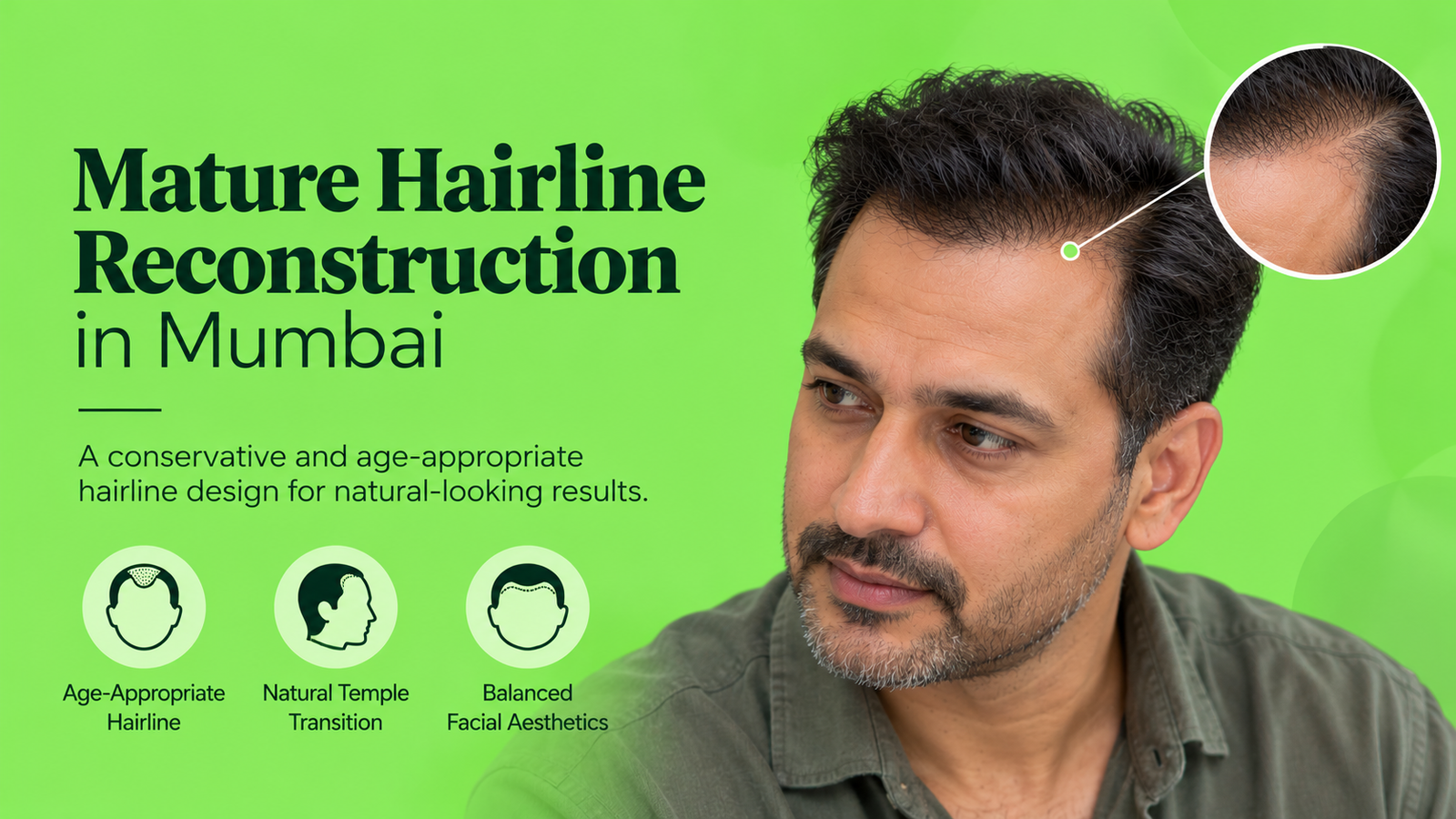
Mature Hairline Reconstruction in Mumbai
A natural male hairline does not necessarily need to resemble the hairline a man had during his teenage years.
As men mature, the frontal hairline may develop a slightly higher position with natural recession at the temples. In some individuals, this creates an attractive, age-appropriate appearance without making the forehead look excessively exposed.
Mature Hairline Reconstruction at Anagen Hair Transplant Clinic in Mumbai focuses on restoring an appropriate adult frontal frame while conserving donor hair for possible future needs.
What Is a Mature Male Hairline?
A mature hairline is an adult frontal hairline that typically sits somewhat higher than a juvenile hairline and may show recession at the frontotemporal corners.
This appearance can be normal in adult men. However, frontal recession can also be part of progressive androgenetic alopecia, and both conditions may coexist.
Mature Hairline Reconstruction is relevant when the existing frontal boundary has receded beyond a cosmetically acceptable position but restoring a very low youthful hairline would be unsuitable.
The objective is to recreate facial framing while preserving a natural adult appearance.
What Is the Difference Between a Juvenile and Mature Hairline?
A juvenile hairline is usually lower and may have relatively closed frontal corners.
A mature hairline often has greater forehead exposure and more visible frontotemporal transitions.
The distinction is not based on a single measurement. Forehead shape, original hairline, ethnicity, age and individual anatomy all influence what looks appropriate.
Transplanting a juvenile hairline onto a man with progressive baldness may require substantial grafts and become disproportionate if surrounding hair continues to thin.
How Is a Mature Hairline Position Selected?
The doctor evaluates the central frontal position, frontal corners and relationship between the forehead and temples.
A mature design may preserve a gentle M, U or curved contour based on the patient’s anatomy.
The lowest frontal point is not selected in isolation. Its placement affects the amount of donor hair required and the appearance of the lateral transition.
A slightly higher hairline may allow a more balanced distribution of grafts behind the frontal boundary, particularly in patients with limited donor supply.
Why Is Conservative Temple Recession Sometimes Important?
Natural adult male hairlines often show some separation between the central frontal contour and the temporal points.
Closing every frontal corner completely may create an unusually youthful, squared-off appearance that does not complement the rest of the scalp.
The doctor considers temple hair density, direction and how the frontal hairline will connect with the side hair.
Where temple reconstruction is required, hair calibre and direction deserve particular attention.
How Does Mature Hairline Planning Help Preserve Donor Hair?
A lower and wider recipient design generally covers more area and can require more grafts.
When a patient has progressive male pattern baldness, a conservative frontal design may preserve follicles for future mid-scalp or crown requirements.
Donor conservation is particularly relevant when the patient is young, has significant family history, shows rapid progression or already has reduced donor density.
The safest long-term approach is not necessarily the one with the lowest possible frontal boundary.
Patients with an advanced pattern may also benefit from understanding Advanced Norwood Hair Transplant planning.
How Is Mature Hairline Reconstruction Performed?
Step 1: Evaluate the Existing Hairline
The doctor determines whether the current recession represents a stable mature pattern or ongoing progressive hair loss.
Step 2: Assess the Donor Area
Donor density, hair calibre, miniaturisation and any previous procedures are reviewed.
Step 3: Design the Mature Frontal Outline
The planned hairline is adjusted according to forehead proportions, temple recession, age and long-term donor needs.
Step 4: Estimate Graft Requirements
The size of the reconstruction area and desired density are used to develop an individual graft allocation plan.
Step 5: Local Anaesthesia and FUE Extraction
Suitable follicular units are carefully harvested from the planned donor region.
Step 6: Recipient-Site Creation and Implantation
Fine single-hair units are generally selected for the leading edge, with appropriate grafts positioned posteriorly to create a natural density transition.
Step 7: Postoperative Follow-Up
The patient receives instructions regarding healing, temporary shedding, hair growth and future native-hair maintenance.
How Is Future Hair Loss Considered?
A mature hairline design should remain aesthetically reasonable if surrounding hair loses further density.
This is particularly important when the central forelock and frontal corners have different rates of miniaturisation.
The doctor may recommend medical stabilisation before surgery or discuss ongoing prescription maintenance after the procedure.
Even with careful planning, future progression may make additional treatment desirable.
What Results Can You Expect?
The intended result is an age-appropriate frontal frame with believable temple transitions and a natural leading edge.
Visible new hair growth commonly begins several months after the procedure. The appearance generally continues to mature over approximately 9–12 months or longer.
The outcome depends on donor quality, graft growth, existing hair and continued hair-loss progression.
Mature Hairline Reconstruction Results
Mature hairline restoration aims to create an appropriate adult frontal frame while preserving donor hair for possible future needs.
Reviewing genuine Hairline Results can help demonstrate different conservative designs and how frontal recession is balanced with temple contours.
View mature hairline results.
Frequently Asked Questions
Is a mature hairline the same as baldness?
No. Some temple recession can be part of normal maturation, although progressive male pattern baldness may also be present.
Will a mature hairline make me look older?
Not necessarily. A properly positioned hairline should suit your adult facial proportions rather than create excessive forehead exposure.
Can I still have a slight V-shaped hairline?
Yes, if a modest central projection suits your natural anatomy and long-term plan.
Why not restore my teenage hairline?
A very low juvenile design may use unnecessary donor grafts and become disproportionate with future hair loss.
Does mature hairline reconstruction require fewer grafts?
It may require fewer grafts than a substantially lower design, but actual requirements depend on recipient area and density.
Can this procedure be combined with frontal density restoration?
Yes, when appropriate. The treatment can extend behind the leading edge if the frontal scalp also requires coverage.
Plan an Age-Appropriate Hairline at Anagen
If your current hairline has receded but you want a conservative, natural adult appearance, Anagen can evaluate an appropriate reconstruction strategy.
Send clear FRONT, BOTH TEMPLES, SIDE PROFILE, TOP and BACK DONOR photographs.
We will assess your hairline position, facial proportions, available donor hair and likely future requirements.
ANAGEN Hair Transplant Clinic — Andheri West, Mumbai
Call / WhatsApp: +91 92222 22407