





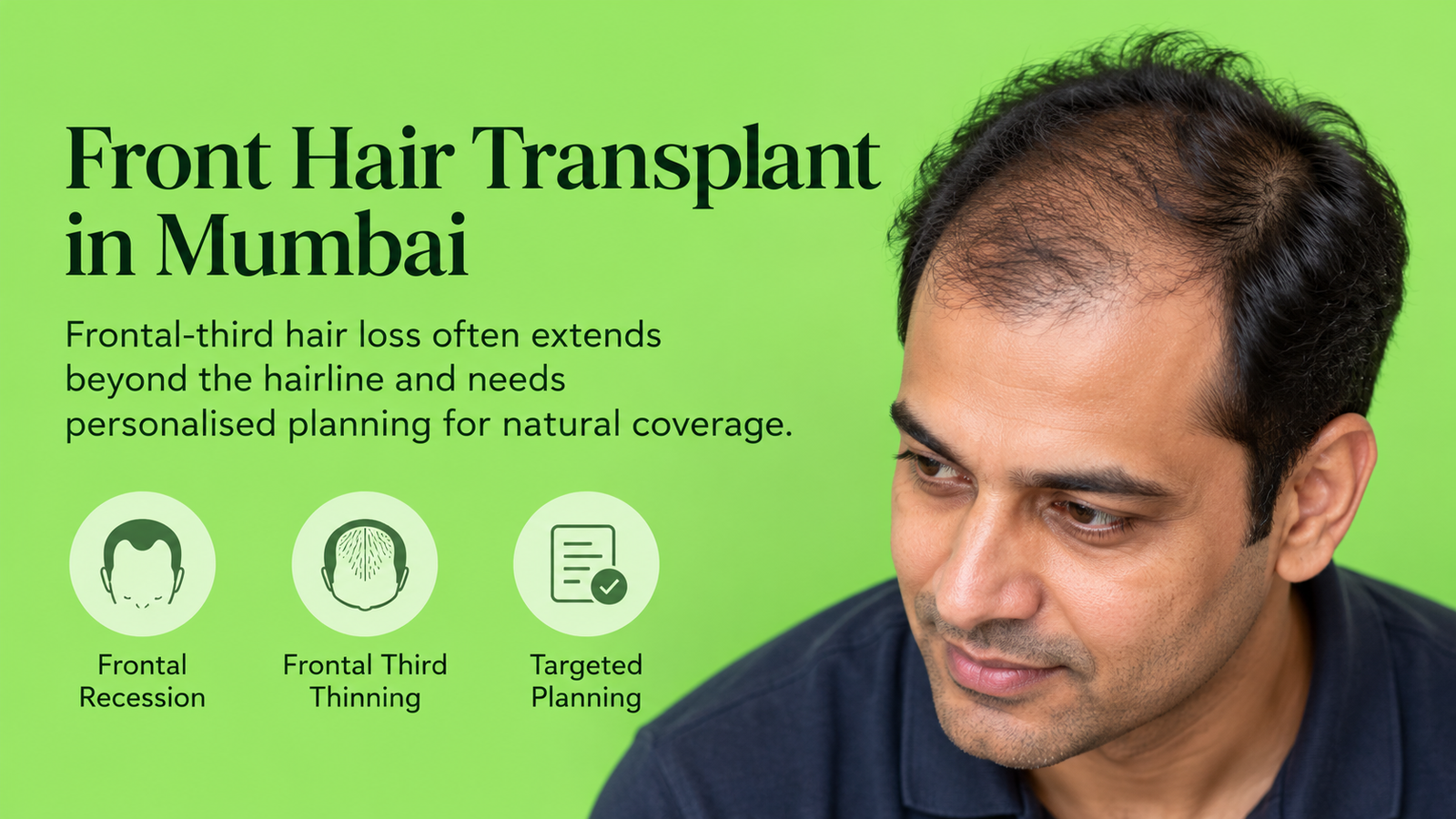
Front Hair Transplant in Mumbai
Hair loss across the front of the scalp can significantly change facial framing, particularly when thinning extends behind the original hairline.
A Front Hair Transplant is designed to restore the frontal scalp, including the hairline and the area immediately behind it, when medically and surgically appropriate.
At Anagen Hair Transplant Clinic in Mumbai, frontal restoration focuses on the relationship between hairline position, frontal density, existing hair and available donor follicles.
What Is a Front Hair Transplant?
A Front Hair Transplant treats the frontal third of the scalp. This includes the frontal hairline when required and the region extending behind it towards the mid-scalp.
The treatment may be suitable for patients whose frontal region has become thin or bald despite retaining satisfactory density further back.
It differs from Male Hairline Restoration, which primarily focuses on reconstructing the receded frontal boundary.
Frontal scalp transplantation often requires a combination of hairline planning and density restoration rather than treatment of a narrow line alone.
Which Part of the Scalp Is the Frontal Third?
The frontal third begins at the anterior hairline and extends backwards towards the central scalp.
The exact boundaries vary between individuals according to head size and the pattern of loss.
Important components include the central forelock, frontal corners, hairline border and the area behind the frontal boundary.
When the central scalp is also significantly affected, the restoration plan may need to include Mid Scalp Hair Transplant.
Who Is Suitable for Frontal Hair Restoration?
Patients with a defined frontal recipient area and adequate donor hair may be candidates.
The doctor evaluates whether the hair loss is predominantly frontal or part of broader progressing androgenetic alopecia.
Existing miniaturised hairs require careful examination because transplantation into thinning regions involves the risk of temporary or persistent shock loss, particularly in vulnerable native hair.
Some patients may benefit from prescription maintenance or a period of observation before surgery.
Why Is Frontal Density Important?
The front of the scalp strongly influences how the hair frames the face.
Frontal restoration often creates substantial visible improvement because this area is apparent in face-to-face interaction.
However, visual density depends on more than the total graft count. Hair shaft calibre, curl, colour contrast, hair direction, existing native hair and graft distribution all influence apparent coverage.
A soft leading edge must connect naturally with a stronger frontal region behind it.
How Is Existing Frontal Hair Protected?
The doctor examines miniaturisation and existing follicular density using clinical assessment and magnification where appropriate.
Recipient sites must be planned to minimise unnecessary trauma to surrounding follicles.
The potential for shock loss and ongoing native-hair thinning should be discussed before transplantation.
In suitable patients, medical maintenance may help preserve susceptible non-transplanted hair. Dense Packing Hair Transplant techniques are not automatically appropriate for every patient with residual frontal follicles.
How Is Front Hair Transplant Performed?
Step 1: Frontal Recipient Assessment
The doctor maps the frontal boundary, central forelock and thinning area behind the hairline.
Step 2: Donor Assessment and Graft Allocation
The donor supply and recipient surface area determine the approximate surgical plan.
Step 3: Frontal Hairline and Density Design
The leading edge and posterior frontal density zones are planned separately.
Step 4: Local Anaesthesia and FUE Extraction
Suitable follicular units are harvested from the planned donor region.
Step 5: Graft Sorting
Fine single-hair grafts are identified for the visible frontal transition. Other suitable grafts are allocated to provide coverage behind the hairline.
Step 6: Recipient-Site Creation
The surgeon plans sites with appropriate direction, angle and consideration of existing native hair.
Step 7: Implantation and Follow-Up
Grafts are implanted according to the distribution plan, followed by postoperative care and review.
How Many Grafts Are Needed for a Front Hair Transplant?
The requirement depends on the width and depth of frontal hair loss, existing native density, desired coverage and donor capacity.
Some moderate frontal-third cases may be planned in the approximate range of 1,500–3,000 grafts, while smaller or extensive cases may differ substantially.
The estimate must be individualised. Transplanting into an area with existing hair is different from reconstructing a completely bald frontal region.
Should the Front Be Restored Before the Crown?
In patients with extensive hair loss and limited donor supply, the frontal region may receive priority because it frames the face.
However, the decision should consider the patient’s current appearance, personal concerns, crown condition and long-term graft requirements.
When loss affects all three major scalp zones, Front + Mid + Crown Hair Transplant planning provides a more comprehensive framework.
Recovery and Long-Term Maintenance
Initial healing commonly includes crusting, redness and temporary sensitivity. Transplanted hair shafts may shed over the first few weeks.
Visible growth often begins around three to four months, with coverage improving progressively during the following months. The result generally matures over approximately 9–12 months or longer.
Surrounding native frontal hair can continue to miniaturise. Appropriate maintenance may be recommended according to the underlying diagnosis.
Front Hair Transplant Results
Frontal restoration often produces a noticeable cosmetic change because the frontal region frames the face.
The final appearance depends on the shape and position of the hairline, graft distribution, donor-hair characteristics and preservation of native hair.
Review genuine Male Hair Transplant Results to understand the different levels of frontal coverage that may be achievable.
View frontal hair transplant results.
How Much Does Front Hair Transplant Cost?
Cost depends on the frontal area being restored, approximate graft requirement, donor characteristics, selected technique and any additional treatment zones.
A frontal hairline correction has a different treatment requirement from reconstruction of an extensively bald frontal third.
The final quotation should follow an individual assessment.
Frequently Asked Questions
Can the entire frontal scalp be covered?
Coverage may be possible when adequate donor hair is available, but achievable density varies.
Is front hair transplantation different from hairline transplantation?
Yes. Front transplantation includes the area behind the frontal boundary, while isolated hairline restoration is more limited.
Will the front look as dense as my original hair?
Original native density cannot be guaranteed. The objective is an appropriate cosmetic improvement using available donor hair.
Can FUE be performed between existing hairs?
Yes, in selected cases, but the surgeon must account for existing follicles and the possibility of shock loss.
How long does frontal hair growth take?
New growth often starts around three to four months, with more meaningful maturation over the following months.
Can the mid-scalp be treated in the same session?
Sometimes, depending on donor supply, recipient requirements and procedural planning.
Restore Your Frontal Hair at Anagen
If you have frontal thinning extending behind the hairline, send clear FRONT, TOP, BOTH SIDES and BACK DONOR photographs.
Anagen can assess whether your treatment should focus on the frontal third alone or include neighbouring scalp zones.
ANAGEN Hair Transplant Clinic — Andheri West, Mumbai
Call / WhatsApp: +91 92222 22407