





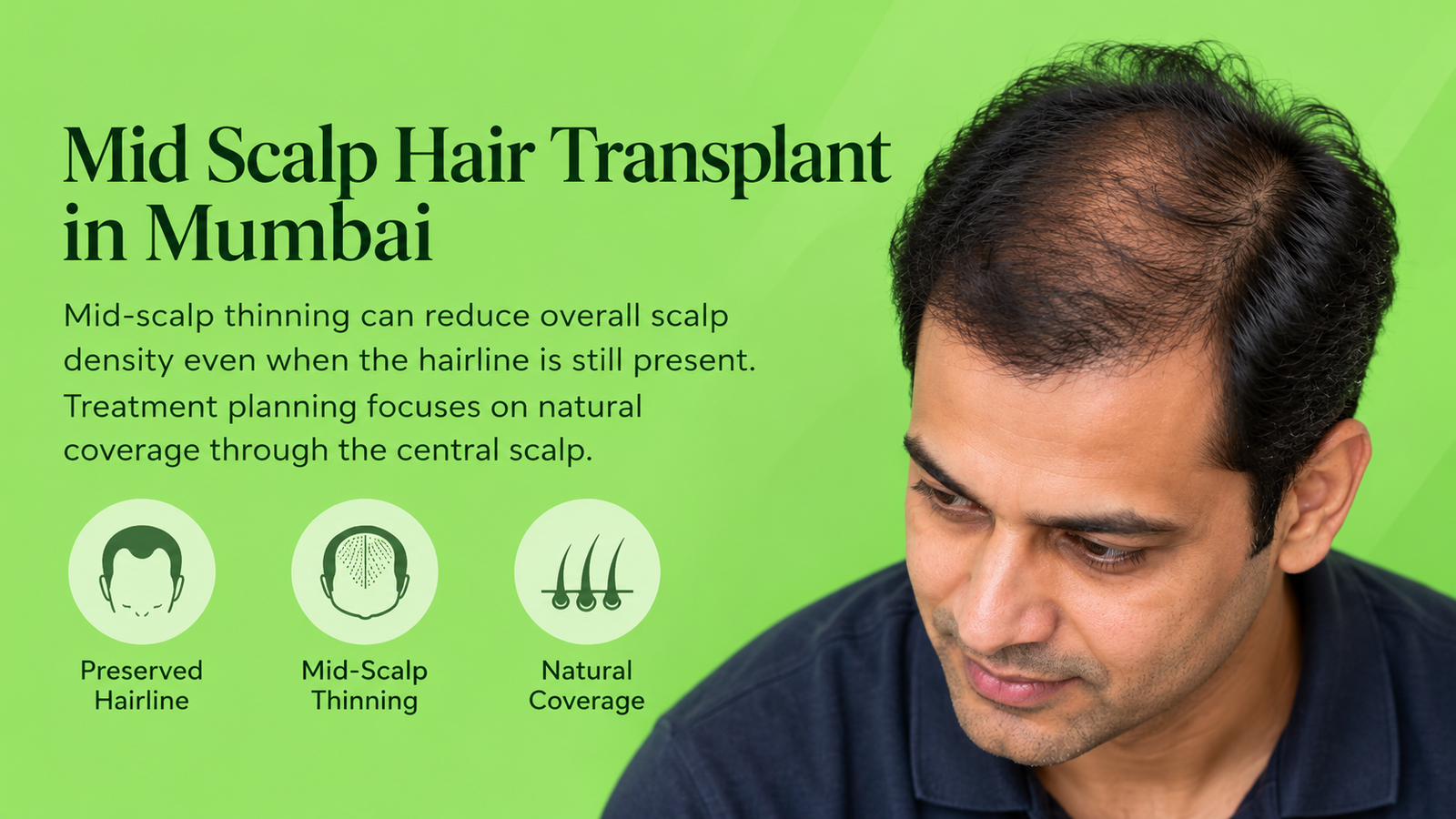
Mid Scalp Hair Transplant in Mumbai
Thinning in the middle of the scalp can make the hair appear sparse even when the frontal hairline remains reasonably intact.
The mid-scalp connects the front of the head to the crown. When density is lost in this central region, the overall hairstyle may lose continuity, and scalp visibility may increase under bright lighting.
Mid Scalp Hair Transplant at Anagen Hair Transplant Clinic in Mumbai focuses on improving suitable central scalp areas while preserving existing hair and planning for long-term hair-loss progression.
Where Is the Mid-Scalp Located?
The mid-scalp is the central region between the frontal scalp and the crown.
It forms a bridge between the front of the hairstyle and the natural rotational pattern of the vertex.
Hair direction in the mid-scalp generally follows the surrounding pattern, but it can transition gradually as it approaches the crown.
This area must be assessed separately because its anatomy, existing density and graft requirements differ from those of the frontal hairline and crown.
Why Does Mid-Scalp Thinning Occur?
Androgenetic alopecia commonly causes gradual miniaturisation of follicles across the upper scalp.
Some patients develop diffuse thinning in the central region before the area becomes completely bald.
The remaining hair may be finer, shorter and less effective at covering the underlying scalp.
However, central thinning may also occur with other forms of hair loss. Sudden shedding, inflammatory symptoms or widespread scalp involvement require diagnostic assessment before surgery.
When Is Mid-Scalp Hair Transplant Appropriate?
Transplantation may be considered when the pattern of loss is sufficiently understood, the recipient area is suitable and adequate donor follicles are available.
The doctor assesses existing follicular density and miniaturisation before choosing a surgical plan.
If the mid-scalp still contains substantial viable hair, medical treatment may be considered to preserve or improve it before surgical intervention.
In patients with widespread thinning, the front, mid-scalp and crown should be evaluated together rather than treating the central scalp as an isolated region.
How Is Existing Mid-Scalp Hair Evaluated?
Assessment may include trichoscopy to examine the difference between normal terminal hairs and miniaturised follicles.
The doctor considers whether the scalp is primarily thin because of reduced follicle density, reduced shaft calibre or a combination of both.
This distinction matters because the desired improvement may require a different number and distribution of grafts.
The amount of existing hair also affects the risk of recipient-site injury and postoperative shock loss.
How Is Natural Hair Direction Maintained?
The mid-scalp is visually connected to both the frontal scalp and crown.
New hair should generally align with the direction of adjacent native hair, producing a continuous flow when combed.
Incorrect direction may cause unnatural separation or make the transplanted area difficult to style.
As the surgeon approaches the vertex, the plan must account for the change towards the natural crown whorl.
How Are Grafts Distributed in the Mid-Scalp?
Graft allocation depends on the amount of recipient surface area, existing density and relationship with the front and crown.
The surgeon aims for suitable visual coverage while respecting donor limitations and the direction of surrounding hair.
Creating excessive density in a limited central area may be inappropriate if the patient also has substantial frontal or crown baldness.
A balanced plan can produce better overall continuity than concentrating all available grafts in one small region.
How Is Mid Scalp Hair Transplant Performed?
Step 1: Central Scalp Assessment
The doctor maps the thinning region and examines the extent of native hair miniaturisation.
Step 2: Donor Assessment
Available safe donor follicles and future donor requirements are assessed.
Step 3: Mid-Scalp Density Planning
Graft distribution is developed according to scalp visibility, surrounding density and hair direction.
Step 4: Local Anaesthesia and FUE Extraction
Suitable follicular units are harvested from the donor area using the planned surgical technique.
Step 5: Recipient-Site Preparation
Sites are created in the central scalp with attention to native follicles, regional angulation and the future crown transition.
Step 6: Graft Implantation
Follicular units are positioned according to the central coverage plan, avoiding unnecessary concentration in already dense areas.
Step 7: Recovery and Follow-Up
The patient receives instructions for postoperative scalp care, native-hair maintenance and gradual growth assessment.
How Many Grafts Are Required?
Graft numbers vary according to the size of the central thinning area and the amount of remaining hair.
Some selected mid-scalp procedures may require approximately 1,000–2,500 grafts, but this is only an illustrative range. More limited or extensive patterns can fall outside it.
A meaningful estimate requires assessment of recipient density, hair calibre, donor capacity and neighbouring scalp priorities.
Can Mid-Scalp Transplantation Be Combined With Other Zones?
Yes. Some patients benefit from simultaneous frontal and central scalp restoration.
Others require a coordinated Front + Mid + Crown Hair Transplant plan because the crown is also affected.
The decision depends on the size of the total recipient area and the amount of donor hair available.
The purpose is to maintain visual continuity across the scalp rather than create isolated areas of higher density.
Recovery and Maintenance
Initial healing generally involves small crusts, temporary redness and possible shedding of transplanted hair shafts.
New growth commonly begins around three to four months. Visible coverage improves gradually over the following months, with final assessment usually more meaningful around 9–12 months or later.
Patients with progressive male pattern baldness may require ongoing medical treatment to preserve non-transplanted hair.
Mid Scalp Hair Transplant Results
Mid-scalp restoration aims to improve central coverage and continuity between the front and crown.
The visible improvement depends on existing hair, graft distribution, donor characteristics and the amount of recipient surface area.
Review genuine Male Hair Transplant Results to understand how central thinning may be addressed within broader restoration plans.
View male hair transplant results.
How Much Does Mid Scalp Hair Transplant Cost?
Cost is influenced by the size of the central thinning area, graft requirement, existing native hair, donor characteristics, treatment complexity and whether neighbouring zones also need surgery.
A personalised plan is required before a reliable quotation can be prepared.
Frequently Asked Questions
Can a transplant improve diffuse mid-scalp thinning?
Sometimes. The underlying diagnosis and condition of existing follicles must first be assessed.
Can grafts be implanted between existing hairs?
Yes, in suitable circumstances, with careful planning to reduce injury to native follicles.
Will medical treatment still be necessary?
It may be appropriate when the underlying condition is progressive androgenetic alopecia.
Is mid-scalp transplantation the same as crown transplantation?
No. The mid-scalp lies between the frontal region and crown and has different direction and density requirements.
Will one session be enough?
Some limited mid-scalp cases can be managed in one session. Widespread loss may require staged planning.
Can mid-scalp transplantation make the front look denser?
Improving central continuity may improve overall styling, but frontal hairline restoration requires separate assessment if the front is also depleted.
Assess Your Mid-Scalp Thinning at Anagen
If your hair appears thin in the middle of the scalp despite retaining some frontal and crown hair, Anagen can assess the central recipient area and surrounding native-hair condition.
Send clear TOP, FRONT, CROWN and BACK DONOR photographs.
Our doctors can help determine whether medical maintenance, mid-scalp transplantation or a broader restoration plan is appropriate.
ANAGEN Hair Transplant Clinic — Andheri West, Mumbai
Call / WhatsApp: +91 92222 22407