





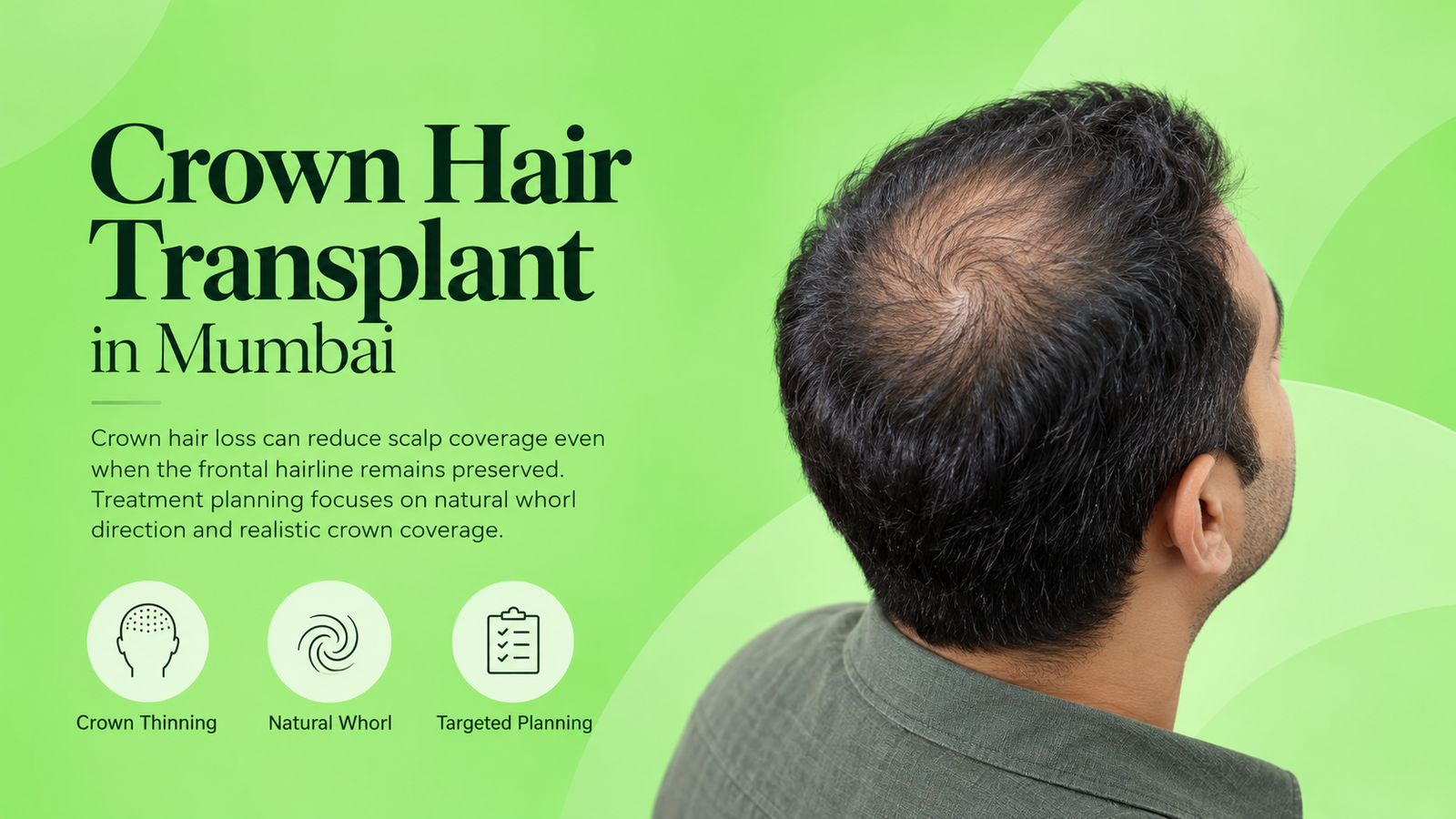
Crown Hair Transplant in Mumbai
Hair loss at the crown can make the scalp increasingly visible from above, even when the frontal hairline remains relatively strong.
The crown, also called the vertex, has a distinctive hair-growth pattern. Hair usually rotates around a central whorl, making surgical planning different from frontal or mid-scalp restoration.
At Anagen Hair Transplant Clinic in Mumbai, crown transplantation is planned according to the size of the thinning area, natural hair direction, available donor follicles and the possibility of continued hair-loss progression.
What Is Crown Hair Loss?
Crown hair loss refers to thinning or baldness around the vertex, towards the upper back portion of the scalp.
In male pattern baldness, follicles in this region may gradually miniaturise. The affected area can enlarge over time, sometimes connecting with mid-scalp thinning.
Crown loss may begin as a small area of reduced density around the whorl. In more advanced cases, it can involve a broad circular or oval region.
The pattern, speed of progression and surrounding hair must be evaluated before recommending transplantation.
Why Is Crown Hair Transplant Different?
Unlike the front of the scalp, the crown contains hair that changes direction around a natural rotational centre.
Its surface area can be relatively large, even when the thinning appears modest in a photograph.
A crown transplant must therefore address both visual coverage and directional accuracy.
The doctor also needs to consider whether the patient has sufficient donor hair to restore the crown without compromising more visually important or future recipient areas.
How Is the Natural Crown Whorl Reconstructed?
The crown whorl is a rotational arrangement of hair around a central pivot.
The rotation may be clockwise, anticlockwise or more complex. Some individuals have multiple whorls or irregular directional patterns.
The surgeon examines existing hair direction to locate the natural centre and determine how follicles should be oriented.
A crown transplant should not be performed by placing all grafts in one direction or arranging them as rigid spokes radiating from the centre.
Why Can the Crown Require Many Grafts?
The crown can occupy a large surface area, and its rotational hair direction influences visual coverage.
To reduce scalp visibility, the surgeon must distribute follicles across the affected region while maintaining the whorl.
Even a seemingly small increase in the radius of a bald area can substantially increase the total surface area requiring treatment.
This is why graft requirements should be estimated from measurements rather than from a photograph or a standard crown package.
How Many Grafts Are Needed for Crown Restoration?
Crown graft requirements are highly individual.
A smaller thinning vertex may require a limited number of grafts, whereas a large crown with little remaining native hair may require substantially more.
For some moderate crown cases, a preliminary estimate might be around 1,500–2,500 grafts. Extensive vertex loss may exceed this range, and a smaller area may need fewer grafts.
The final recommendation depends on measured recipient area, existing density, hair calibre, donor supply and the desired cosmetic coverage.
A high number of grafts does not guarantee complete concealment of the scalp under every lighting condition.
Should the Front or Crown Be Restored First?
This is an important decision for men who have both frontal recession and crown baldness.
Frontal restoration often receives priority because it frames the face. However, a patient with a strong frontal hairline and isolated crown loss may be an appropriate candidate for crown-focused treatment.
The doctor evaluates total recipient demand and available donor follicles before deciding whether to treat the crown during the first session.
When donor supply is limited, prioritising the front and mid-scalp may leave fewer grafts available for crown restoration.
How Is Crown Density Planned?
Crown restoration usually aims to improve visual coverage while respecting the natural whorl.
The central pivot and surrounding regions may require different graft orientation and spacing.
Existing hair density, curl and calibre influence how much coverage each follicular unit provides.
A reasonable result may still show some scalp under direct overhead lighting, especially when donor supply is limited or the crown area is extensive.
How Is Crown Hair Transplant Performed?
Step 1: Crown and Overall Scalp Assessment
The doctor examines the extent of vertex loss, remaining crown hair, frontal region and possible future progression.
Step 2: Donor Assessment
Safe donor density and available graft supply are evaluated alongside other scalp requirements.
Step 3: Crown Whorl Mapping
The natural pivot and rotational direction are identified from existing hair and scalp anatomy.
Step 4: Recipient-Area and Density Planning
The crown treatment area is measured and a realistic graft-distribution plan is developed.
Step 5: Local Anaesthesia and FUE Extraction
Suitable follicular units are harvested from the designated donor region.
Step 6: Recipient-Site Creation
Sites are planned with careful attention to changing hair direction around the vertex.
Step 7: Graft Implantation
Follicular units are implanted according to the directional and density map.
Step 8: Postoperative Care
The patient receives advice on healing, temporary shedding, ongoing hair-loss management and follow-up.
Can Crown Transplantation Be Performed in Stages?
Yes. Staged crown restoration may be appropriate when the crown is extensive or when other areas have higher priority.
For example, the first session may focus on the front and mid-scalp, followed by crown restoration after the initial result is assessed and donor reserves are reviewed.
Alternatively, a patient with isolated crown thinning may be treated without frontal transplantation.
Staging should be determined by the clinical situation rather than a universal rule.
Crown Transplant Recovery and Growth
After surgery, temporary scalp tenderness, swelling, redness and crusting may occur.
Transplanted hair shafts frequently shed during the early weeks. New visible growth commonly begins around three to four months.
Crown improvement can develop gradually, and maturation may continue for approximately 12–18 months in some patients.
The appearance should be judged under comparable lighting and hair lengths, rather than relying on a single overhead photograph.
Crown Hair Transplant Results
Crown restoration requires realistic planning because the treatment area can be large and the natural whorl affects graft distribution.
Reviewing genuine Crown Restoration Results can help patients understand different levels of achievable coverage, including cases where some scalp visibility remains.
View crown restoration results.
How Much Does Crown Hair Transplant Cost?
The cost depends on crown size, existing hair density, total graft requirement, donor characteristics, surgical technique and whether treatment is performed in one or more sessions.
A comprehensive assessment is necessary before estimating the number of grafts and the likely cost.
Frequently Asked Questions
Is crown hair transplantation more difficult than frontal restoration?
The crown has additional planning challenges because of its rotational growth pattern, surface area and potential future expansion.
Will my crown become completely dense?
Complete native density cannot be guaranteed. The objective is appropriate visual coverage within donor limitations.
Can I restore only the crown?
Yes, if the crown is the main concern and the overall donor and scalp assessment supports treatment.
Why does crown growth sometimes take longer?
The visible maturation of crown results can be gradual. Individual growth and hair characteristics also vary.
Can crown baldness increase after transplantation?
Yes. Untreated native hair surrounding the transplanted region may continue to miniaturise.
Can the crown and front be transplanted together?
Sometimes. The decision depends on combined recipient demand and donor availability.
Get Your Crown Hair Loss Assessed at Anagen
For a meaningful crown assessment, the surgeon needs to see the entire scalp, not only the thinning vertex.
Send clear TOP/CROWN, REAR DONOR, FRONT and BOTH SIDE photographs.
Anagen can evaluate your whorl pattern, crown size, available donor hair and whether isolated or staged restoration is appropriate.
ANAGEN Hair Transplant Clinic — Andheri West, Mumbai
Call / WhatsApp: +91 92222 22407