





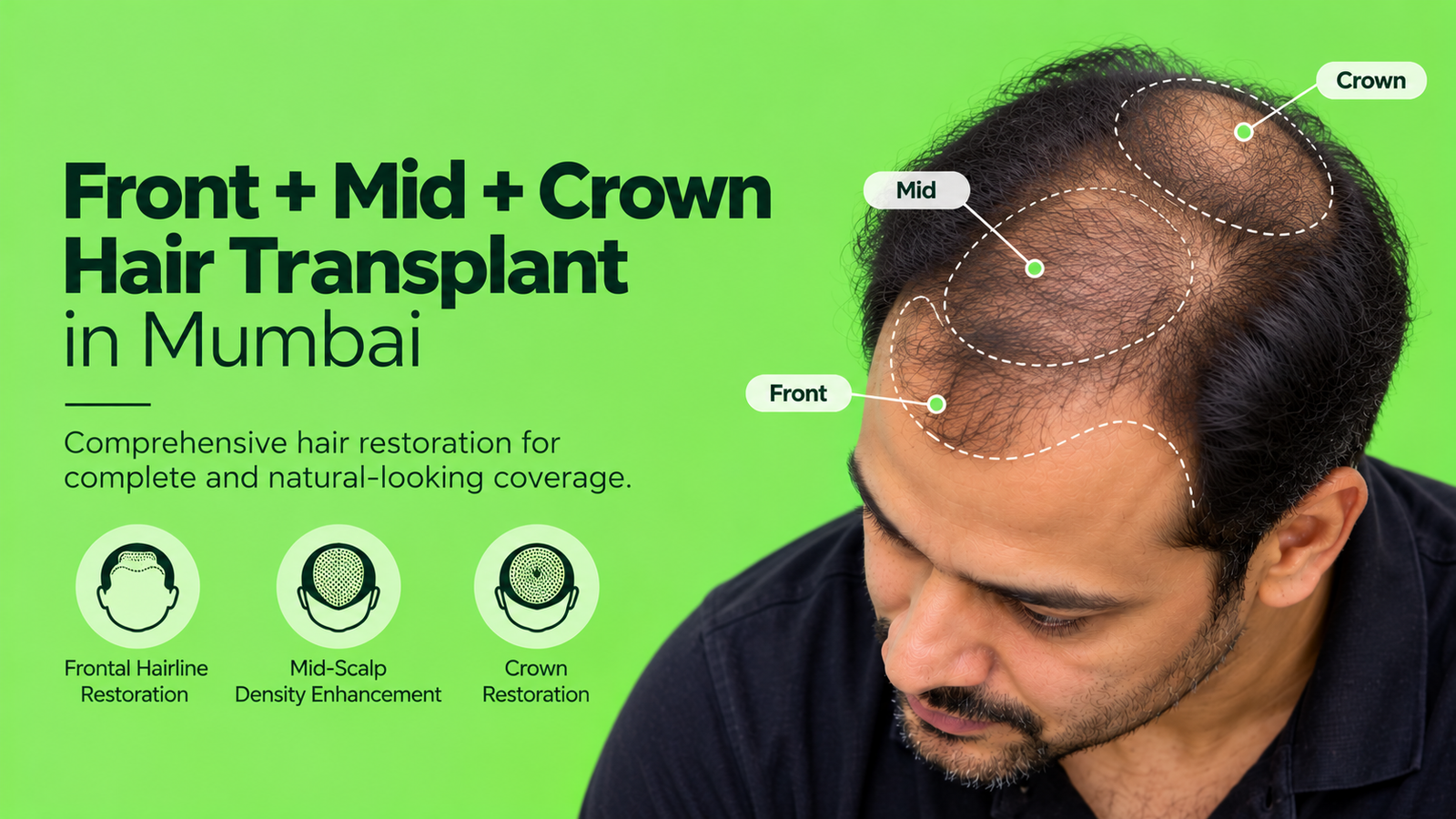
Front + Mid + Crown Hair Transplant in Mumbai
Hair loss affecting the front, middle and crown of the scalp requires a coordinated restoration plan.
Treating these three areas is more complex than concentrating on one limited bald region. The surgeon must consider the total surface area, available donor hair, the visual importance of each zone and the possibility of future thinning.
At Anagen Hair Transplant Clinic in Mumbai, Front + Mid + Crown Hair Transplant planning focuses on distributing suitable grafts across all three regions according to realistic clinical and cosmetic priorities.
What Is a Front + Mid + Crown Hair Transplant?
This treatment plan addresses the three main regions of the upper scalp:
Frontal Scalp
The frontal region includes the hairline and area immediately behind it. It plays a major role in facial framing.
Mid-Scalp
The middle region connects the frontal scalp with the crown. Restoring continuity here can improve the overall appearance of scalp coverage.
Crown
The crown lies around the vertex and natural hair whorl. Its rotational direction and potentially large surface area require separate planning.
A comprehensive plan considers these regions together even when one zone is more advanced than another.
Can All Three Areas Be Treated Together?
In selected patients, all three areas may be addressed within one appropriately planned surgical episode.
However, treating all zones together is not automatically suitable.
The total graft demand must be compared against the available safe donor supply, medical fitness, procedural duration and realistic density targets.
When recipient demand is greater than the available supply or a staged approach offers safer planning, more than one surgical stage may be recommended.
The presence of three affected zones does not mean that every zone must receive equal coverage during the first procedure.
How Are Grafts Allocated Between Front, Mid-Scalp and Crown?
The available donor supply determines the realistic scope of treatment.
The frontal scalp commonly receives significant priority because it frames the face.
The mid-scalp is planned to provide continuity behind the frontal region.
The crown may receive a different density allocation or be treated later, particularly when recipient demand is high.
These decisions depend on the individual patient’s pattern of baldness, donor characteristics and visual goals.
Why Is Density Different Across the Three Zones?
Different scalp regions affect appearance in different ways.
The frontal border requires softness and suitable single-hair grafts.
The frontal scalp behind the hairline may need greater visual coverage, particularly around the central forelock.
The mid-scalp should blend with neighbouring areas.
The crown requires a natural rotational design and may remain less dense where donor resources are limited.
A successful-looking three-zone plan should balance these requirements rather than pursue maximum numerical density everywhere.
How Is Donor Capacity Assessed?
A three-zone plan may require significant donor resources.
The surgeon assesses the back and sides of the scalp for density, calibre, miniaturisation and previous harvesting.
A patient with thick multi-hair follicular units may obtain different visual coverage from the same number of grafts compared with a patient with finer hair.
The doctor must also preserve appropriate donor reserve for future progression.
Beard or body hair may be considered in selected extensive cases, but alternative donor hair differs from scalp hair and is not automatically appropriate for every region.
One Session or Two Stages?
Both approaches may be appropriate in different patients.
One-Session Planning
A single treatment episode may be considered when the total recipient demand, donor availability and medical factors allow a safe and coherent plan.
Staged Planning
A two-stage approach may prioritise the front and mid-scalp initially, followed by crown treatment or supplementary density after the first result matures.
A staged strategy can also help reassess future progression and remaining donor capacity.
The number of sessions is determined by individual requirements rather than a fixed clinic protocol.
How Is Front + Mid + Crown Hair Transplant Performed?
Step 1: Whole-Scalp Assessment
The doctor evaluates all three regions, including remaining native hair and likely future thinning.
Step 2: Safe Donor Mapping
Donor characteristics and harvesting limits are assessed.
Step 3: Three-Zone Graft Allocation
The total recipient requirement is divided into appropriate frontal, central and crown priorities.
Step 4: Hairline and Directional Design
A natural frontal outline is planned, along with mid-scalp flow and vertex-whorl orientation.
Step 5: Local Anaesthesia and FUE Extraction
Suitable follicular units are harvested from the designated donor area.
Step 6: Graft Sorting and Recipient-Site Preparation
Grafts are organised according to their intended use, with recipient sites planned to respect each zone’s anatomy and existing follicles.
Step 7: Implantation
Follicular units are distributed across the selected recipient zones according to the approved treatment plan.
Step 8: Recovery and Follow-Up
The patient receives instructions for postoperative care, hair-growth monitoring and native-hair maintenance.
How Many Grafts Are Required for All Three Zones?
The graft requirement depends on the total bald surface area, existing density, donor strength and desired cosmetic coverage.
Some extensive three-zone plans may involve approximately 4,500–6,000 grafts across one or more procedures, but smaller or more extensive requirements are possible.
Such figures are not a standard prescription. They should not be used as a guarantee that the entire scalp can be covered.
The surgical plan must always remain within safe donor and procedural limits.
What Results Can You Expect?
A comprehensive three-zone transplant aims to improve overall scalp coverage and continuity.
The frontal region may be visually stronger, while the crown may have comparatively lighter coverage depending on donor limitations.
Temporary postoperative shedding is common. Growth often begins around three to four months, with continued improvement over subsequent months.
The crown can mature more slowly than the front. Final evaluation may therefore require 12–18 months in selected cases.
Front + Mid + Crown Hair Transplant Results
Treating all three scalp zones requires careful graft allocation.
Results should be judged not only by total graft count but by how the available donor hair is distributed across the scalp, the naturalness of each zone and the amount of remaining native hair.
Explore genuine Male Hair Transplant Results for suitable multi-zone restoration examples.
View full-area hair transplant results.
How Much Does Three-Zone Hair Transplant Cost?
The cost depends on the total recipient area, graft requirements, donor characteristics, technique selected and whether surgery is performed in one or more stages.
Complexity can increase when the three zones require different directional patterns or when previous surgery has affected donor availability.
A complete scalp and donor evaluation is necessary for a meaningful quotation.
Frequently Asked Questions
Can front, middle and crown hair be transplanted together?
Yes, in selected patients with suitable donor capacity and surgical planning.
Is the same density used in all three regions?
Not necessarily. Different zones may receive different density targets based on their visual importance and available donor follicles.
How many sessions are required?
Some patients may be suitable for one planned treatment episode, while others benefit from staged surgery.
Should the crown receive fewer grafts?
Sometimes, particularly when frontal framing and donor conservation receive higher priority.
Can beard hair supplement a three-zone procedure?
It may be considered in selected patients, but donor-hair matching, available quantity and recipient location must be assessed.
Will the transplanted hair prevent further baldness?
No. Existing non-transplanted follicles can continue to miniaturise.
Plan Your Three-Zone Hair Restoration at Anagen
If your hair loss affects the front, centre and crown, a whole-scalp assessment is more useful than a graft estimate based on one bald photograph.
Send clear FRONT, TOP, CROWN, BOTH SIDES and BACK DONOR photographs.
Anagen can assess whether combined or staged three-zone restoration may be appropriate and discuss realistic density priorities.
ANAGEN Hair Transplant Clinic — Andheri West, Mumbai
Call / WhatsApp: +91 92222 22407