





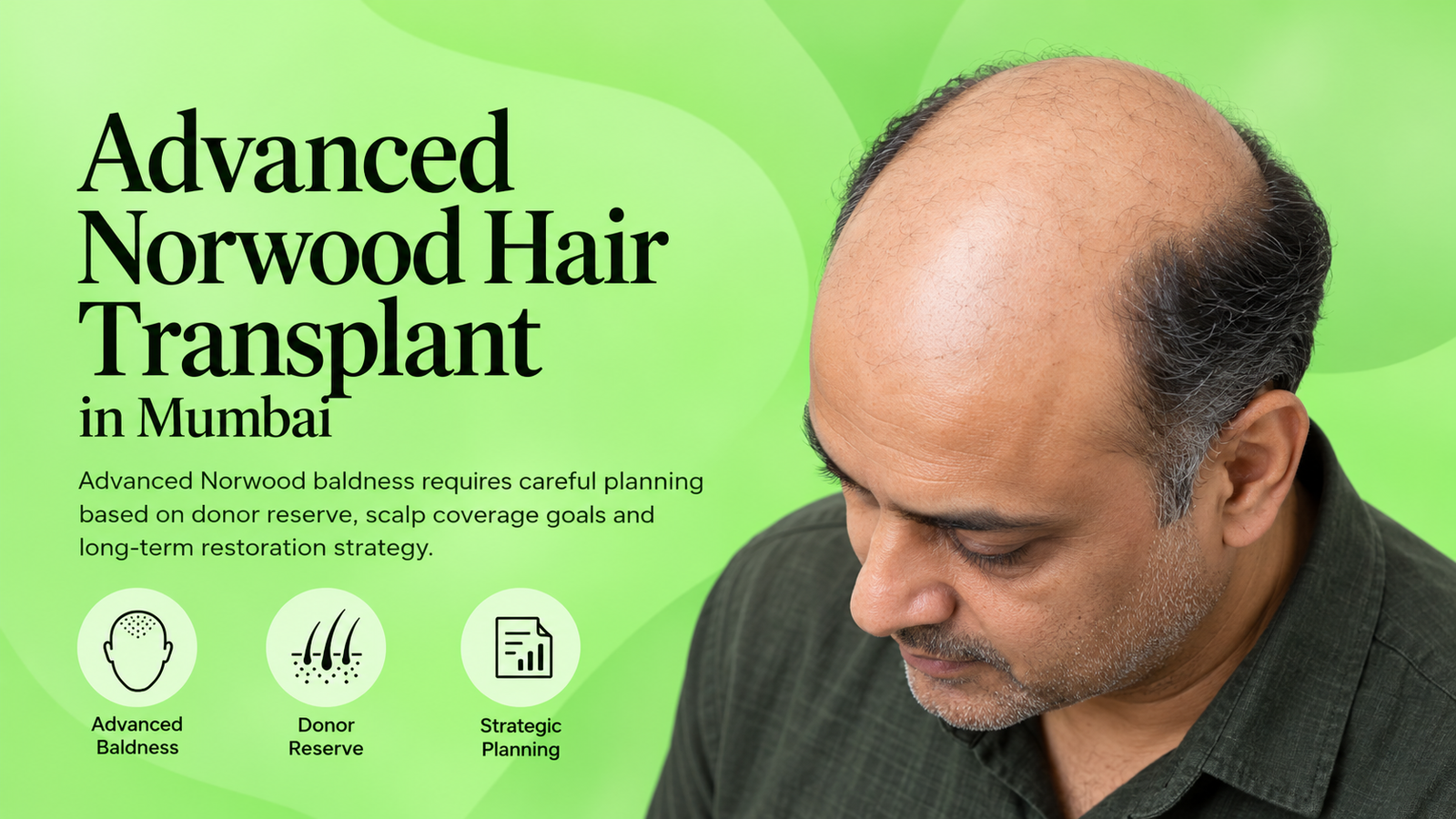
Advanced Norwood Hair Transplant in Mumbai
Men with advanced male pattern baldness often wonder whether hair transplantation is still possible after substantial recession or loss across the upper scalp.
The Norwood classification helps describe the distribution of male pattern baldness. However, an advanced Norwood grade does not automatically mean transplantation is impossible, nor does it determine the exact graft requirement.
At Anagen Hair Transplant Clinic in Mumbai, Advanced Norwood Hair Transplant planning combines an assessment of the baldness pattern with donor mapping, recipient-area measurements, medical evaluation and realistic long-term restoration goals.
What Is the Norwood Classification?
The Hamilton–Norwood scale is commonly used to describe the pattern and extent of male androgenetic alopecia.
Earlier patterns may involve limited frontal recession. More advanced patterns can involve the frontal scalp, mid-scalp and vertex, eventually leaving a relatively narrow band of hair at the sides and back.
The classification is useful for communicating the distribution of hair loss, but it does not measure donor capacity, hair calibre, progression speed or surgical suitability.
Two patients assigned a similar Norwood grade may require very different treatment plans.
Which Norwood Grades Are Considered Advanced?
Norwood IV
Frontal recession and crown thinning may both be established, with varying amounts of hair remaining between them.
Norwood V
The front and crown areas may become more extensive, with a narrowing zone of hair separating them.
Norwood VI
Frontal and vertex bald regions are generally connected, leaving a more extensive upper-scalp recipient area.
Norwood VII
Hair loss can become very extensive, with a relatively narrow remaining fringe of hair around the sides and back.
These descriptions are simplified educational guides. Actual patterns may be irregular, diffuse or difficult to classify precisely.
Can Advanced Norwood Baldness Be Treated With FUE?
FUE may be an option for selected patients with advanced baldness when sufficient appropriate donor follicles are available.
The surgeon must assess whether the available grafts can provide a meaningful and sustainable cosmetic improvement.
In advanced cases, the recipient surface may be very large while the safe scalp donor area is comparatively restricted.
It may therefore be preferable to restore a conservative frontal frame and central coverage rather than attempt an unrealistic high-density reconstruction of every affected region.
Patients with extremely limited donor supply and severe recipient demand may need the specialised coverage approach described in High Grade Baldness Restoration.
Why Does Donor Mapping Matter More in Advanced Norwood Patterns?
Safe donor follicles are finite.
The donor area must be assessed for density, follicular-unit composition, hair calibre, miniaturisation and previous harvesting.
The surgeon should also examine whether hair near the upper or lower edges of the presumed donor zone shows evidence of instability.
An extended donor area that appears dense today may not remain equally reliable as androgenetic alopecia progresses.
Excessive extraction can compromise the donor appearance and limit future surgical options.
How Is Miniaturisation Assessed?
Miniaturisation occurs when genetically susceptible follicles gradually produce thinner and shorter hairs.
In advanced patterns, identifying miniaturisation within or near the donor region is important because some hair that looks acceptable at a glance may not be suitable for long-term transplantation.
Clinical examination and trichoscopy can help assess shaft-diameter variation and follicular condition.
The extent of miniaturisation may change both the graft estimate and the recommendation for surgery.
Which Areas Should Be Restored First?
Treatment priority depends on the patient’s visible hair-loss pattern and donor reserve.
Conservative Frontal Hairline
A naturally positioned adult hairline can frame the face while avoiding excessive donor consumption.
Frontal Scalp Coverage
Appropriate frontal density may provide meaningful visible improvement.
Mid-Scalp Continuity
Central coverage can connect the frontal region towards the vertex.
Crown Restoration
The crown may receive lighter coverage, be delayed or remain untreated when donor limitations make complete restoration unrealistic.
These decisions should be made through a personalised plan rather than a fixed graft allocation for every Norwood grade.
Can Beard or Body Hair Supplement Scalp Donor Hair?
In selected advanced cases, scalp follicles alone may be insufficient for the desired restoration.
Beard follicles can sometimes be used as supplementary donor hair because of their relatively robust shaft characteristics.
Selected body-hair donor sites may also be considered in appropriate candidates, though yield and growth characteristics vary.
Scalp, beard and body hair are not interchangeable. Differences in curl, length, growth cycle and texture affect their suitability for specific recipient areas.
Fine scalp donor hair is generally more appropriate for delicate frontal-hairline work, while selected supplementary hair may be considered in suitable supporting regions.
These options are discussed further in Beard To Scalp Hair Transplant, Body Hair To Scalp Hair Transplant and Alternative Donor Hair Restoration.
How Is Advanced Norwood Hair Transplant Performed?
Step 1: Hair Loss Pattern Classification
The doctor reviews the distribution of frontal, central and crown hair loss and considers the Norwood classification.
Step 2: Complete Donor Assessment
The safe scalp donor region is mapped, including density, calibre, miniaturisation and any previous surgical harvesting.
Step 3: Recipient-Area Measurement
The total bald surface is measured to compare recipient demand with realistic available supply.
Step 4: Restoration Prioritisation
The hairline, frontal coverage, mid-scalp and crown are assigned suitable treatment priorities.
Step 5: Alternative Donor Evaluation
Where appropriate, the doctor assesses potential beard or selected body-hair supplementation.
Step 6: Stage and Graft Allocation Planning
An individual surgical plan is developed, including the possibility of multiple procedures.
Step 7: Local Anaesthesia and FUE Extraction
Suitable follicular units are harvested under appropriate clinical and anaesthetic protocols.
Step 8: Recipient-Site Creation and Implantation
Grafts are implanted according to the regional direction and coverage strategy, with careful consideration of frontal naturalness and crown limitations.
Step 9: Postoperative Monitoring
Recovery, transplanted growth, native-hair progression and remaining donor supply are reviewed before any additional procedure.
How Many Grafts Are Needed for Norwood V, VI or VII?
Norwood grade alone cannot determine graft requirements.
A patient with a broad Norwood V pattern may have a larger recipient area than another patient classified similarly.
Similarly, two Norwood VI patients may differ substantially in donor density, hair calibre and cosmetic objectives.
Advanced restoration may require several thousand grafts across one or more procedures, but the safe number must be established through individual donor mapping.
A high estimated graft demand does not mean that the donor supply can satisfy it.
One Session or Staged Surgery?
Staged surgery may be appropriate when the recipient surface is extensive or when donor reserves must be carefully managed.
A possible strategy is initial reconstruction of the frontal hairline and frontal-to-mid-scalp coverage, followed by reassessment of crown treatment after the first-stage result has matured.
This approach can also provide time to assess postoperative donor appearance and ongoing native-hair loss.
Why Is a Lifetime Donor Strategy Important?
Advanced androgenetic alopecia may continue to progress, and the available donor supply does not regenerate after harvesting.
The first procedure should therefore be planned with consideration for possible future recipient demand.
Long-term planning also accounts for ageing, changes in native hair and the possibility that a patient may want additional density later.
The objective is to preserve options rather than exhaust the donor area in pursuit of a short-term maximum graft number.
Recovery and Realistic Results
Postoperative healing can involve temporary crusting, redness, swelling and shedding of transplanted hair shafts.
Visible regrowth often begins after several months. The overall cosmetic appearance develops gradually, and assessment of larger multi-zone procedures may continue over 12–18 months.
A patient with advanced baldness should not expect to reproduce the density of his teenage scalp.
A realistic improvement may involve a natural frontal frame, central coverage and a less dense crown, depending on available donor resources.
Advanced Norwood Hair Transplant Results
Advanced Norwood cases require individualised planning because recipient demand often exceeds available scalp donor supply.
Genuine Norwood Grade Results can help demonstrate different strategies for frontal restoration, central coverage and crown prioritisation.
View Norwood grade results.
What Does Advanced Norwood Hair Transplant Cost?
Cost depends on recipient surface area, number of grafts, donor condition, alternative donor requirements, technique, complexity and whether multiple surgical stages are needed.
Previous procedures and donor miniaturisation may further influence the treatment plan.
A detailed assessment is required before a meaningful quotation can be prepared.
Frequently Asked Questions
Can Norwood VI baldness be transplanted?
Some patients are suitable for transplantation, but achievable coverage depends on actual donor characteristics and recipient demand.
Is Norwood VII suitable for FUE?
Selected patients may obtain partial cosmetic restoration, but extensive donor limitations can make requested coverage unachievable.
Can beard hair be used in Norwood VI or VII?
It may be considered as supplementary donor hair in appropriate candidates.
Is the front normally restored before the crown?
The front often receives priority because of its visual importance, but treatment planning remains individual.
Will I require two sessions?
Possibly. Extensive baldness may benefit from staged treatment, although no fixed session count applies to every patient.
Does Norwood grade determine my graft count?
No. Direct assessment of recipient area, existing hair and donor capacity is necessary.
Will hair transplantation stop my remaining hair from falling?
No. Progressive androgenetic alopecia may continue, and native-hair maintenance may be appropriate.
Get Your Advanced Norwood Hair Loss Assessed at Anagen
If you have extensive frontal, central or crown baldness, a Norwood grade can help describe the pattern, but it cannot establish your actual donor capacity.
Send clear FRONT, TOP, BOTH SIDES, CROWN and BACK DONOR photographs. If you have had a previous transplant, mention the date and approximate graft count. Beard photographs may also help where alternative donor assessment is relevant.
Anagen can review your scalp, donor limitations and realistic restoration priorities.
ANAGEN Hair Transplant Clinic — Andheri West, Mumbai
Call / WhatsApp: +91 92222 22407