





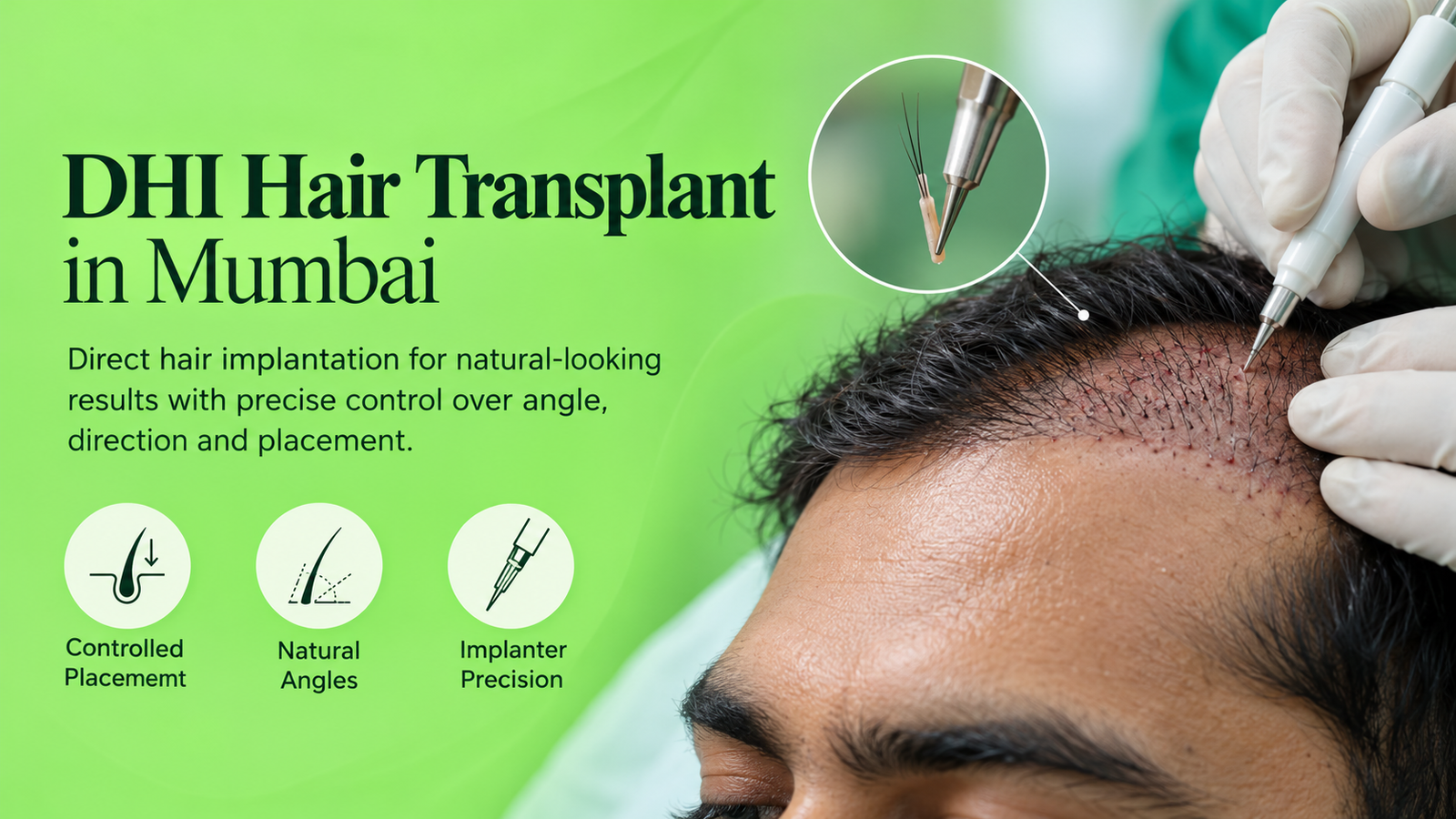
DHI Hair Transplant in Mumbai
DHI hair transplant is a term commonly used to describe hair transplantation in which extracted follicular units are implanted using a specialised implantation system, often involving an implanter pen. The objective is to place each graft according to the planned hair direction, exit angle, depth and distribution.
However, patients comparing DHI with FUE should understand an important distinction: FUE refers to the extraction of individual follicular units, while DHI generally refers to an implantation approach or workflow.
DHI does not eliminate the need for donor assessment, follicular extraction, hairline design or careful surgical planning.
At Anagen Hair Transplant Clinic in Mumbai, selection of an implantation method should be based on the patient’s hair-loss pattern, donor characteristics, recipient-area requirements and the surgeon’s assessment rather than the popularity of a technique name.
What Is DHI Hair Transplant?
DHI is commonly expanded as Direct Hair Implantation. In contemporary hair-transplant discussions, it frequently describes an implantation technique in which prepared follicular units are loaded into an instrument and inserted into the recipient scalp.
A follicular unit is a naturally occurring grouping of one or more hairs. These units are obtained from a suitable donor area, commonly the back or sides of the scalp.
The extracted grafts must then be positioned where additional coverage is needed.
A sharp implanter may create the recipient opening and deposit the graft during the same insertion movement. Other systems use recipient sites that have already been prepared.
The exact workflow matters more than the label.
DHI should not be understood as a completely different way of extracting hair or as a guarantee of better growth.
DHI vs FUE Hair Transplant: What Is the Difference?
This is one of the most important questions patients should ask.
FUE, or Follicular Unit Excision/Extraction, describes the removal of individual follicular units from a donor region.
Implantation describes the subsequent placement of those grafts into the recipient area.
Therefore, an operation may combine FUE extraction with an implanter-based graft-placement approach.
| Feature | FUE | DHI terminology |
|---|---|---|
| Main meaning | Individual graft extraction | Commonly refers to implantation workflow |
| Donor extraction | Individual follicular units removed | Extraction is still required |
| Recipient sites | Can be prepared separately or combined with implantation, depending on method | Often associated with sharp implanter placement |
| Hairline planning | Essential | Essential |
| Graft handling | Essential | Essential |
| Guaranteed superior growth | No | No |
Patients interested in the extraction stage can read about Biotech FUE Hair Transplant.
The main question is not whether DHI replaces FUE. It is which extraction and implantation combination is appropriate for the individual patient.
Why Are Angle, Direction and Depth Important in DHI?
Hair transplantation is not simply the insertion of follicles into empty scalp.
Each recipient area has its own natural pattern of hair growth.
Hair Direction
Frontal hair generally follows a different direction from temporal or crown hair.
Incorrect direction can produce unnatural outward-pointing hairs, particularly near the visible hairline.
Hair Exit Angle
The exit angle determines how closely the hair follows the surface of the scalp.
The appropriate angle varies by anatomical region and the individual pattern of native hair.
Implantation Depth
A graft must be placed at an appropriate depth for its dimensions and the prepared tissue.
Incorrect placement can cause graft elevation, burial, unnecessary tissue trauma or visible surface irregularities.
Graft Distribution
The number and placement of single-hair and multi-hair follicular units influence the final appearance.
A softer frontal transition generally requires different graft selection from deeper regions requiring visual coverage.
These principles are discussed further in Natural Hairline Design.
How Are Grafts Loaded Into an Implanter?
Where an implanter-based technique is selected, extracted follicular units are inspected and organised before placement.
The loading process requires appropriate instrument selection and gentle handling.
An operator may introduce a prepared graft into the hollow channel of the implanter. During placement, the instrument supports the graft while the clinician controls its orientation.
Grafts must remain appropriately protected and hydrated during this workflow.
Incorrect loading can damage delicate follicular structures. An expensive instrument does not remove the need for a trained surgical team.
How Is DHI Used During Hair Transplantation?
Step 1: Hair Loss and Donor Assessment
The surgeon evaluates the pattern of hair loss, donor density, hair characteristics, existing scalp conditions and medical suitability.
Step 2: Hairline and Recipient Planning
The treatment area is mapped according to facial proportions, existing hair direction and realistic achievable coverage.
Step 3: Follicular Unit Extraction
Suitable donor grafts are individually extracted using the selected FUE approach.
Step 4: Graft Inspection and Organisation
Grafts are examined, organised according to their characteristics and maintained under appropriate handling conditions.
Step 5: Implantation Planning
The team establishes where individual follicular units should be positioned and which implantation method is most suitable.
Step 6: Implanter Preparation and Graft Loading
Where sharp implanters are used, selected follicular units are loaded into appropriately chosen instruments.
Step 7: Controlled Graft Implantation
Grafts are placed according to planned direction, angle, depth and spacing while avoiding unnecessary injury to neighbouring follicles.
Step 8: Final Recipient-Area Inspection
The team reviews graft position, coverage, bleeding and any visible irregularities requiring attention.
Step 9: Early Post-Procedure Care
The patient receives instructions covering scalp protection, washing, medications, activity restrictions and follow-up.
Recovery and Hair Growth After DHI
DHI does not eliminate normal healing after hair transplantation.
The donor and recipient regions may develop mild swelling, redness, crusting and temporary sensitivity.
Some transplanted hair shafts commonly shed during the early weeks. This does not necessarily indicate graft failure.
New visible growth often begins around three to four months. Density gradually develops over subsequent months, and a meaningful assessment is commonly made around nine to twelve months or later.
Recovery varies with the number of grafts, recipient-area condition, technique and individual healing.
Does DHI Produce Better Results Than Other Implantation Methods?
Not automatically.
Implanter instruments can be useful in experienced hands, but they do not guarantee greater graft survival, faster growth or a more natural appearance.
The final result also depends on donor quality, hairline planning, graft handling, recipient-site design, appropriate density and postoperative care.
Technique selection must consider the surgeon’s experience and the specific graft-placement requirements.
DHI Hair Transplant Cost in Mumbai
The cost depends on the complete surgical plan, not simply the DHI label.
Relevant factors include graft requirements, implantation complexity, device selection, recipient area, native-hair density, procedure duration and whether treatment is staged.
Patients should request a written quotation explaining the surgical technique, graft estimate, inclusions and possible additional charges.
DHI Hair Transplant Results
The final result of a DHI-based transplant depends on more than the implanter instrument. Hairline design, donor characteristics, graft quality, placement accuracy and postoperative growth all contribute.
Patients can review Male Hair Transplant Results or Hairline Results in Anagen’s dedicated Results section.
View hair transplant results.
Frequently Asked Questions
Is DHI different from FUE?
DHI commonly describes implantation, while FUE describes graft extraction. The approaches may be combined in a single procedure.
Does every DHI procedure use an implanter pen?
The term is used inconsistently. Patients should ask which actual instrument and implantation protocol will be used.
Is DHI completely scarless?
No. FUE extraction leaves small donor wounds, and recipient implantation involves tissue penetration. Healing characteristics and scar visibility vary.
Can DHI be used for a natural hairline?
Appropriate implantation can contribute to natural hairline reconstruction, but graft selection, design, direction and distribution are equally important.
Is DHI better for dense packing?
Not necessarily. Safe achievable density depends on scalp characteristics, vascularity, existing hair and surgical planning.
Does DHI hair grow faster?
There is no reliable basis for promising faster growth solely because an implanter instrument was used.
Can DHI increase the cost of transplantation?
It may affect procedural complexity or pricing, but any additional cost should be justified by the individual treatment plan.
Book a DHI Hair Transplant Consultation in Mumbai
Before choosing DHI, the useful questions are whether transplantation is appropriate, how many grafts are required, which extraction and implantation combination will be used, and what level of coverage can realistically be achieved.
Anagen can review your hair-loss pattern, donor area, hairline and existing density before recommending a suitable approach.
Send clear FRONT, TOP and BACK donor photographs for an initial assessment, or contact Anagen Hair Transplant Clinic.