





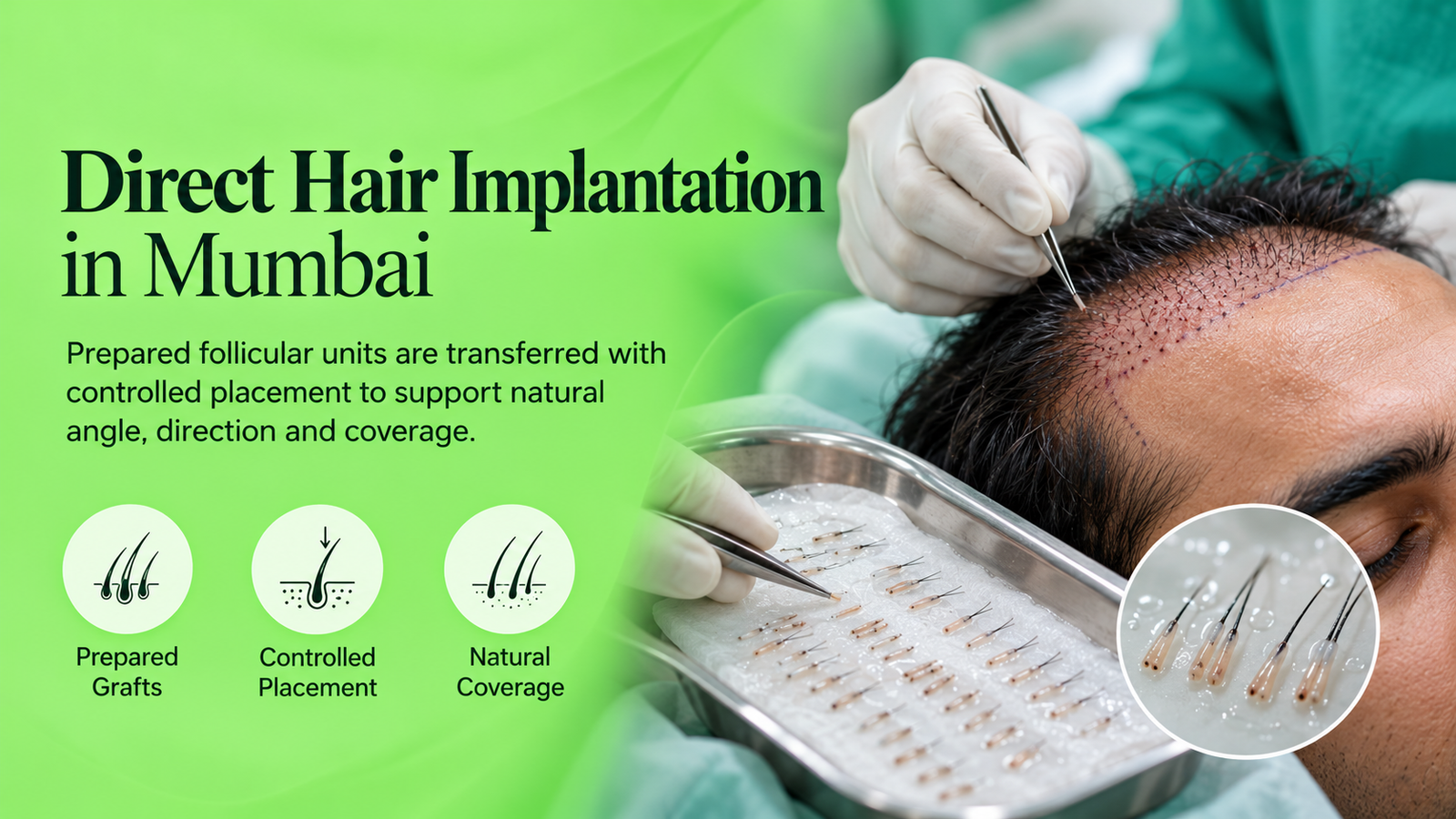
Direct Hair Implantation in Mumbai
Direct Hair Implantation is a term used to describe the placement of prepared hair follicular units into the recipient scalp. In hair-transplant practice, it is commonly associated with DHI, or Direct Hair Implantation, although clinicians may use the expression differently.
Some use it to describe graft placement using a sharp implanter. Others use it to describe an organised extraction-to-implantation workflow.
The important point is that the term alone does not identify a separate, clinically superior hair transplant procedure.
Understanding how grafts are extracted, preserved, organised and implanted is more useful than choosing treatment solely by its name.
What Does Direct Hair Implantation Mean?
During transplantation, hair follicles are removed from an appropriate donor area and placed into regions where additional hair is needed.
Direct Hair Implantation commonly refers to the implantation part of this process.
However, the terminology is not universally standardised.
It may refer to placement using a sharp implanter that creates a recipient opening as the graft is inserted, or to a workflow intended to organise graft transfer efficiently.
Patients should therefore ask their surgeon exactly how the term is being used.
The relevant clinical questions concern graft handling, recipient-site preparation, orientation, implantation depth and protection of existing hair.
Is Direct Hair Implantation the Same as DHI?
In common terminology, yes: DHI is frequently expanded as Direct Hair Implantation.
It would be misleading to suggest that they are routinely two unrelated operations.
A clinic could potentially describe a distinct extraction-to-placement protocol using similar terminology, but that distinction must be demonstrated through actual procedural steps.
For the broader explanation, see DHI Hair Transplant.
If no distinct Anagen workflow is confirmed, these topics should be consolidated into a single substantive page instead of competing for nearly identical search queries.
Why Does the Extraction-to-Implantation Workflow Matter?
Hair follicles are delicate living tissue.
After extraction, grafts must be protected until implantation.
The clinical team should consider:
- Appropriate hydration and storage.
- Minimising avoidable handling.
- Preventing mechanical trauma.
- Organising grafts by follicular-unit characteristics.
- Managing the extraction and implantation sequence.
- Maintaining accurate graft identification and placement.
- Avoiding unnecessary delays.
Reducing avoidable handling is a reasonable procedural objective, but a short out-of-body time or the word “direct” does not guarantee higher graft survival.
For a separately defined approach to extraction and prompt placement, patients can also read about Instant FUE Hair Transplant.
How Are Hair Grafts Protected During Implantation?
Graft Hydration
Extracted grafts should not be unnecessarily exposed to drying conditions.
Suitable storage and handling practices help protect delicate follicular tissue.
Graft Inspection
The team examines follicular units for their characteristics and suitability.
Careful inspection helps guide where single-hair or multi-hair units may be placed.
Minimal Unnecessary Manipulation
Repeated gripping, bending or forceful insertion can potentially injure graft tissue.
The chosen instrument and handling technique should support controlled placement.
Team Coordination
Extraction, graft preparation and implantation must be coordinated.
A well-organised team can reduce avoidable delays, but workflow efficiency should never come at the expense of surgical accuracy.
Why Does Recipient-Site Planning Still Matter?
An implantation workflow cannot compensate for incorrect hairline planning.
The recipient area must be designed around the patient’s existing hair pattern and long-term restoration needs.
Important considerations include hair direction, angle, depth, spacing and appropriate follicular-unit selection.
Near the frontal hairline, grafts may need a more delicate transition.
In the mid-scalp, the surgeon must balance coverage with existing hair and donor availability.
In the crown, implantation direction needs to follow the natural swirl or whorl pattern wherever possible.
For a broader explanation, see Natural Hairline Design.
How Is Direct Hair Implantation Used During Hair Transplantation?
The following is a general clinical workflow, not a verified proprietary Anagen protocol.
Step 1: Patient and Donor Assessment
The surgeon evaluates hair loss, donor quality, scalp health and suitability for transplantation.
Step 2: Hairline and Recipient Mapping
The intended graft distribution, recipient direction and required coverage are planned.
Step 3: Follicular Unit Extraction
Individual follicular units are harvested from a suitable donor area using the chosen extraction approach.
Step 4: Graft Preservation and Sorting
Grafts are protected, inspected and grouped according to their characteristics.
Step 5: Implantation Method Selection
The team determines whether the selected workflow uses pre-made recipient sites or a suitable implanter instrument.
Step 6: Recipient-Site Preparation
Recipient openings are prepared according to the chosen technique, either before graft placement or during sharp-implanter insertion.
Step 7: Controlled Graft Placement
The follicular units are positioned while respecting the surgical plan and surrounding native hair.
Step 8: Final Inspection
The recipient area is reviewed for appropriate placement, visible abnormalities and graft positioning.
Step 9: Postoperative Care
The patient receives instructions for scalp protection, washing and follow-up.
Who May Benefit From a Carefully Organised Implantation Workflow?
All hair-transplant patients benefit from appropriate graft handling.
However, the choice of specific implantation instruments and sequencing may become especially relevant when treating areas with existing hair, planning delicate visible hairlines or working with challenging graft characteristics.
This does not mean Direct Hair Implantation is automatically preferable in every case.
Patient suitability depends on donor supply, recipient tissue, surgical objectives and clinical judgement.
Recovery, Risks and Limitations
Recovery follows the biological healing process associated with hair transplantation.
Patients may experience redness, crusting, temporary swelling, sensitivity and early shedding of implanted hair shafts.
Potential surgical risks include infection, folliculitis, bleeding, scarring, temporary numbness, poor graft growth and visible placement irregularities.
An organised implantation workflow cannot remove these risks.
The procedure also does not prevent ongoing loss of untreated native hair.
Direct Hair Implantation Cost in Mumbai
The total cost depends on graft requirements, treatment complexity, implantation approach, surgical time, donor management and the overall treatment plan.
Patients should avoid paying a premium solely because a familiar procedure has been assigned a different marketing name.
A meaningful quotation should specify exactly what is being provided.
Direct Hair Implantation Results
The value of implantation is assessed through the complete outcome: natural hair direction, appropriate distribution, donor management and eventual growth.
No genuine result can reliably be attributed to shorter handling time or the word “direct” alone.
Explore Male Hair Transplant Results and Hairline Results under Anagen’s Results menu.
View hair transplant results.
Frequently Asked Questions
Is Direct Hair Implantation different from DHI?
Usually, Direct Hair Implantation is the expanded form of DHI. A separate Anagen protocol would need to be clearly documented to justify a different clinical explanation.
Are grafts always implanted immediately after extraction?
No. Timing and sequencing depend on the surgical workflow, and the word “direct” does not establish an exact time interval.
Does direct implantation avoid recipient incisions?
No. The graft still needs a recipient opening. Some approaches create it during sharp-implanter placement, while others use previously prepared sites.
Does direct implantation reduce graft handling?
A well-designed protocol may aim to reduce unnecessary handling, but the actual benefit depends on how the procedure is performed.
Can direct implantation protect existing hair?
Careful planning can help minimise disturbance, but implantation between native follicles still carries a risk of trauma.
Does the technique guarantee faster growth?
No. Growth is influenced by graft viability, scalp conditions, surgical execution and individual healing.
Discuss Direct Hair Implantation With Anagen
Patients should request a clear explanation of their proposed extraction method, graft-handling process and implantation instrument.
The objective is to choose a medically appropriate surgical plan, not simply a technique name.
For an initial assessment, send FRONT, TOP and BACK donor photographs or contact Anagen.