





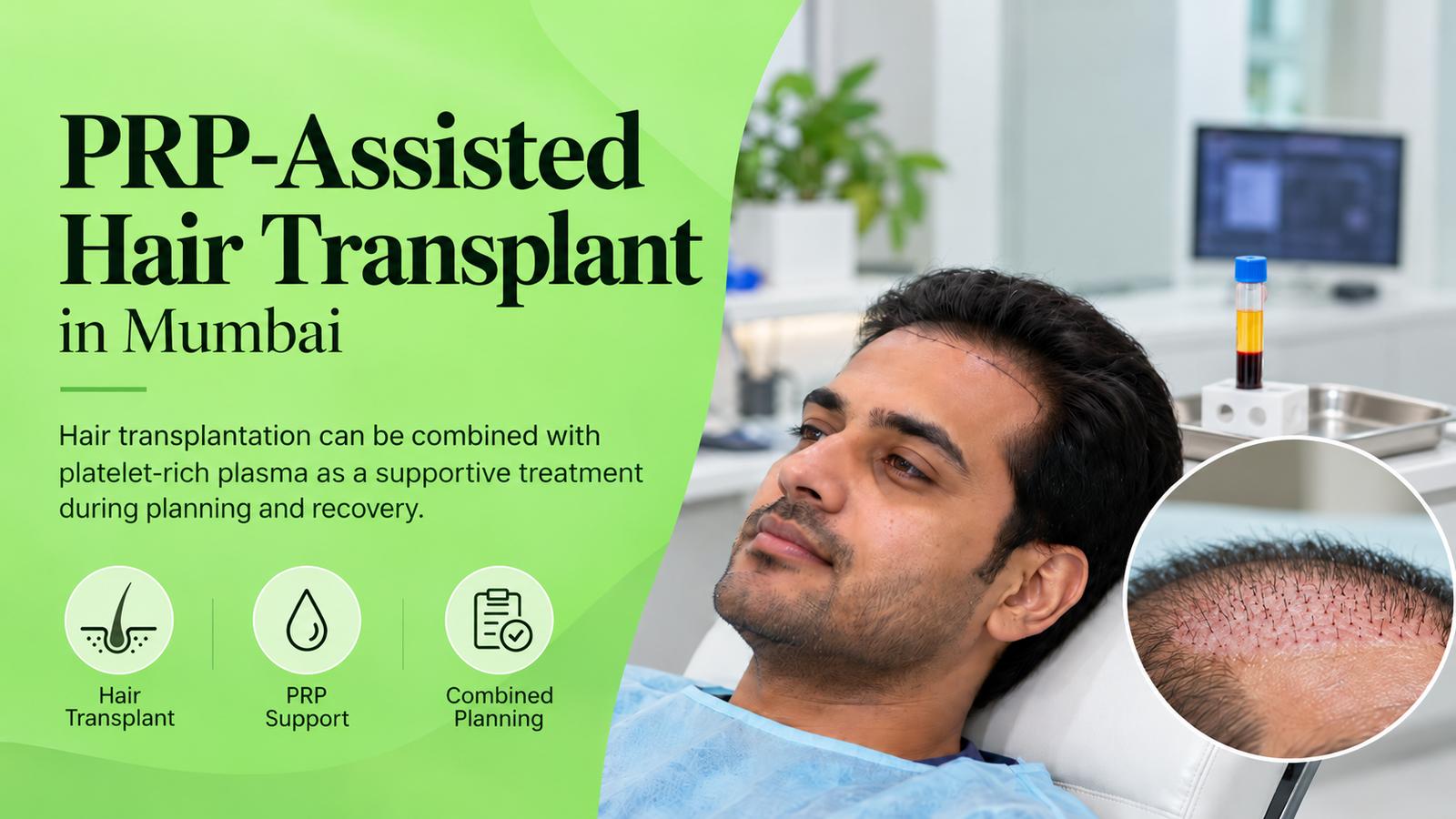
PRP-Assisted Hair Transplant in Mumbai
PRP-assisted hair transplant combines conventional surgical hair transplantation with Platelet-Rich Plasma, a preparation obtained from the patient’s own blood.
The hair transplant remains the main surgical procedure. Healthy follicular units are extracted from an appropriate donor area and implanted into regions requiring restoration.
PRP may be considered as a supportive biological adjunct at selected stages of treatment.
It does not replace donor grafts, create new follicles in completely bald skin or guarantee better transplant growth.
At Anagen Hair Transplant Clinic in Mumbai, the decision to include PRP should depend on the patient’s scalp condition, existing native hair, medical suitability and overall treatment plan.
What Is PRP-Assisted Hair Transplant?
A PRP-assisted hair transplant is a surgical hair restoration procedure in which Platelet-Rich Plasma is incorporated as an optional supportive treatment.
PRP is prepared from a sample of the patient’s blood using a processing method intended to obtain a platelet-rich fraction.
Platelets contain biologically active substances involved in tissue signalling and repair.
The rationale for PRP use is to provide biological support to selected scalp tissues and follicles.
However, PRP preparations differ in platelet concentration, cellular composition, activation method and treatment schedule. These differences make it difficult to assume that every PRP protocol will produce identical outcomes.
How Is PRP Different From Hair Transplantation?
Hair transplantation physically transfers viable follicular units from a donor region into a recipient region.
PRP does not transplant follicles.
It is a biological preparation that may be administered as an adjunct to surgical treatment or used separately in selected patients with thinning native hair.
| Hair Transplant | PRP |
|---|---|
| Surgical follicular transfer | Blood-derived preparation |
| Provides donor follicles to recipient areas | May support selected biological processes |
| Requires suitable donor hair | Requires appropriate patient selection and blood processing |
| Creates the structural basis for transplanted coverage | Does not replace donor follicles |
| Outcome depends on graft growth | Response varies with condition and protocol |
For patients considering PRP without surgery, see PRP Hair Treatment under Biologix.
How Is PRP Prepared?
PRP preparation typically involves collecting an appropriate blood sample and processing it to separate blood components.
The resulting platelet-rich preparation is handled according to the selected protocol.
Preparation methods vary between systems, including differences in centrifugation and final composition.
Because these details can influence the product, patients should ask which specific PRP method is being used.
Why Might PRP Be Considered With Hair Transplantation?
Support Around the Recipient Scalp
PRP has been investigated as an adjunct that may influence biological processes relevant to tissue healing and follicular activity.
However, any meaningful benefit depends on the selected protocol and individual response.
Support for Existing Native Hair
Some patients undergoing transplantation also have thinning hair surrounding the recipient region.
PRP may be considered as part of a broader management plan for those native follicles.
This does not replace diagnosis or established medical management of progressive hair loss.
Perioperative or Postoperative Use
PRP may be incorporated during the surgical period or in later supportive sessions.
The timing and number of sessions should be based on the clinical protocol, not a universal schedule.
Individualised Treatment Planning
Not every patient requires PRP.
For some, a well-planned transplant and appropriate management of native hair may be sufficient.
How Is PRP Used With Hair Transplantation?
Step 1: Medical and Hair-Loss Assessment
The surgeon evaluates the pattern of hair loss, donor availability, existing hair, medical history and suitability for surgery.
Step 2: Surgical Planning
The proposed graft number, hairline, recipient distribution and operative approach are established.
Step 3: PRP Suitability Assessment
The clinician determines whether PRP has a reasonable supportive role and reviews relevant risks, blood-related conditions and medications.
Step 4: Blood Collection and PRP Preparation
If selected, an appropriate blood sample is obtained and processed using the clinic’s verified PRP protocol.
Step 5: Hair Transplant Surgery
Suitable follicular units are extracted and implanted according to the surgical plan.
Step 6: PRP Administration Where Indicated
PRP is administered according to the selected protocol, with attention to the recipient scalp, existing hair or postoperative treatment plan.
Step 7: Early Healing and Postoperative Care
The patient follows instructions for wound protection, cleansing and follow-up.
Step 8: Assessment of Growth and Ongoing Hair Loss
The clinician monitors surgical recovery, transplanted growth and the condition of untreated native hair.
What Does Research Say About PRP-Assisted Transplantation?
Clinical studies have investigated PRP during or around hair transplant surgery.
Some controlled studies report improvements in measures such as density, timing of visible growth or other transplant outcomes.
However, the evidence remains limited by relatively small study populations, differing preparation methods and inconsistent evaluation standards.
There is not enough high-quality evidence to promise that PRP will reliably increase graft survival, prevent postoperative shedding or improve the result of every transplant.
Patients should view PRP as a possible adjunct rather than a substitute for high-quality surgery.
Can PRP Prevent Shock Loss?
Temporary shedding after transplantation may affect implanted hair shafts and sometimes surrounding native hair.
PRP cannot reliably prevent all such shedding.
The risk and extent of postoperative loss depend on several factors, including the condition of existing follicles and the surgical procedure.
Anagen should explain this possibility during preoperative counselling.
Does PRP Change Recovery?
PRP may be included in a supportive care plan, but standard postoperative precautions still apply.
Patients may experience temporary scalp tenderness, redness or swelling after injections.
Transplant-site healing, early shedding and gradual hair growth still occur.
Risks and Limitations of PRP
Because PRP is prepared from the patient’s own blood, it avoids some risks associated with donor-derived products, but it is not risk-free.
Blood collection and scalp injections can cause temporary discomfort, bruising or local irritation. Infection or other complications are possible if appropriate medical and sterile practices are not followed.
Certain blood disorders, infections, medications and medical conditions may affect suitability.
PRP also does not correct insufficient donor supply, poor graft handling or an incorrectly designed hairline.
PRP-Assisted Hair Transplant Cost in Mumbai
The cost depends on graft requirements, surgical technique, whether PRP is included, and the number and timing of any supportive sessions.
Patients should request a quotation clearly separating the surgery from optional biological treatments.
Paying for additional PRP does not guarantee a superior surgical result.
PRP-Assisted Hair Transplant Results
PRP is an adjunct rather than the source of transplanted follicles.
The final result should therefore be judged according to the overall surgical plan, donor quality, graft growth, native-hair management and long-term appearance.
View genuine cases under Male Hair Transplant Results or Female Hair Transplant Results.
View hair transplant results.
Frequently Asked Questions
Does PRP improve hair transplant growth?
Some studies report potential benefits, but improvement cannot be guaranteed and the evidence remains heterogeneous.
Is PRP compulsory after a transplant?
No. It is an optional adjunct based on patient suitability and clinical judgement.
Does PRP make transplanted hair grow immediately?
No. Transplanted follicles still pass through normal postoperative healing and growth phases.
Can PRP save damaged grafts?
PRP cannot reliably reverse serious follicular injury or compensate for poor surgical handling.
How many PRP sessions are required?
There is no universal schedule. The decision depends on the treatment objective and selected protocol.
Can PRP regrow hair in a completely bald area?
It cannot be relied upon to replace follicles that are no longer present.
Is PRP the same as GFC?
No. Preparation methods and final products may differ. Both are blood-derived approaches, but the specific protocol matters.
Book a PRP-Assisted Hair Transplant Consultation in Mumbai
Before adding PRP, the essential question is whether it offers a reasonable supportive role in your individual treatment plan.
Anagen can assess whether you primarily need surgical restoration, treatment for existing thinning hair or a combination of approaches.
Send clear FRONT, TOP and BACK donor photographs or contact Anagen.