





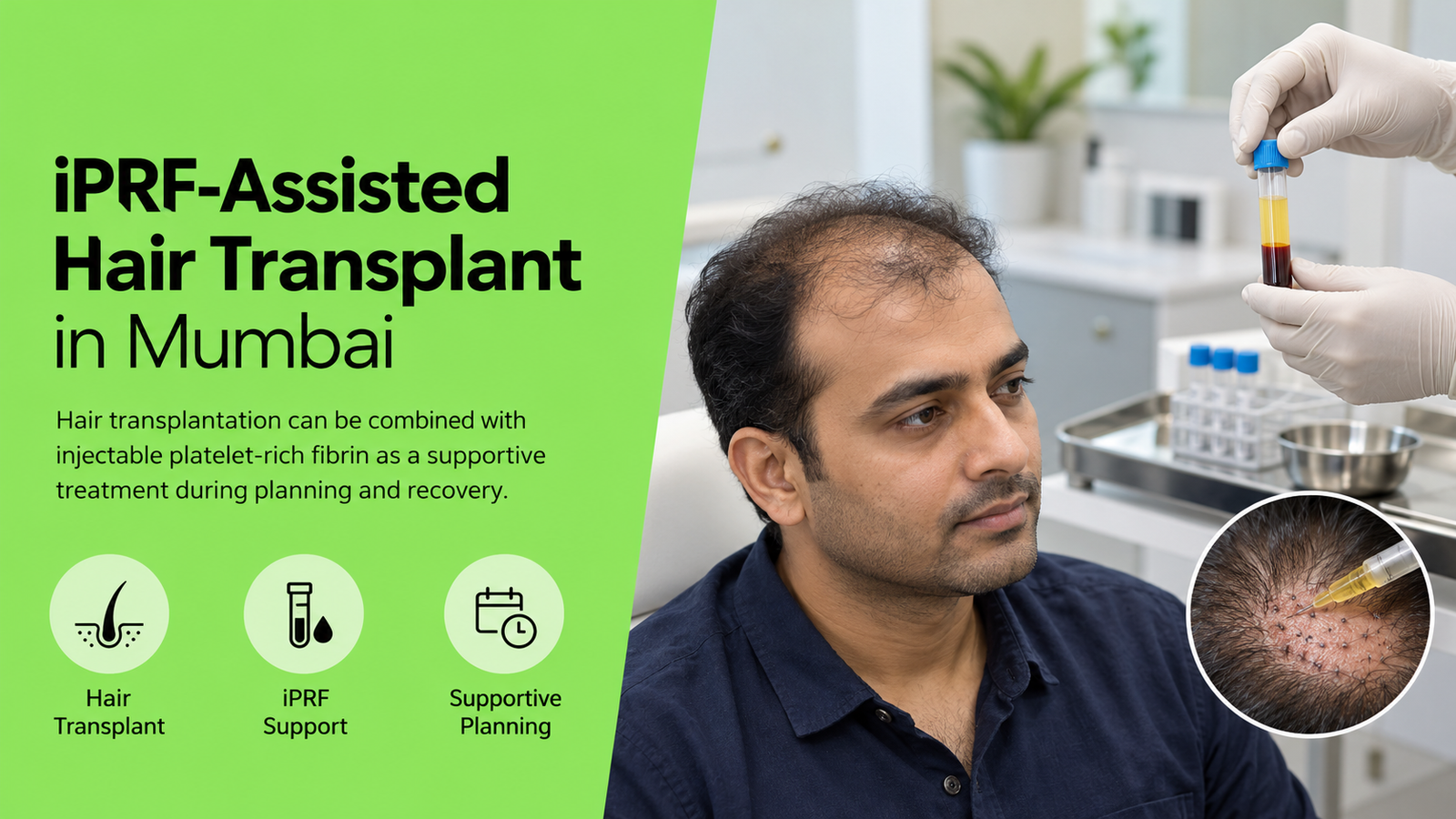
iPRF-Assisted Hair Transplant in Mumbai
An iPRF-assisted hair transplant combines surgical follicular-unit transplantation with injectable Platelet-Rich Fibrin, a blood-derived biological preparation that may be considered for supportive treatment.
The hair transplant itself remains responsible for moving viable follicles from the donor region into areas requiring restoration.
iPRF does not replace surgical grafts, create unlimited donor follicles or guarantee improved transplant survival.
The possible role of iPRF is to provide biological support around selected scalp tissues and existing follicles as part of an individualised treatment plan.
At Anagen Hair Transplant Clinic in Mumbai, suitability should be determined after reviewing the patient’s hair loss, donor area, scalp health and medical history.
What Is iPRF?
iPRF stands for injectable Platelet-Rich Fibrin.
It is prepared from a patient’s own blood using a processing method intended to obtain an injectable fraction containing platelets and other blood components within a fibrin-forming system.
Unlike many conventional PRP protocols, iPRF is often prepared without added anticoagulants.
Its composition and handling characteristics depend on the preparation method.
Because iPRF can form a fibrin network after processing, preparation and administration require appropriate timing and technique.
These biological properties have encouraged investigation of iPRF in tissue repair and regenerative medicine.
However, laboratory characteristics should not automatically be interpreted as proof of superior hair-transplant results.
How Is iPRF Different From PRP?
Both PRP and iPRF are autologous, meaning they are prepared from the patient’s own blood.
However, their preparation methods and final biological characteristics can differ.
| Feature | PRP | iPRF |
|---|---|---|
| Full name | Platelet-Rich Plasma | Injectable Platelet-Rich Fibrin |
| Source | Patient’s blood | Patient’s blood |
| Processing | Varies by system; commonly includes anticoagulated blood | Common protocols use no added anticoagulant |
| Final characteristics | Platelet-rich plasma preparation | Injectable preparation capable of fibrin-network formation |
| Role with transplantation | Potential adjunct | Potential adjunct |
| Proven superior graft survival | Not established for every protocol | Not established |
Some experimental work discusses differences in growth-factor release and fibrin behaviour.
Even if one preparation demonstrates a longer laboratory release profile, that alone does not establish better transplanted hair growth in patients.
For the broader PRP approach, see PRP-Assisted Hair Transplant.
Why Might iPRF Be Used With Hair Transplantation?
Biological Support Around the Scalp
iPRF contains blood-derived components involved in tissue signalling and repair.
Its potential supportive effects are being investigated, but clinical results vary and the evidence for transplantation-specific benefits remains limited.
Existing Native Hair
Some patients have thinning native hair surrounding the area selected for surgery.
A clinician may consider biological support while separately addressing the underlying cause of hair loss.
iPRF should not be presented as a proven replacement for established medical treatment.
Perioperative Planning
Depending on the verified protocol, iPRF may be considered around the surgical period.
However, the timing, route and number of treatments should be confirmed individually.
Selected Patient Suitability
Not everyone is an appropriate candidate.
Relevant considerations may include blood-related disorders, infection, current medications, clinical history and the nature of the scalp condition.
How Is iPRF Prepared for Supportive Hair Treatment?
A blood sample is collected and processed using a method suitable for the intended injectable preparation.
The final product must be handled according to the selected medical protocol.
Because preparation variables can affect the resulting blood-derived fraction, the term iPRF does not describe one universally identical product.
How Is iPRF Used With Hair Transplantation?
Step 1: Assessment of Hair Loss and Donor Supply
The surgeon establishes the reason for hair loss, the state of existing follicles and the patient’s suitability for transplantation.
Step 2: Surgical Treatment Planning
The required donor grafts, recipient design and implantation approach are planned.
Step 3: Assessment of iPRF Suitability
The clinical team determines whether iPRF has a reasonable supportive role and reviews contraindications and medications.
Step 4: Blood Collection and Preparation
When selected, iPRF is prepared using the clinic’s verified medical protocol.
Step 5: Hair Transplant Surgery
Viable follicular units are extracted, prepared and implanted according to the surgical plan.
Step 6: iPRF Administration Where Indicated
The preparation is administered only according to the approved clinical protocol and individual assessment.
Step 7: Recovery and Scalp Monitoring
The patient receives postoperative guidance and monitoring for normal healing or complications.
Step 8: Long-Term Growth Assessment
The transplanted area and remaining native hair are reviewed during follow-up.
What Does the Evidence Say About iPRF-Assisted Transplantation?
iPRF and related platelet-rich fibrin preparations have been investigated for hair and tissue-related applications.
However, evidence from treatment of androgenetic alopecia is not the same as evidence demonstrating improved survival of surgically transplanted grafts.
Direct, standardised comparative evidence for iPRF as a hair-transplant adjunct remains limited.
Differences in preparation methods, small clinical studies and variable outcome measurements make confident comparisons difficult.
Therefore, iPRF should be described as a possible supportive treatment rather than a proven method for guaranteeing superior graft growth.
Can iPRF Prevent Shock Loss?
No reliable guarantee can be made.
Temporary shedding of transplanted hair shafts and possible shedding of surrounding native hair can occur despite biological support.
The underlying biology of hair cycling and the condition of native follicles remain important.
Recovery, Risks and Limitations
Recovery after transplantation remains largely determined by the surgical procedure and individual healing.
If iPRF involves scalp injection, possible temporary effects include tenderness, redness, swelling or bruising.
Infection and other injection-related complications remain possible.
iPRF does not correct poor donor management, improper implantation or active untreated hair-loss conditions.
It also cannot create follicles in areas where the necessary follicular structures are absent.
iPRF-Assisted Hair Transplant Cost in Mumbai
Cost depends on graft number, surgical requirements, whether iPRF is included, the selected preparation system and any planned supportive sessions.
An itemised quotation should distinguish surgical charges from adjunctive treatment charges.
The presence of iPRF does not automatically make an operation more effective.
iPRF-Assisted Hair Transplant Results
A complete hair-transplant result should be assessed through donor selection, recipient planning, hair direction, graft growth and long-term appearance.
iPRF cannot be credited as the sole cause of the final result.
Patients can review Male Hair Transplant Results or Female Hair Transplant Results in Anagen’s dedicated Results menu.
View hair transplant results.
Frequently Asked Questions
Is iPRF the same as PRP?
No. They are related blood-derived preparations with different processing and biological characteristics.
Is iPRF better than PRP for transplantation?
There is insufficient standardised clinical evidence to establish universal superiority.
Does iPRF guarantee more transplanted hair growth?
No. Graft growth depends on many surgical and biological factors.
Is iPRF compulsory after FUE?
No. It may be considered as an optional supportive treatment.
Can iPRF prevent all postoperative shedding?
No. Temporary shedding can still occur.
Can iPRF replace a hair transplant?
Not in an area requiring restoration of missing follicles through donor transplantation.
Is iPRF safe for everyone?
No. Medical history, blood-related conditions, medications and other contraindications must be reviewed.
Book an iPRF-Assisted Hair Transplant Consultation in Mumbai
Before choosing iPRF support, the important question is whether transplantation itself is required and whether the adjunct provides a reasonable additional role in your plan.
Anagen can assess your existing hair, donor area and likely treatment requirements.
Send clear FRONT, TOP and BACK donor photographs or contact Anagen Hair Transplant Clinic.