





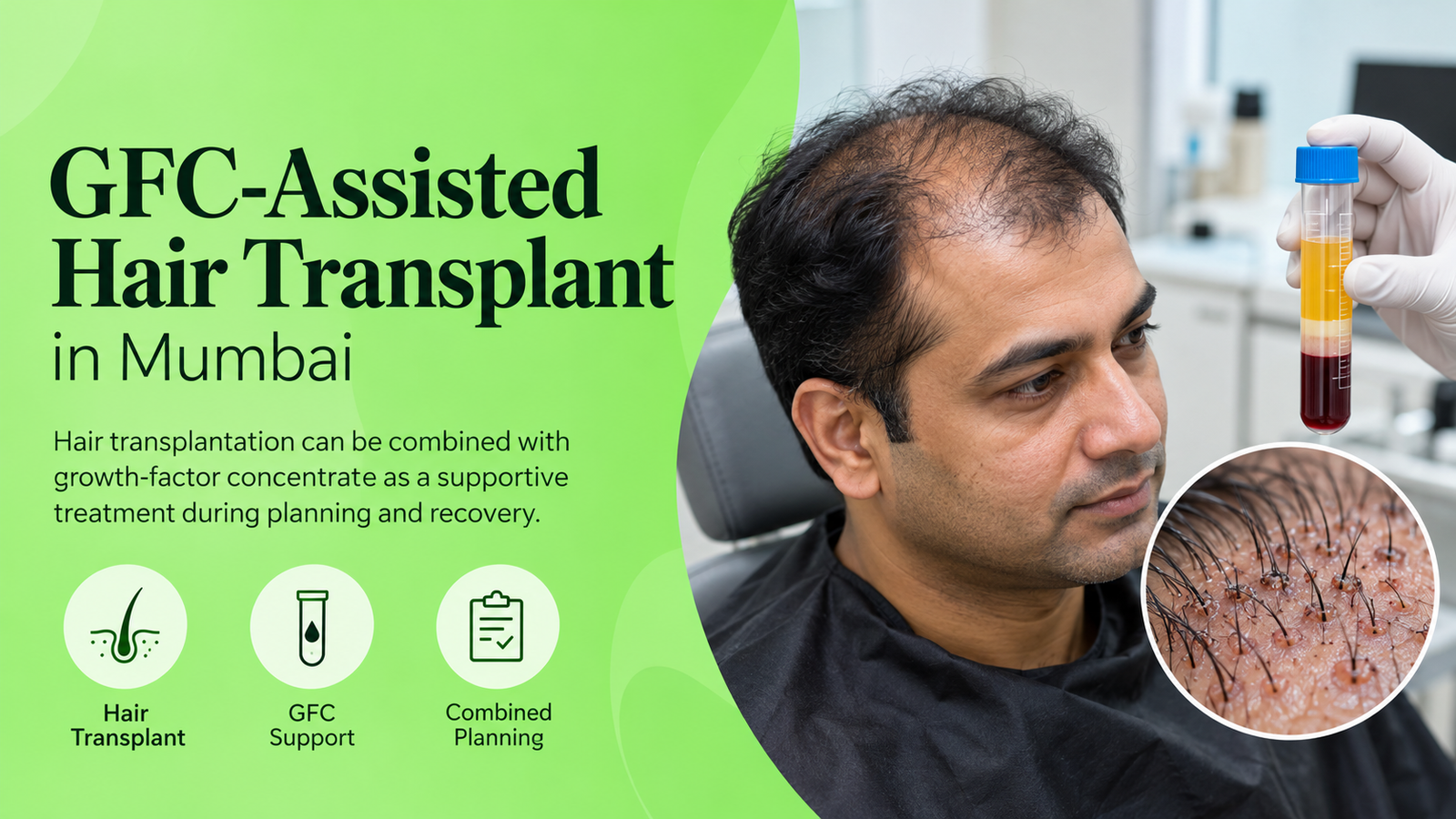
Male Pattern Baldness Hair Transplant in Mumbai
A GFC-assisted hair transplant combines surgical hair restoration with a blood-derived growth-factor concentrate that may be considered as an additional supportive treatment.
Hair transplantation remains the primary procedure. Healthy donor follicles are extracted and implanted into areas affected by significant hair loss.
GFC does not replace transplanted follicles. It may be considered to support selected biological processes involving the scalp and remaining native hair.
The actual usefulness of GFC depends on the preparation system, clinical objective and individual patient response.
At Anagen Hair Transplant Clinic in Mumbai, GFC should be incorporated only when its role within the overall treatment plan is clear.
What Is GFC-Assisted Hair Transplant?
GFC generally refers to Growth Factor Concentrate, although commercial systems and clinical terminology vary.
In the context of hair treatment, it commonly describes a blood-derived preparation intended to deliver a concentrated fraction of biologically active factors.
When used alongside transplantation, GFC is an adjunct rather than the surgical method.
The transplant supplies follicles. GFC may be considered as part of supportive scalp or native-hair treatment.
Patients should understand that different preparation systems can produce different final products.
The label GFC does not establish a universal biological composition or standardised clinical response.
How Is GFC Different From PRP and iPRF?
PRP, iPRF and GFC are related by their use of blood-derived biological components, but they should not automatically be treated as identical.
PRP refers to platelet-rich plasma.
iPRF refers to injectable platelet-rich fibrin, commonly associated with a different preparation method and fibrin-forming characteristics.
GFC refers to a growth-factor concentrate approach, the specifics of which depend on the system being used.
| Treatment | General description | Role with transplantation |
|---|---|---|
| PRP | Platelet-rich plasma preparation | Potential supportive adjunct |
| iPRF | Injectable platelet-rich fibrin preparation | Potential supportive adjunct |
| GFC | Growth-factor concentrate preparation | Potential supportive adjunct |
No one preparation should be described as universally superior without relevant, high-quality comparative evidence.
The term Concentrated Growth Factors (CGF) is also used in published research. CGF results must not automatically be attributed to every commercial GFC preparation, because products and processing methods may differ.
For treatment-specific explanations, see PRP-Assisted Hair Transplant and iPRF-Assisted Hair Transplant.
How Is GFC Prepared?
The exact process depends on the system being used.
Blood is generally collected and processed according to a designated preparation method intended to obtain the selected biological concentrate.
Different kits or laboratory approaches may have different collection requirements, processing methods and final compositions.
This is why a meaningful clinical explanation must identify the actual product rather than relying only on the letters GFC.
Why Might GFC Be Used With Hair Transplantation?
Support for Existing Native Hair
Many transplant candidates still have miniaturising native follicles near the planned recipient area.
GFC may be considered as part of a treatment plan for selected thinning areas, although the underlying diagnosis remains important.
Recipient Scalp Support
The biological rationale for growth-factor-based treatments includes potential effects on local tissue signalling and follicular activity.
However, this does not prove that GFC improves transplanted graft survival in every patient.
Postoperative Hair-Loss Management
Some patients require continued management of progressive native-hair loss after transplantation.
A supportive treatment may be considered alongside established medical care when appropriate.
Personalised Combined Treatment
GFC should not automatically be given to every transplant patient.
The clinician should explain why it is being considered, which area it is intended to treat and what measurable improvement is reasonably expected.
How Is GFC Used With Hair Transplantation?
Step 1: Hair Loss and Donor Assessment
The surgeon evaluates the cause and extent of hair loss, donor supply and condition of remaining native follicles.
Step 2: Surgical Planning
Graft requirements, recipient design and implantation method are established.
Step 3: GFC Suitability Assessment
The clinician determines whether growth-factor concentrate has a reasonable adjunctive role and reviews relevant contraindications.
Step 4: Blood Collection and GFC Preparation
The selected concentrate is prepared according to the verified product and clinical protocol.
Step 5: Hair Transplant Surgery
Viable donor grafts are extracted and implanted according to the surgical plan.
Step 6: GFC Administration Where Indicated
The concentrate is administered according to the patient’s approved adjunctive treatment plan.
Step 7: Postoperative Care
The patient receives advice on wound protection, medications, washing and monitoring.
Step 8: Follow-Up and Native-Hair Maintenance
The surgeon reviews transplant growth, ongoing hair loss and whether any further supportive therapy is justified.
Can GFC Improve Hair Transplant Results?
Research into blood-derived growth-factor treatments for hair loss is developing.
Some studies of related preparations report improvements in hair density or other measures.
However, benefits observed in nonsurgical treatment of existing hair do not automatically prove improved survival of transplanted follicles.
Evidence also varies by preparation system, patient group, study design and follow-up duration.
A claim that GFC always increases graft survival, creates permanent additional density or is categorically better than PRP would be unjustified.
Can GFC Prevent Hair Loss After Transplantation?
GFC cannot guarantee that surrounding native hair will stop thinning.
Pattern hair loss may continue after a successful transplant.
The underlying cause should be assessed and an appropriate long-term maintenance plan discussed.
For nonsurgical options, see Advanced GFC Hair Treatment under Biologix.
Recovery, Risks and Limitations
Hair transplant recovery follows the normal course of surgical healing.
GFC does not remove the possibility of redness, crusting, swelling or shedding of implanted hair shafts.
If the adjunct requires scalp injections, temporary discomfort, bruising, irritation and other injection-related risks may occur.
Medical suitability must be assessed before blood collection or administration.
The treatment cannot create new donor follicles, restore unlimited density or compensate for technical shortcomings during surgery.
GFC-Assisted Hair Transplant Cost in Mumbai
Cost depends on graft requirements, operative complexity, the specific GFC preparation and the timing or number of supportive sessions.
Patients should request a clear quotation showing what is included in the transplant and what is charged separately.
A higher package cost does not guarantee a better result.
GFC-Assisted Hair Transplant Results
A complete transplant outcome reflects donor-hair availability, hairline design, surgical execution and individual follicular growth.
GFC should be viewed as a possible supportive component rather than the source of transplanted coverage.
Review genuine Male Hair Transplant Results, Female Hair Transplant Results or Crown Restoration Results under Anagen’s Results menu.
View hair transplant results.
Frequently Asked Questions
What is GFC-assisted hair transplant?
It is a hair transplant combined with a selected blood-derived growth-factor concentrate used as an adjunct.
Is GFC the same as PRP?
Not necessarily. Preparation systems and the resulting biological fractions may differ.
Is GFC better than iPRF or PRP?
There is insufficient consistent evidence to claim universal superiority.
Does GFC guarantee graft survival?
No. Graft survival depends on surgical and patient-related factors.
Is GFC compulsory after FUE?
No. It should be considered only when clinically appropriate.
Can GFC regrow hair in a completely bald region?
It cannot reliably replace missing follicles or create unlimited new hair.
How many GFC sessions are needed?
There is no universal schedule. The protocol should be explained according to the specific product and treatment objective.
Book a GFC-Assisted Hair Transplant Consultation in Mumbai
The starting point is determining whether you need a transplant, treatment for existing hair thinning or a combined plan.
Anagen can assess donor availability, scalp health and the potential role of GFC before recommending treatment.
Send clear FRONT, TOP and BACK donor photographs or contact Anagen Hair Transplant Clinic.