





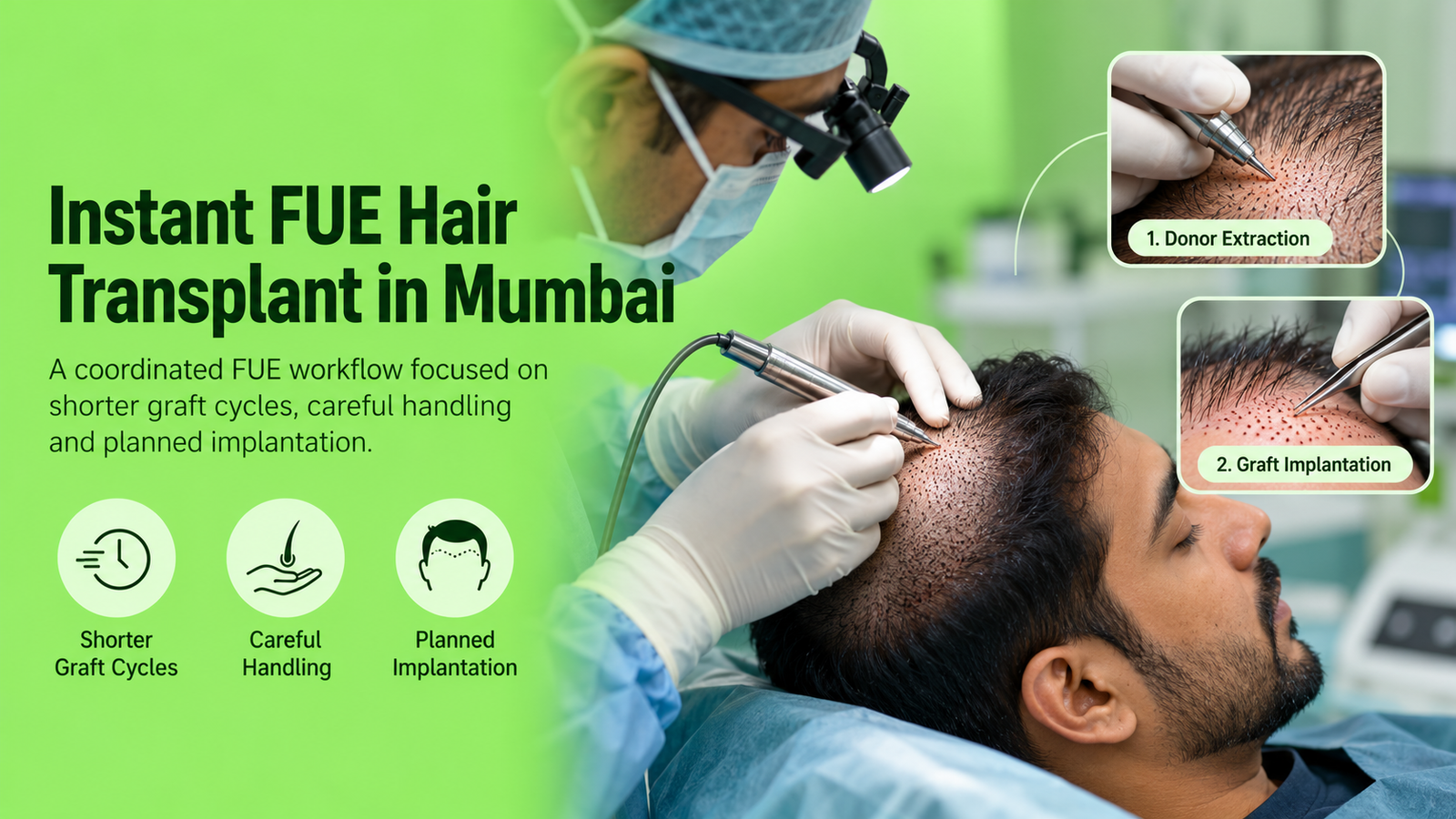
Instant FUE Hair Transplant in Mumbai
Instant FUE Hair Transplant is an approach to follicular-unit transplantation focused on reducing unnecessary delays between graft extraction and implantation.
The purpose is to coordinate donor harvesting, graft inspection, temporary holding, recipient-site preparation and implantation in an organised surgical workflow.
The word “Instant” does not mean that transplanted hair grows instantly. It describes how grafts are managed during the procedure.
At Anagen Hair Transplant Clinic in Mumbai, Instant FUE is a technique that patients may consider when learning about graft-handling time, tissue protection and coordinated implantation.
What Is Instant FUE Hair Transplant?
In standard FUE transplantation, follicular units are harvested from the donor scalp, examined and temporarily protected before being implanted in the recipient area.
Instant FUE refers to a workflow intended to reduce avoidable graft waiting time.
Instead of treating extraction and implantation as completely separate large phases, the team may organise smaller extraction, preparation and implantation cycles, depending on the confirmed surgical protocol.
This requires advance recipient-site planning, clear graft organisation and coordination between the surgical and graft-handling teams.
Instant FUE is therefore primarily a workflow modification. It is not a different source of hair follicles and does not automatically determine which implantation instrument will be used.
Why Does Graft Out-of-Body Time Matter?
A follicular-unit graft is living tissue. Once harvested, it no longer receives the blood circulation it had within the donor scalp.
During this period, careful preservation is important. Grafts must be protected from dehydration, physical damage and unsuitable holding conditions.
Reducing unnecessary waiting can be a reasonable surgical objective. However, graft survival also depends on tissue quality, extraction trauma, temperature, hydration, handling and the recipient environment.
Shorter out-of-body time cannot compensate for damaged grafts or poor surgical planning.
Importantly, implantation does not immediately restore normal graft blood circulation. Healing and revascularisation develop after the graft has been placed.
How Does the Instant FUE Workflow Differ?
The principal intended difference is the timing and coordination of the surgical stages.
Recipient planning may be completed before harvesting so that grafts can move efficiently through inspection and placement.
Appropriate staffing and communication are essential. The surgeon must also maintain control over donor extraction distribution, graft selection and recipient-site quality.
A shorter workflow should never mean rushed extraction, inadequate inspection or reduced attention to implantation angle and depth.
For patients who wish to understand Anagen’s wider technical approach, see Biotech FUE Hair Transplant.
How Is Instant FUE Hair Transplant Performed?
Step 1: Hair Loss and Medical Assessment
The surgeon evaluates the pattern of hair loss, scalp condition, relevant medical history and whether transplantation is suitable.
Step 2: Donor Area Planning
The safe donor region is assessed for follicular density, hair calibre, miniaturisation and the number of grafts that may be harvested responsibly.
Step 3: Recipient-Site and Hairline Planning
The hairline, frontal density, mid-scalp or crown requirements are planned before harvesting. The intended direction, angle and distribution of grafts are established.
Step 4: Donor Preparation and Local Anaesthesia
The selected donor area is prepared and local anaesthesia is administered according to the clinical plan.
Step 5: Controlled FUE Extraction
Follicular units are harvested using appropriately sized punches while preserving the remaining donor area.
Step 6: Graft Inspection and Organisation
Extracted grafts are inspected and organised according to their characteristics. Necessary short-term protection and hydration are maintained.
Step 7: Smaller Extraction and Implantation Cycles
Where this is part of the verified Instant FUE protocol, harvesting and implantation are coordinated in smaller cycles rather than leaving all grafts awaiting placement after one prolonged harvesting phase.
Step 8: Recipient-Site Creation and Implantation
Grafts are implanted into planned recipient positions using the selected site-creation and implantation technique. Timing must not compromise direction, depth, handling or density planning.
Step 9: Postoperative Assessment
The treated areas are checked, written care instructions are provided and postoperative follow-up is arranged.
Does Instant FUE Use Sapphire Blades or DHI?
These terms describe different aspects of hair transplantation.
FUE is the donor-harvesting technique. Instant FUE describes the intended timing and coordination of graft handling.
A sapphire blade may be used for recipient-site creation, while an implanter-based technique may be selected for graft placement.
Whether these methods are combined depends on the surgical plan.
They should not be advertised as automatically included under the Instant FUE name.
Does Instant FUE Improve Graft Survival?
Graft survival is affected by numerous factors, including harvesting trauma, graft integrity, preservation conditions, implantation technique and postoperative healing.
Managing out-of-body time is one relevant consideration, but there is no justification for promising a specific survival percentage for every patient.
Similarly, immediate implantation does not guarantee instant hair growth.
Who May Be Suitable for Instant FUE?
Instant FUE may be considered for appropriately selected hair-transplant candidates when the surgical team can apply its planned workflow safely and consistently.
The deciding factors remain donor adequacy, recipient needs, medical suitability and practical surgical organisation.
Patients requiring extensive restoration, revision surgery or challenging donor harvesting may need a modified procedure plan or more than one session.
A technique should be selected because it fits the case, not because the word “Instant” sounds faster.
Recovery After Instant FUE
Patients should expect the usual biological recovery of an FUE hair transplant.
Early redness, swelling, scabbing or temporary discomfort may occur. Transplanted hair shafts may shed during the first several weeks.
New follicular growth generally becomes noticeable over subsequent months and develops progressively. Mature appearance may take a year or longer.
The use of a shorter graft-handling workflow does not eliminate the normal hair-growth cycle.
Instant FUE Cost in Mumbai
Cost depends on graft requirements, surgical complexity, recipient coverage, operating time, team organisation, additional instruments and any confirmed adjunctive treatment.
A patient should request a written explanation of what is included in an Instant FUE package and whether the workflow materially changes their treatment plan.
View Instant FUE Hair Transplant Results
A natural-looking result depends on donor quality, intact grafts, hairline design, recipient-site planning and individual growth.
The extraction-to-implantation workflow is only one factor.
To assess real patient outcomes, view hair transplant results in Anagen’s dedicated Results section.
Frequently Asked Questions
What does Instant FUE actually mean?
It refers to an organised workflow intended to limit unnecessary time between follicular-unit harvesting and implantation.
Does Instant FUE make hair grow immediately?
No. Transplanted follicles still undergo healing and their normal growth cycle.
Is graft out-of-body time always zero?
No. Grafts still require harvesting, handling and appropriate preparation. A claim of zero out-of-body time would be misleading.
Is Instant FUE the same as DHI?
No. Instant FUE concerns workflow timing, while DHI generally refers to an implantation approach. They may be combined in selected procedures.
Will transplanted hair shed after Instant FUE?
Yes, temporary shedding may still occur.
Is Instant FUE suitable for large sessions?
Suitability depends on donor supply, the number of grafts, available surgical resources and the ability to maintain safe graft handling throughout the operation.
Is Instant FUE guaranteed to give better survival?
No. There is no universal guarantee of improved survival or final density.
Plan Your Instant FUE Consultation at Anagen
The consultation should clarify your expected graft requirement, donor reserve, recipient-area coverage and the actual extraction-to-implantation workflow proposed.
At Anagen Hair Transplant Clinic in Andheri West, Mumbai, the team can discuss whether Instant FUE is appropriate for your case.
Send clear FRONT, TOP and BACK donor photographs on WhatsApp: +91 92222 22409.