





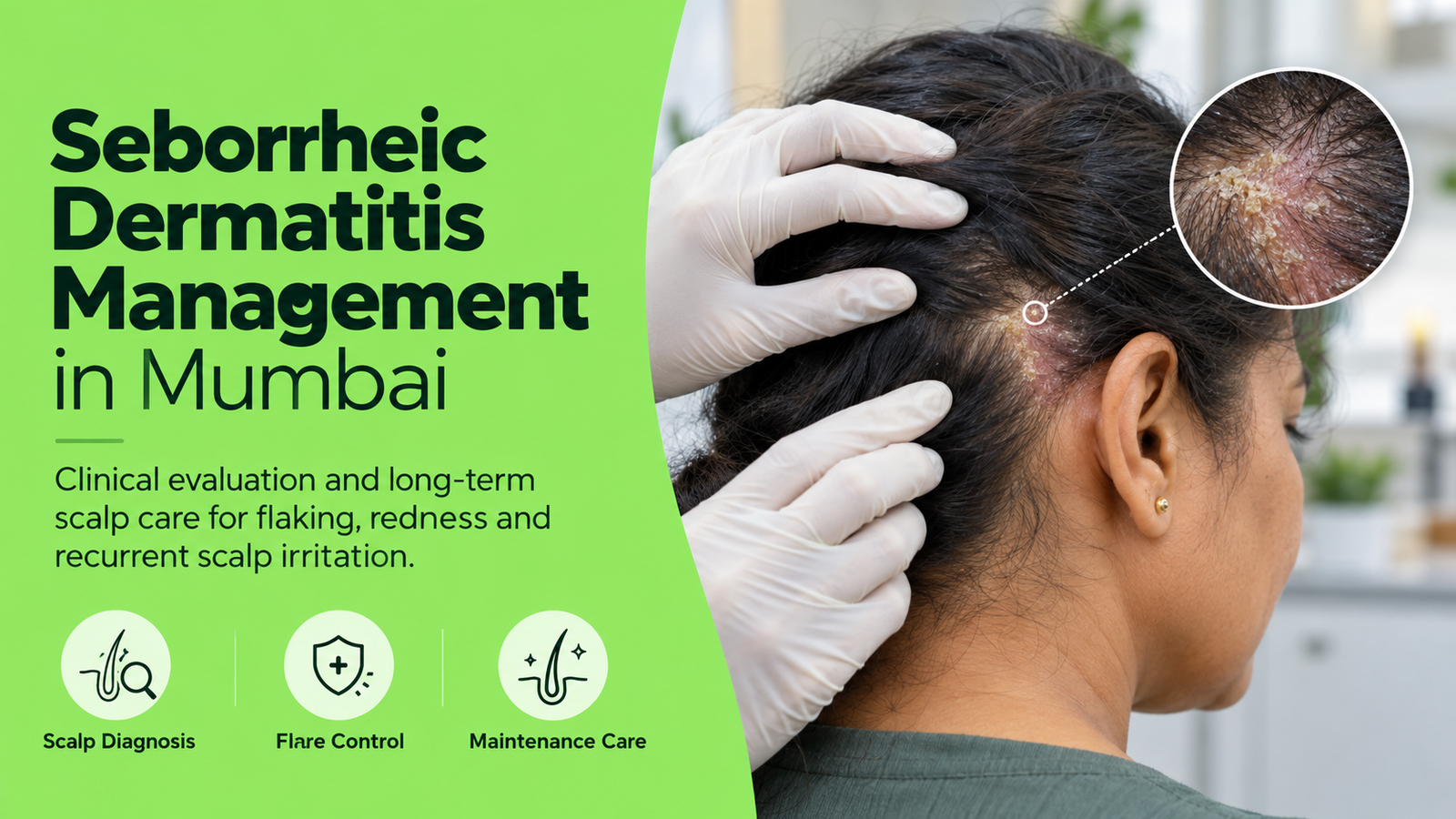
Seborrheic Dermatitis Management in Mumbai — Scalp Flaking, Redness and Recurrent Flares
Some patients experience scalp flaking that repeatedly returns despite changing shampoos or improving their hair-care routine.
The flakes may be greasy or adherent, and the scalp may also feel itchy, irritated or inflamed. Similar scaling can sometimes affect the eyebrows, ears or areas around the nose.
These symptoms may be associated with seborrheic dermatitis, a common inflammatory skin condition that often follows a recurrent course.
Seborrheic dermatitis can usually be managed, but many patients require ongoing maintenance rather than a one-time treatment.
What Is Seborrheic Dermatitis?
Seborrheic dermatitis is an inflammatory skin disorder that commonly affects areas with relatively high sebaceous-gland activity.
On the scalp, it can cause scaling, itching and visible skin irritation.
The condition is associated with interactions among skin oil, naturally occurring Malassezia yeast, skin-barrier function and the body’s inflammatory response.
It is not simply caused by poor scalp hygiene.
Symptoms may become less noticeable with appropriate treatment and then return during later flare-ups.
Symptoms of Scalp Seborrheic Dermatitis
Common features include:
- Greasy or pale-yellowish scale on the scalp.
- Itching that may become troublesome.
- Redness or other visible colour changes in the affected skin.
- Recurrent flaky patches.
- Discomfort or mild burning.
- Scaling around the hairline, eyebrows, ears or nearby facial areas.
Inflammation does not always look bright red. In darker skin tones, affected areas may appear pink, purple-brown, lighter or darker than surrounding skin.
The appearance can vary considerably between patients.
Why Does Seborrheic Dermatitis Develop?
There is no single cause that explains every patient’s symptoms.
Malassezia organisms are normal inhabitants of the skin, but in susceptible individuals they can participate in inflammatory responses.
Sebum, skin-barrier characteristics and individual immune responses also contribute.
Certain patients notice flare-ups when their usual routine changes or during periods of stress or illness.
Seborrheic dermatitis is not a result of simply failing to wash the hair.
It is also not the same as a typical contagious scalp infection.
Seborrheic Dermatitis vs Ordinary Dandruff
Dandruff and scalp seborrheic dermatitis overlap, but the distinction becomes important when symptoms are persistent or substantially inflamed.
| Ordinary Dandruff | Seborrheic Dermatitis |
|---|---|
| Often presents mainly as visible scalp flakes | Frequently includes scaling with clinically apparent inflammation |
| Itching may be mild | Itching or burning may be more troublesome |
| Commonly managed with suitable anti-dandruff care | May require prescription treatment and longer-term maintenance |
| Usually limited to the scalp | May involve eyebrows, ears, face or other oily skin areas |
| Can recur | Commonly follows a chronic relapsing course |
These are general patterns rather than strict diagnostic rules.
Patients with relatively mild flaking can find guidance in dandruff treatment, while those with recurrent inflammation need a more specific evaluation.
How Is Seborrheic Dermatitis Diagnosed?
A dermatologist usually begins with a clinical history and examination.
Important considerations include the location of the rash, how long symptoms have been present, previous treatment responses and whether similar scaling affects the face or ears.
Other conditions can resemble seborrheic dermatitis, including scalp psoriasis, contact dermatitis and certain fungal infections.
If symptoms are unusual, severe or resistant to appropriate treatment, further assessment may be required.
How Is Seborrheic Dermatitis Managed?
The main goals are to control inflammation, reduce scale and itching, improve patient comfort and limit recurrence.
Medicated Scalp Cleansing
Antifungal or other medicated shampoos may be recommended to help manage scaling and the condition’s underlying contributors.
The product and frequency of use depend on the severity and clinical assessment.
Control of Active Inflammation
Some patients need prescription topical anti-inflammatory treatment during flare-ups.
These medicines should be selected and used under appropriate medical guidance, particularly because prolonged or inappropriate use can cause adverse effects.
Gentle Skin and Scalp Care
Harsh products, scratching and unnecessary abrasive treatments may worsen irritation.
A suitable routine should balance scalp cleansing with protection of the skin barrier.
Long-Term Maintenance
Once symptoms improve, maintenance care may be needed to reduce the frequency or severity of future flare-ups.
Why Does Seborrheic Dermatitis Keep Returning?
Seborrheic dermatitis is often chronic or relapsing.
This means that effective treatment may reduce symptoms without completely removing the patient’s underlying tendency to develop the condition.
Some patients experience long intervals with very little discomfort, while others have more frequent flare-ups.
The practical objective is to create a sustainable plan that helps control symptoms and provides clear instructions for recognising and treating a recurrence.
Can Seborrheic Dermatitis Cause Hair Loss?
Seborrheic dermatitis can be associated with increased hair shedding in some patients, particularly when inflammation and scratching are substantial.
However, uncomplicated seborrheic dermatitis does not ordinarily destroy hair follicles permanently.
When patients experience significant shedding, visible thinning or patchy hair loss, another cause may be present at the same time.
The scalp disease and the hair-loss problem should both be assessed rather than assuming one explains the other.
If the pattern is atypical or there are signs of possible follicular damage, a broader scalp inflammation assessment may be necessary.
Daily Care for Seborrheic Dermatitis
Patients should use prescribed products as directed and maintain a suitable scalp-cleansing routine.
Avoid repeatedly scratching or pulling off adherent scales.
Hair oils, fragrances and styling products may irritate some patients, so the routine should be adjusted according to individual tolerance.
It is also important not to stop all maintenance care automatically when symptoms improve if the clinician has recommended continued use.
When Should You Seek Medical Attention?
Medical review is appropriate when symptoms persist despite suitable care, repeatedly disrupt sleep or daily activities, or extend to the eyebrows, ears or face.
Painful lesions, pus, progressive hair loss, extensive crusting or an uncertain diagnosis warrant further assessment.
Severe or unusual symptoms may require investigation for conditions other than seborrheic dermatitis.
Seborrheic Dermatitis Treatment Cost in Mumbai
Costs vary according to consultation requirements, the severity of inflammation, medications, follow-up needs and whether investigations are necessary.
Because the condition can recur, patients should consider the practical cost of ongoing maintenance rather than only the cost of one visit.
Frequently Asked Questions
Is seborrheic dermatitis a fungal infection?
It is an inflammatory condition associated partly with the activity of normally present skin yeast. It should not be equated with a typical contagious fungal infection.
Can seborrheic dermatitis be cured permanently?
The condition can often be controlled, but recurrence is common. Permanent cure cannot be promised.
Is it the same as dandruff?
The conditions overlap, but seborrheic dermatitis usually refers to more clearly inflammatory disease and may involve areas beyond the scalp.
Can I use ordinary shampoo?
Ordinary shampoo may not adequately control symptoms in some patients. A clinician may recommend medicated cleansing and other treatment.
Can seborrheic dermatitis affect the face?
Yes. It can affect the eyebrows, sides of the nose, ears and other areas.
Should scalp microneedling be performed during a flare?
Elective microneedling should generally be deferred when there is active significant inflammation or infection until the scalp has been assessed and appropriately managed.
Get a Management Plan for Recurrent Seborrheic Dermatitis
If greasy scaling, redness and itching repeatedly return, the answer may not be to keep changing shampoos.
A diagnosis-based treatment and maintenance plan can help reduce discomfort and manage future flare-ups.
For assessment of recurrent scalp inflammation, contact Anagen Hair Transplant Clinic in Mumbai.