





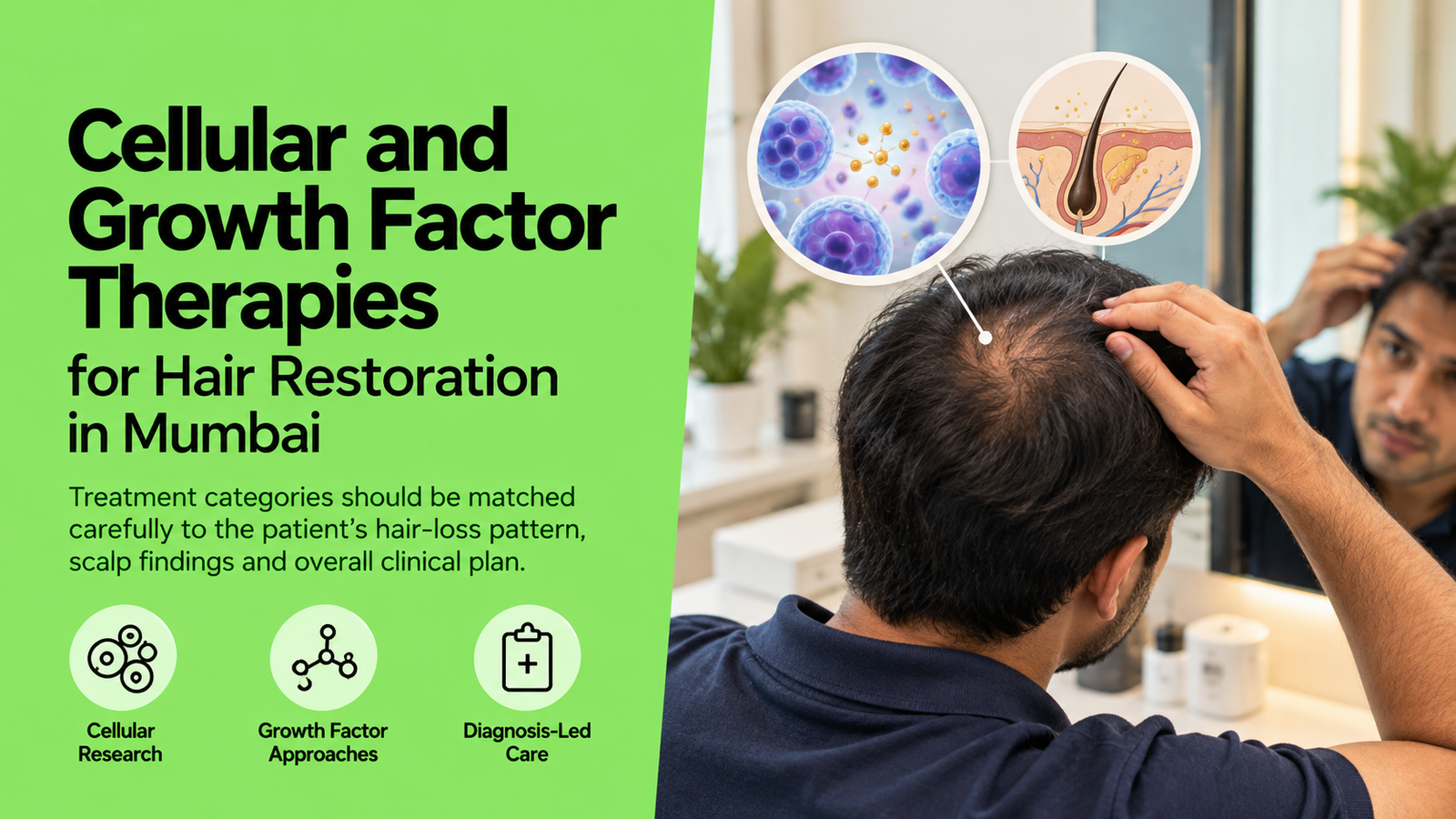
Cellular and Growth Factor Therapies for Hair Restoration in Mumbai
Not all regenerative hair treatments use the same biological material.
Some approaches involve platelet-derived preparations. Others investigate cells, tissue-derived components or extracellular vesicles involved in cell-to-cell communication.
These differences matter because each approach has its own biological rationale, preparation requirements, clinical evidence and potential risks.
Cellular and Growth Factor Therapies is an overview of these treatment categories and how they relate to hair-restoration research.
It should not be interpreted as a claim that every therapy described here is established, approved or offered routinely at Anagen.
What Are Cellular and Growth Factor Therapies?
The category includes several different biological approaches.
Cellular therapies involve living cells or specifically characterised cell populations, depending on the treatment.
Growth-factor preparations contain proteins or other biological mediators involved in cellular signalling.
Some tissue-derived materials contain mixtures of cells and extracellular components.
Extracellular vesicles, including exosomes, are small membrane-bound structures involved in communication between cells. They are not living cells themselves.
A treatment name alone does not establish its precise contents.
Cellular vs Cell-Free Therapies
The distinction between cellular and acellular, or cell-free, approaches is important.
| Category | General Description |
|---|---|
| Cellular therapy | Involves living cells in a defined preparation |
| Growth-factor preparation | Contains biological signalling molecules |
| Extracellular-vesicle preparation | Contains membrane-bound vesicles released from cells |
| Tissue-derived preparation | May contain cellular and extracellular components, depending on processing |
The categories can overlap scientifically, but they should not be used interchangeably in patient communication.
Platelet-Based Therapies
PRP and iPRF use preparations derived from the patient’s blood. Certain GFC systems focus on growth-factor-containing material.
These treatments have their own preparation methods, evidence bases and clinical considerations.
They should not be assumed to contain equivalent concentrations of platelets or growth factors.
Patients unfamiliar with this category can review PRP Hair Treatment before comparing more specialised approaches.
Follicle-Derived Biological Approaches
Hair follicles contain multiple interacting cell populations and surrounding biological structures.
Researchers are investigating whether follicle-derived preparations can influence existing follicular biology.
Anagen’s proposed Follicular Biocell Matrix (FBM) belongs in this discussion only after its actual source and composition are verified.
Autologous Exosome Therapy
Exosomes are extracellular vesicles involved in cell-to-cell signalling.
Research has explored whether certain exosome-containing preparations may affect hair-follicle biology.
However, safety, product identity, manufacturing consistency and clinical efficacy require careful evaluation.
Autologous Exosome Therapy is not automatically equivalent to PRP, GFC or a stem-cell treatment.
Dermal Papilla Cell Research
Dermal papilla cells help regulate follicular activity.
Researchers have investigated their potential use in follicular reconstruction and cell-based therapies.
Maintaining the appropriate biological properties of these cells during laboratory processing remains a significant challenge.
A scientifically interesting cell type is not proof that routine clinical hair multiplication is available.
Autologous Cellular and Fat-Derived Approaches
Some research programmes investigate living cells or tissue-derived products obtained from the patient’s own body.
Possible source categories include follicular tissue and adipose tissue, but specific cell populations and protocols must be confirmed.
Nanofat preparations are not automatically identical to purified stem-cell products or stromal vascular fraction.
How Is the Appropriate Treatment Selected?
A medical diagnosis comes first.
A patient with androgenetic alopecia may have existing miniaturised follicles. Someone with telogen effluvium may need investigation of a triggering illness, deficiency or medication.
Patients with scalp inflammation or scarring alopecia require condition-specific assessment.
A proposed biological therapy is only relevant if there is an appropriate indication, reasonable evidence, an acceptable risk profile and an appropriate regulatory basis.
How Is the Appropriate Treatment Selected?
A medical diagnosis comes first.
A patient with androgenetic alopecia may have existing miniaturised follicles. Someone with telogen effluvium may need investigation of a triggering illness, deficiency or medication.
Patients with scalp inflammation or scarring alopecia require condition-specific assessment.
A proposed biological therapy is only relevant if there is an appropriate indication, reasonable evidence, an acceptable risk profile and an appropriate regulatory basis.
Diagnosis and Scalp Assessment
The clinician examines hair density, pattern of loss and scalp condition.
Review of Established Options
Evidence-supported prescription treatments, monitoring and, when appropriate, surgical restoration should be considered before experimental interventions.
Evaluation of Biological Therapy
The exact product, source, processing, composition, available evidence and regulatory status must be reviewed.
Clinical Follow-Up
Any treatment requires appropriate monitoring, including assessment of benefit and adverse effects.
Are These Treatments Proven?
Evidence differs substantially between treatment categories and even between products within the same category.
PRP has a larger clinical research literature than many newer cellular and extracellular-vesicle approaches.
Certain regenerative methods remain primarily investigational.
A positive result in laboratory experiments, animals or a small human pilot study does not establish routine clinical efficacy.
Are Cellular Therapies the Same as Hair Transplantation?
No.
Hair transplantation physically redistributes intact follicles. Cell-derived or growth-factor treatments have different proposed mechanisms.
A biological preparation should not be presented as an unlimited replacement for donor follicles.
For established bald areas, patients may need a separate hair transplantation assessment.
What About Safety and Regulation?
Safety depends on the exact product and method.
Autologous origin does not automatically make a preparation safe or legally authorised for a particular indication.
Living-cell products, expanded cell cultures and extracellular-vesicle preparations can involve additional manufacturing and regulatory issues.
Cost and Treatment Availability
Prices depend on the verified treatment, source material, preparation, clinical administration and monitoring.
Higher price or greater biological complexity does not mean superior effectiveness.
Anagen-specific service availability and pricing must be confirmed.
Frequently Asked Questions
Are all regenerative hair therapies stem-cell treatments?
No. Many use acellular biological preparations or other materials.
Are growth factors the same as exosomes?
No. Growth factors are signalling molecules; exosomes are membrane-bound extracellular vesicles.
Can these treatments produce new follicles?
That cannot be generally promised. New functional human follicle generation remains a challenging research objective.
Which treatment is most effective?
There is no universal answer. It depends on the diagnosis and evidence for the specific treatment.
Are these therapies approved for routine clinical use?
Regulatory status depends on the exact product, indication and jurisdiction.
Do they replace prescription medication?
Not automatically. Standard diagnosis-specific treatment may still be necessary.
Understand Which Treatment Category Is Relevant
A useful treatment decision begins with identifying the cause of hair loss, not selecting the newest biological-sounding name.
For assessment of hair thinning and discussion of appropriate options, contact Anagen.