





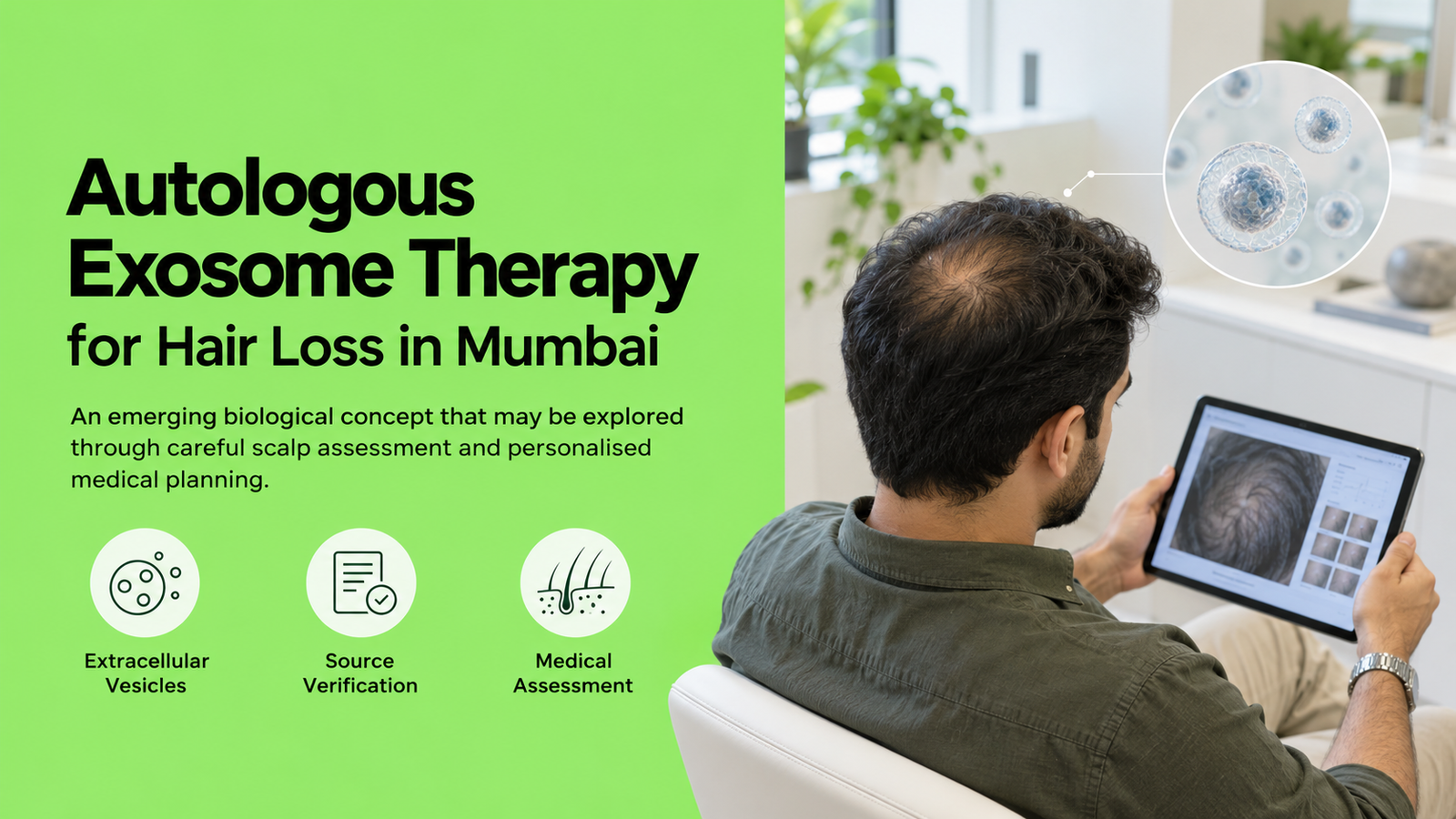
Autologous Exosome Therapy for Hair Loss in Mumbai
Exosomes are small extracellular vesicles involved in communication between cells.
Researchers are investigating whether exosome-containing preparations could influence biological processes relevant to hair-follicle activity.
This has created growing interest in exosome-based hair restoration, but important questions remain about the source, identity, processing, safety and effectiveness of the preparations being studied.
Autologous Exosome Therapy is a particularly specific term. Autologous means the biological material originates from the patient receiving treatment.
It should not be used unless the actual source of the proposed preparation is verified.
What Are Exosomes?
Exosomes are a type of extracellular vesicle produced through cellular processes.
They are surrounded by a lipid membrane and can carry biological cargo such as proteins, lipids and nucleic acids.
They participate in communication between cells, although their specific functions vary according to their cellular origin and biological environment.
Exosomes are not living hair follicles, stem cells or transplanted grafts.
They should not be represented as tiny structures that automatically transform into new hair.
In clinical practice, the term exosome is sometimes used broadly for extracellular-vesicle preparations, even when a product has not been fully characterised as containing specifically isolated exosomes.
That distinction matters.
What Does Autologous Exosome Therapy Mean?
Autologous means patient-derived.
For an exosome-related treatment, this would require identifying the patient’s source material and establishing how an extracellular-vesicle-containing preparation is obtained.
A preparation derived from the patient’s own blood is not automatically a purified or characterised exosome product.
Similarly, a generic growth-factor concentrate cannot simply be relabelled as autologous exosome therapy without confirming its actual components.
The processing method, quality controls, vesicle characterisation and clinical indication must be documented.
Where Do the Exosomes Come From?
Extracellular vesicles can originate from many cell types.
Research has studied vesicles associated with several tissues and cellular sources.
However, the origin of Anagen’s proposed autologous preparation cannot be inferred from general exosome literature.
Before publication or treatment, Anagen must confirm whether the material originates from blood, follicular tissue or another patient-derived source.
The actual preparation must also be distinguished from commercially supplied or donor-derived products, which are not autologous to the recipient.
Why Are Exosomes Being Studied for Hair Loss?
Hair growth depends on interactions between follicular cells and surrounding tissue.
Researchers have investigated whether extracellular vesicles can influence cellular signalling pathways related to follicle biology.
Laboratory and animal studies have reported biological effects of interest.
Small human studies have also investigated selected exosome-related preparations for androgenetic alopecia.
However, variations in product source, preparation, treatment technique and follow-up make direct comparison difficult.
A result obtained with one exosome preparation does not establish that another preparation will produce the same effect.
Does Exosome Therapy Regrow Hair?
Some preliminary studies report improvements in hair-related measures.
That does not mean exosome therapy is a standard, universally effective treatment or that it creates new follicles on completely bald scalp.
There is insufficient evidence to promise permanent restoration, predictable density improvement or superiority over established medical treatment.
Patients should also understand that clinical-trial results and routine commercial treatment are not interchangeable.
Who May Be Suitable?
Suitability depends first on a confirmed diagnosis.
Patients with androgenetic alopecia may be evaluated differently from those experiencing postpartum shedding, inflammatory alopecia or scarring hair loss.
Even if a patient appears suitable from a hair-loss perspective, the exact product must have an appropriate safety and regulatory basis.
A consultation does not automatically establish eligibility for an exosome procedure.
How Is Autologous Exosome Therapy Performed?
Anagen’s exact process is not verified. A technical procedure cannot responsibly be described as though it is established.
Step 1: Hair-Loss Assessment
The clinician establishes the diagnosis and reviews established treatment options.
Step 2: Product and Source Verification
The biological source, autologous status and intended product must be confirmed.
Step 3: Regulatory and Safety Assessment
Appropriate approvals, product quality, characterisation and clinical-use permissions must be verified.
Step 4: Clinical Treatment Planning
Only if the proposed intervention has an appropriate clinical and regulatory basis should an administration plan be established.
Step 5: Informed Consent
The patient should understand investigational status, risks, uncertainties and alternatives.
Step 6: Follow-Up
An appropriately authorised intervention requires monitoring of adverse effects and objective hair outcomes.
Exosome Therapy vs PRP and Growth Factor Therapy
PRP is a platelet-rich plasma preparation.
Growth-factor therapy refers to biological signalling molecules in an identified preparation.
Exosome preparations refer to extracellular vesicles.
These are different concepts, although certain complex biological preparations may contain more than one type of component.
Their potential clinical effects cannot be assumed to be identical.
The separate Growth Factor Therapy page explains that category in more detail.
Is Exosome Therapy the Same as Stem-Cell Therapy?
No.
Exosomes are extracellular vesicles, not living stem cells.
Vesicles obtained from stem-cell cultures also remain different from the living cells that produced them.
The words “stem-cell derived” do not automatically establish clinical efficacy, purity or safety.
Safety and Regulatory Considerations
The safety profile depends on product source, preparation, contamination controls, administration and patient circumstances.
Potential risks can include reactions to the preparation and complications related to the delivery procedure.
Long-term safety information for many hair-loss applications remains limited.
Autologous origin is not, by itself, proof of safety or permission for routine clinical use.
Exosome Hair Therapy Cost in Mumbai
Cost cannot be responsibly stated until Anagen verifies the actual preparation, permitted clinical use, procedure and follow-up.
There is no basis for presenting a high price as evidence of greater biological potency.
Frequently Asked Questions
What are exosomes?
Small membrane-bound extracellular vesicles involved in biological communication.
Are exosomes living stem cells?
No. Exosomes are not living cells.
Where do autologous exosomes come from?
From a patient-derived source, but Anagen’s actual source and processing must be confirmed.
Does exosome therapy create new follicles?
That is not an established clinical outcome for Anagen’s unverified protocol.
Is exosome therapy permanently effective?
Long-term efficacy is not established for all products and indications.
Is exosome therapy an approved routine hair treatment?
The regulatory status must be established for the exact product and its intended use in India.
Is it better than PRP?
There is insufficient evidence to establish universal superiority.
Discuss Evidence-Based Hair-Loss Options
Exosome research is developing, but patients should understand the exact product, evidence and clinical status before considering any intervention.
For assessment of hair thinning and established treatment alternatives, contact Anagen.