





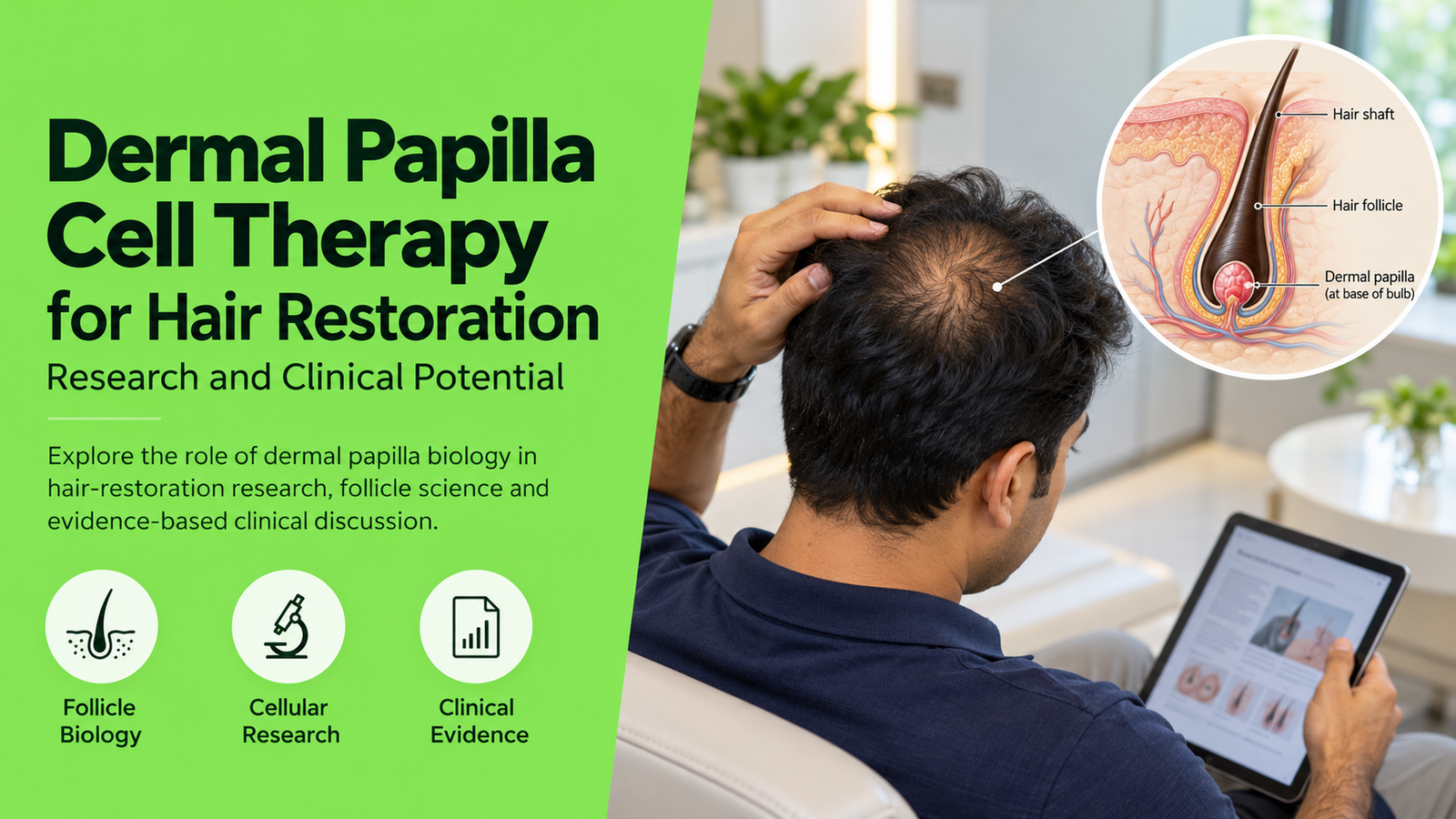
Dermal Papilla Cell Therapy for Hair Restoration – Research and Clinical Potential
At the base of each growing hair follicle is a specialised structure called the dermal papilla.
Its cells participate in communication with other follicular cells and help regulate hair growth.
Because of this role, dermal papilla cells have become an important focus of research into follicular regeneration and future cell-based treatments.
However, studying these cells is not the same as having a routine, proven treatment that creates unlimited new hair follicles.
Dermal Papilla Cell Therapy must be described according to the actual clinical and research status of the proposed approach.
What Are Dermal Papilla Cells?
Dermal papilla cells are specialised cells located within the dermal papilla at the base of the hair follicle.
They interact with nearby epithelial cells and help regulate follicular development, growth and cycling.
These cells are therefore important for understanding why follicles grow, rest and change over time.
However, a dermal papilla cell does not function independently as a complete hair follicle.
Hair-follicle formation requires coordinated interactions among multiple cellular populations and surrounding tissues.
Why Are Dermal Papilla Cells Studied?
Researchers are interested in the signals exchanged between dermal papilla cells and neighbouring follicular structures.
Understanding these interactions may help develop new approaches to maintaining follicular activity or eventually reconstructing hair follicles.
Laboratory studies have demonstrated important biological properties of these cells.
However, maintaining their hair-inducing characteristics outside the body is difficult.
Cell processing and culture can change their behaviour, which presents a major obstacle for translating experiments into reliable human treatment.
Can Dermal Papilla Cells Create New Hair Follicles?
This is a major objective of hair-regeneration research.
Experimental systems have explored ways of combining dermal papilla cells with other cell populations and supporting structures.
Some laboratory and animal studies are encouraging.
However, routinely creating fully functioning, naturally cycling human follicles with predictable density, direction and long-term survival remains a scientific challenge.
How Would a Dermal Papilla Cell-Based Approach Be Evaluated?
The following is a clinical and research assessment framework, not an Anagen treatment SOP.
Step 1: Diagnosis
Confirm the type and stage of hair loss.
Step 2: Evaluate Established Alternatives
Consider relevant prescription treatment and conventional surgical options.
Step 3: Identify the Proposed Cellular Material
Confirm that the intended preparation genuinely contains characterised dermal papilla cells.
Step 4: Review Processing and Regulatory Status
Determine whether cells are isolated, cultured, expanded or otherwise manipulated, and whether the proposed clinical use is appropriately authorised.
Step 5: Assess Evidence and Safety
Review suitable human clinical evidence, potential risks and alternatives.
Step 6: Plan Appropriate Clinical Monitoring
Any properly authorised clinical investigation needs defined outcome measures, adverse-event monitoring and informed consent.
How Does This Differ from FBM?
FBM requires verification of its biological source and components.
Dermal Papilla Cell Therapy specifically concerns dermal papilla cells.
How Does It Differ from Hair Transplantation?
A transplant relocates intact follicles.
Dermal papilla cell research investigates the potential use of specialised cells, but does not automatically supply complete new follicles for transplantation.
For established bald areas, conventional hair transplantation remains a separate treatment category.
What Are the Limitations and Risks?
The principal uncertainties concern cellular identity, stability, biological function, manufacturing, safety and efficacy.
Potential risks depend on cell collection, processing and administration.
Cell-based procedures may also have regulatory requirements that differ substantially from those of ordinary scalp injections.
Autologous origin alone does not remove these concerns.
Cost and Treatment Availability
tbd
Frequently Asked Questions
What are dermal papilla cells?
Specialised cells at the base of follicles involved in hair-growth signalling.
Is Dermal Papilla Cell Therapy hair cloning?
Research into cell-based follicle reconstruction exists, but the terms should not be treated as evidence that routine hair cloning is available.
Can the cells produce unlimited new follicles?
That has not been established for a routine Anagen treatment.
Is this a proven clinical therapy?
The exact protocol, human evidence and regulatory position must be verified.
Is it the same as FBM?
Only if the verified FBM preparation actually involves the relevant dermal papilla cells.
Can it replace a hair transplant?
No such general replacement claim is justified.
Explore Established and Emerging Hair-Restoration Options
Patients interested in dermal papilla research should receive a clear explanation of the difference between laboratory developments and clinically available treatment.
For assessment and treatment planning, contact Anagen.