





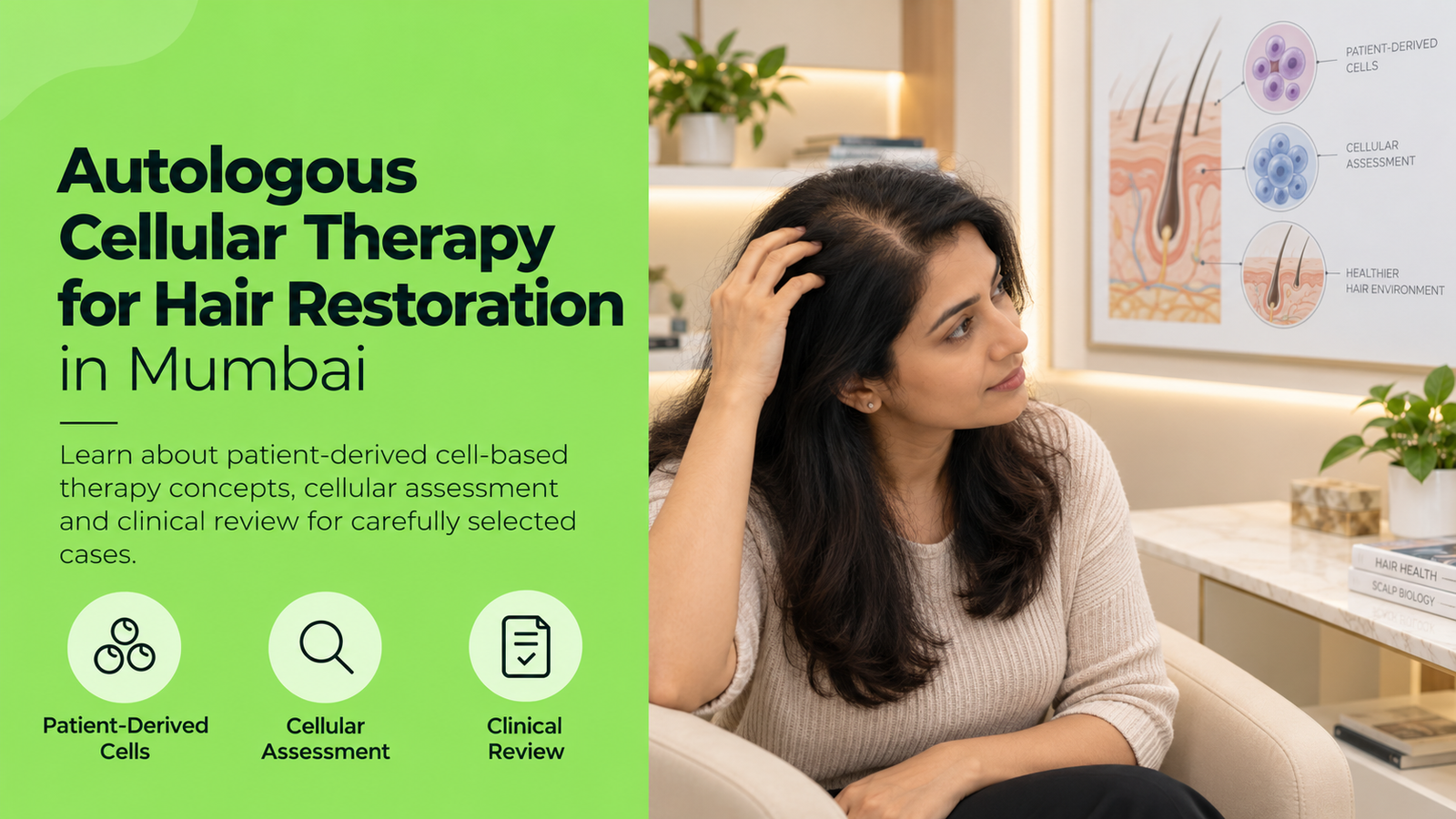
Autologous Cellular Therapy for Hair Restoration in Mumbai
Autologous cellular therapy is a broad term describing treatment approaches that use cells obtained from the person receiving treatment.
The word “autologous” identifies the source relationship. The word “cellular” indicates that living cells form part of the intended preparation.
Together, these words do not define one standard treatment, cell type or clinical procedure.
In hair-restoration research, investigators are exploring how specialised cells and follicle-associated tissues might influence existing follicles or contribute to future regenerative approaches.
However, the scientific and regulatory status of a particular cell-based intervention depends on what cells are used and how they are obtained, processed and administered.
What Is Autologous Cellular Therapy?
Autologous cellular therapy involves the patient’s own cells being used in a defined clinical or research intervention.
Different approaches may use different cell populations.
These cell populations can vary considerably in biological function.
A preparation consisting of processed follicular tissue is not automatically equivalent to isolated and characterised living cells.
Likewise, an acellular preparation containing proteins or extracellular vesicles is not the same as a treatment involving living cells.
The exact cellular identity must be established before a treatment can be described responsibly.
Why Does the Cell Source Matter?
Cells from different tissues have different characteristics.
Their biological function depends on cell type, surrounding environment and processing.
Cells associated with hair follicles participate in follicle structure and signalling, while adipose tissue contains other biological populations.
These differences matter when interpreting research findings.
A positive result involving one cell type cannot automatically be applied to a product prepared from another tissue.
How Is Autologous Cellular Therapy Different from PRP?
PRP is commonly an autologous blood-derived platelet preparation.
Autologous cellular therapy is a broader category that requires identification of the actual living-cell population.
Although PRP contains blood-derived biological components, it should not automatically be treated as equivalent to a specifically defined cell-based regenerative product.
The two approaches have different preparation, evidence and potentially regulatory considerations.
How Does Cellular Therapy Differ from Exosome Therapy?
Cells are living biological units.
Exosomes are extracellular vesicles released through cellular processes and are not living cells.
An extracellular-vesicle preparation should not be described as transplanting living stem cells.
Similarly, a defined living-cell product should not be relabelled as exosome therapy.
Where Could Autologous Cells Originate?
Possible cellular research approaches have involved follicular or other patient-derived tissues.
However, no particular source should be attributed to Anagen without verification.
Before treatment, patients should be told which cells are involved, whether tissue collection is necessary, how the preparation is processed and whether the cells have been cultured or expanded.
The distinction between minimally handled tissue and extensively manipulated cell products is important for safety and regulation.
How Is Autologous Cellular Therapy Performed?
There is no universal procedure because cellular products differ.
A responsible clinical pathway should address the following steps.
Step 1: Diagnosis of Hair Loss
The clinician assesses the patient’s scalp, pattern of thinning and possible underlying disorders.
Step 2: Evaluation of Established Treatment Options
Appropriate prescription therapy, scalp-disease management, monitoring and transplantation are considered according to the diagnosis.
Step 3: Cellular Source Verification
The actual tissue or cell population and its autologous origin are confirmed.
Step 4: Collection and Processing Review
Collection methods, manipulation, cell identity, handling and appropriate quality controls are established.
Step 5: Regulatory and Safety Review
The proposed clinical use must have an appropriate legal, ethical and safety basis.
Step 6: Administration Planning
The treatment method can be defined only after the cellular product and indication have been verified.
Step 7: Follow-Up and Monitoring
If performed under an appropriate clinical framework, the intervention requires adverse-event monitoring and objective outcome assessment.
Is Autologous Cellular Therapy Stem-Cell Therapy?
Not necessarily.
The presence of living cells does not mean that they are stem cells.
Stem-cell terminology must be supported by the actual cellular identity, processing and relevant scientific characterisation.
A preparation should not be marketed as stem-cell therapy merely because the material was obtained from hair follicles or fat tissue.
Can Cellular Therapy Create New Hair Follicles?
Functional human follicle generation remains a major research objective.
It requires coordination of several specialised cell populations and appropriate tissue architecture.
The existence of stem cells, dermal papilla cells or other follicular cells does not mean that injecting them will reliably create complete new follicles.
No guarantee of hair multiplication, unlimited donor supply or permanent reversal of advanced baldness should be made.
Who May Be Suitable?
Clinical eligibility depends on the actual cell preparation, treatment indication, safety information and regulatory status.
A diagnosis must come first.
Patients with pattern thinning may have different needs from those with telogen effluvium, scarring alopecia or inflammatory scalp conditions.
The availability of a sophisticated cell-based technology does not make it appropriate for every patient.
Safety and Regulatory Considerations
Potential risks can arise from tissue collection, biological processing, contamination, immune or inflammatory reactions and the administration procedure.
Different types of cell manipulation may trigger different regulatory requirements.
Autologous origin is not a substitute for quality control or medical approval.
The long-term safety of investigational preparations may also remain uncertain.
Autologous Cellular Therapy vs FBM and Dermal Papilla Cell Therapy
Autologous Cellular Therapy is a broad category.
FBM is an Anagen-specific name requiring precise biological definition.
Dermal Papilla Cell Therapy concerns a particular specialised follicular cell population.
Does Cellular Therapy Replace Hair Transplantation?
Not automatically.
Hair transplantation surgically relocates intact follicles from an available donor area.
Cell-based research seeks other biological approaches, but complete functional hair-follicle production remains a scientific challenge.
Patients with established bald regions may still need conventional surgical assessment if suitable.
Recovery, Maintenance and Cost
Recovery depends on the source collection method, cellular preparation and administration technique.
There is no single session schedule or standardised aftercare routine that applies across all autologous cellular treatments.
Cost may be influenced by tissue collection, processing, laboratory requirements, clinical administration and long-term monitoring.
Frequently Asked Questions
What does autologous cellular therapy mean?
A therapy involving cells obtained from the same patient who receives them.
Which cells are used?
That depends on the verified protocol. The cell type must be specifically identified.
Is autologous cellular therapy always stem-cell therapy?
No. Living cells and stem cells are not interchangeable terms.
Are autologous cells automatically safe?
No. Collection, processing and administration can still carry risks.
Can the treatment create new hair follicles?
That is not an established general clinical outcome.
Is it the same as exosome therapy?
No. Exosomes are extracellular vesicles, not living cells.
Can it replace hair transplantation?
There is no general basis for claiming it can replace conventional follicle transfer.
Understand the Evidence Before Choosing Cellular Therapy
Autologous cellular research offers scientific possibilities, but treatment decisions require a precise understanding of the actual cells, safety, evidence and regulatory status.
Patients should receive a diagnosis-led plan that includes established alternatives.
For scalp and hair-loss assessment, contact Anagen Hair Transplant Clinic.