





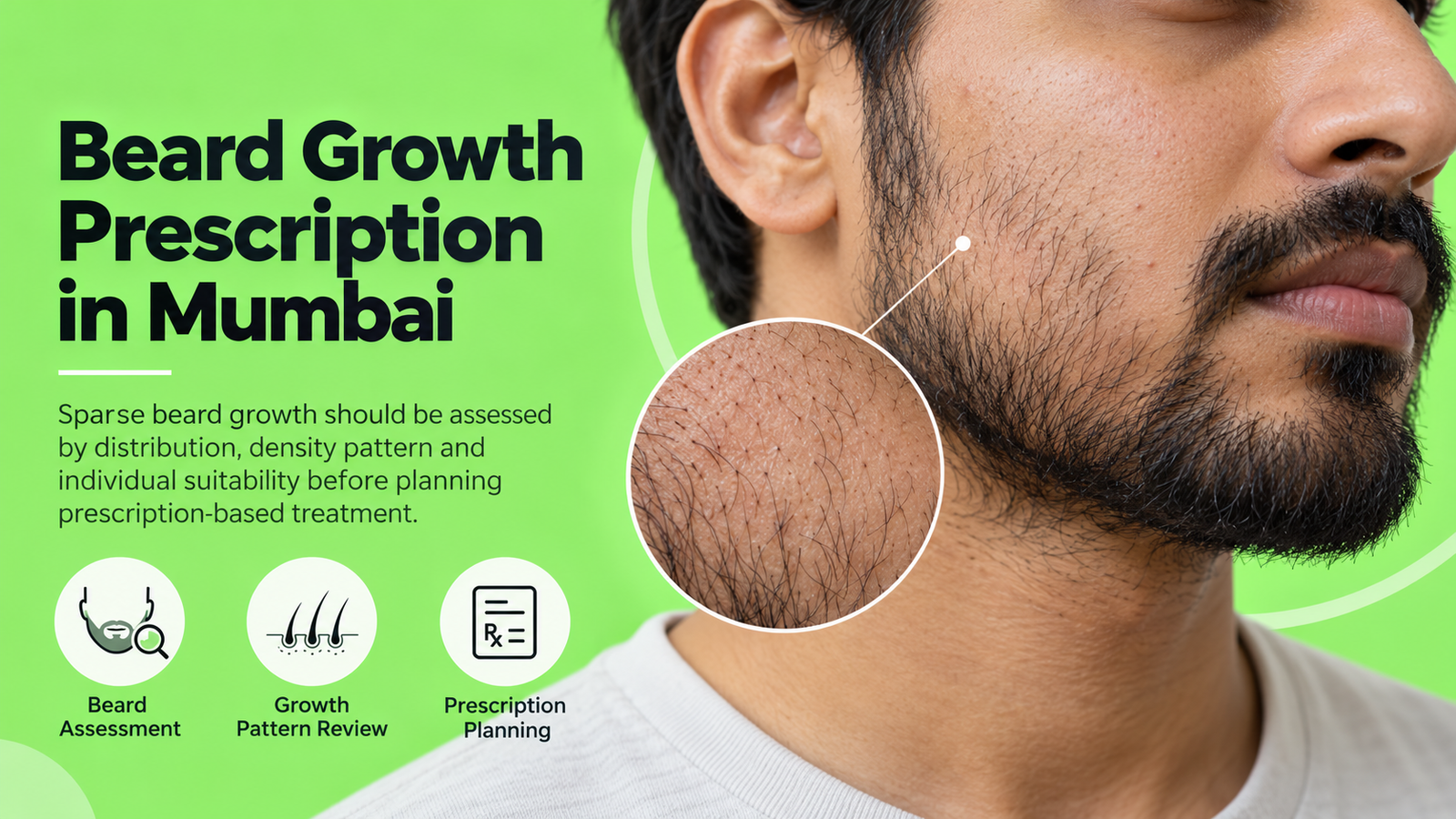
Beard Growth Prescription in Mumbai
A sparse, patchy or uneven beard may result from genetics, age-related development, reduced hair density or certain medical conditions.
At Anagen Hair Transplant Clinic, Mumbai, a doctor-guided Beard Growth Prescription begins with assessing the underlying cause and the condition of existing facial-hair follicles.
Depending on the diagnosis, medically supervised treatment may be considered to support beard growth where appropriate. However, not every sparse beard requires medication, and treatment cannot reliably create new follicles in areas where they are absent.
A clinical assessment helps determine whether prescription management, observation or another restoration approach is suitable.
Understanding Sparse or Patchy Beard Growth
A beard may develop unevenly, remain naturally sparse or gradually lose density. Some men have lighter hair coverage over the cheeks despite satisfactory growth around the chin and jawline. Others notice isolated patches, reduced thickness or new areas of beard loss after previously having normal growth.
A Beard Growth Prescription focuses on understanding the cause of reduced facial-hair growth and determining whether medically supervised treatment may be appropriate.
Not every sparse beard requires medication. Beard density depends on genetics, age, follicular distribution and individual responses to hormones. Some men naturally develop limited facial hair without having any medical disorder.
Where existing follicles are present and a treatable condition is identified, prescription management may help selected patients. However, medication cannot reliably create new follicles in skin where follicles are genuinely absent.
The appropriate first step is diagnosis, not automatically starting a beard-growth product.
What Should Be Diagnosed Before Starting a Beard Growth Prescription?
An assessment should distinguish a naturally sparse beard from acquired facial-hair loss.
1. Natural Genetic Beard Pattern
Beard density varies considerably between individuals. Some men develop a dense beard across the cheeks, while others predominantly develop hair along the moustache, chin and jawline.
A lifelong sparse beard without progressive hair loss, inflammation or other symptoms may simply represent a normal inherited pattern.
This does not automatically indicate hormonal deficiency or disease.
2. Age and Beard Maturation
Beard development can continue beyond adolescence and into early adulthood. The rate and extent of development vary.
A younger patient with incomplete facial-hair development may benefit from observation rather than immediate medical or surgical treatment.
Age alone does not determine whether treatment is appropriate.
3. Alopecia Areata of the Beard
Alopecia areata can cause sudden, localized hair loss within the beard.
Patients may notice one or more smooth, round or irregular areas where previously present facial hair has disappeared.
This differs from a beard that has always been sparse.
A dermatologist may consider disease-specific medical treatment after confirming the diagnosis.
4. Inflammatory Skin Conditions
Dermatitis, follicular inflammation, certain infections and other skin disorders may interfere with the normal condition of facial hair.
Redness, scaling, itching, tenderness, pustules or other changes around the beard may require dermatological assessment.
Treating the underlying skin condition takes priority over attempting cosmetic density enhancement.
5. Scarring or Previous Injury
Burns, trauma, surgery and certain inflammatory conditions can damage facial-hair follicles.
Mature scar tissue may have limited potential for medication-induced regrowth.
The extent of follicular damage and condition of the skin influence treatment planning.
6. Medical, Nutritional or Hormonal Factors
Systemic conditions may occasionally contribute to changes in hair growth.
Hormonal assessment is appropriate when there are relevant clinical findings, such as abnormal sexual development, symptoms suggesting an endocrine disorder or other associated medical concerns.
A sparse beard alone is not sufficient evidence of low testosterone.
Nutritional testing should similarly be based on history, examination and suspected deficiency rather than performed routinely for every patient.
How Doctors Assess Beard Follicles
The possibility of medical treatment depends partly on the underlying condition and whether functional hair follicles remain.
A clinical beard assessment may include:
- Reviewing when the beard concern first appeared and whether it has progressed.
- Comparing hair distribution across the cheeks, sideburns, jawline and chin.
- Looking for fine hairs, established terminal hairs and completely hairless regions.
- Examining the skin for redness, scaling, inflammation or scar formation.
- Assessing for alopecia areata or other dermatological conditions.
- Reviewing medications, relevant illnesses and previous facial procedures.
- Considering additional investigations only when clinically indicated.
Close examination or dermoscopy may help identify follicular openings, hair-shaft variations and signs of inflammatory or scarring disease.
However, the visual appearance of a hairless area alone does not reliably establish whether follicles are absent.
Prescription Overview
Concern: Sparse beard, patchy growth, low facial-hair density or acquired beard thinning.
Assessment Required: History of beard development, regional density examination, skin evaluation, follicular assessment and identification of medical causes when suspected.
Possible Prescription Categories: Clinician-selected topical therapy for suitable cases, disease-specific dermatological treatment and management of an identified underlying medical condition.
Supportive Care: Gentle facial cleansing, management of irritation, appropriate skin moisturization and avoidance of unnecessary irritating products.
Monitoring: Changes in beard distribution, hair caliber where assessable, skin tolerance, disease activity and any treatment-related adverse effects.
Follow-Up: Individualized according to diagnosis, prescribed treatment and clinical response.
When Further Treatment May Be Considered: Persistent structural gaps, established scar-associated loss or stable areas with insufficient follicles after appropriate medical assessment.
Important: This page provides general prescription information and does not replace an individual clinical assessment. Prescription medicines, where indicated, should be selected according to the patient’s medical history, diagnosis and examination.
What Prescription Treatments May Be Considered for Beard Growth?
There is no single beard-growth prescription that is appropriate for every man.
A treatment plan depends on the diagnosis, the condition of the skin and follicles, medical history and expected benefit.
1. Topical Hair-Growth Treatment
Selected topical medicines may be discussed when there is a reasonable medical basis for attempting to improve hair growth.
Minoxidil is one medicine that has been investigated for facial-hair growth. However, beard use is generally off-label, and evidence does not establish a predictable response in all patients.
Possible concerns include irritation, unwanted hair growth outside the intended area and other adverse effects depending on the formulation and exposure.
The exact product, concentration, application method, frequency and duration require medical assessment.
Patients should not transfer a scalp hair-growth regimen directly to their beard.
2. Treatment for Alopecia Areata
If localized beard loss is caused by alopecia areata, treatment focuses on the autoimmune condition rather than general beard thickening.
A dermatologist may consider anti-inflammatory or immune-modulating treatment according to the diagnosis, disease extent and patient circumstances.
Some localized cases may be observed, while others require prescription treatment or clinician-administered procedures.
Response and recurrence remain variable.
3. Treatment of Underlying Skin Disease
Where facial-hair thinning is associated with dermatitis, infection or another inflammatory skin condition, the underlying disorder should be treated appropriately.
Growth-promoting products are not a substitute for controlling active disease.
4. Treatment of Confirmed Medical Deficiency
If an assessment identifies a relevant nutritional or medical disorder, correcting it may form part of the management plan.
Routine supplements are not a substitute for a diagnosis, and taking excessive supplements does not reliably improve normal genetic beard density.
5. Hormonal Treatment Only When Medically Indicated
Beard development is influenced by androgen activity and follicular sensitivity, but sparse facial hair does not automatically indicate testosterone deficiency.
Hormone therapy should only be considered for a diagnosed endocrine disorder under appropriate medical supervision.
It should not be promoted as a routine cosmetic beard-growth prescription.
How Is a Beard Growth Prescription Used?
Any prescribed medicine should be used according to the individual clinician’s instructions.
The correct regimen depends on the treatment selected, skin sensitivity, relevant medical conditions and other medicines being used.
During treatment, patients should understand:
- Which area is intended to receive treatment.
- How the prescribed product is to be used.
- Which adverse effects require stopping treatment and medical review.
- Whether other skincare products or grooming practices should be adjusted.
- When the next clinical review is recommended.
- What level of improvement would be meaningful and realistic.
Increasing the amount of medication or combining several products without medical approval does not guarantee better growth and may increase risk.
Existing Beard Follicles vs Completely Hairless Areas
This distinction is central to prescription-based beard management.
Where fine or reduced-caliber hairs remain, certain medically appropriate treatments may have a biological target, depending on the diagnosis.
Where hair has been lost because of a treatable inflammatory or autoimmune condition, regrowth may be possible if the follicles remain capable of producing hair.
In contrast, areas with true follicular destruction, established scarring or congenital lack of follicles may respond poorly to growth-promoting medication.
A longstanding hairless area is not proof of follicular absence. Clinical assessment is needed before reaching that conclusion.
What Improvement Can Be Expected From Beard Prescription Treatment?
The potential response depends on why beard growth is limited.
For a patient with an inflammatory or autoimmune cause of beard loss, improvement may depend on controlling the underlying condition.
For naturally sparse facial hair, the benefit of a growth-promoting medicine is less predictable and may be limited.
For patients with mature scar tissue or genuine absence of follicles, medication alone may not achieve the desired coverage.
Hair growth is gradual. Visible assessment may require repeated review over time, but no fixed response timeline applies to every treatment.
Any benefit maintained by ongoing medication may change when therapy is stopped. The clinician should explain treatment-specific expectations before prescribing.
Prescription treatment should not be represented as guaranteeing a complete beard, uniform density or permanent improvement.
When May a Beard Transplant Be More Appropriate?
Prescription management and beard transplantation work through different mechanisms.
Prescription treatment attempts to manage a medical condition or support hair growth from existing functional follicles where appropriate.
A beard transplant transfers suitable donor follicles into selected facial regions.
Transplantation may be considered for appropriately selected adults with stable structural deficiency, established scars or persistent gaps that are unlikely to respond sufficiently to medical treatment.
The surgical options address different situations:
Patchy Beard Correction discusses targeted restoration of localized beard gaps.
Beard Density Enhancement focuses on improving coverage within an established beard pattern.
Full Beard Hair Transplant addresses more extensive facial-hair restoration where suitable.
Beard Scar Repair discusses surgical options for selected stable scar-associated defects.
These procedures are not substitutes for diagnosing active medical hair loss. Disease activity, donor suitability and realistic expectations must be assessed first.
Monitoring, Follow-Up and Maintenance
Beard prescription treatment requires evaluation rather than indefinite unsupervised use.
At follow-up, the clinician may review:
- Whether the original diagnosis remains appropriate.
- Whether acquired patches are expanding, stable or improving.
- Changes in hair density and caliber where assessment is reliable.
- Skin irritation or adverse reactions.
- Treatment adherence and tolerability.
- Whether continued treatment, adjustment or discontinuation is appropriate.
Standardized clinical photographs may be useful when taken with consent under consistent lighting, beard length and camera positioning.
For patients with ongoing dermatological disease, maintenance may require continued control of that condition. For naturally sparse beards, observation or acceptance of the normal pattern may be more appropriate than medical intervention.
Frequently Asked Questions About Beard Growth Prescriptions
1. Can prescription treatment make my beard thicker?
Some treatments may help selected patients depending on the underlying cause and existing follicle function. However, naturally sparse beard patterns do not respond predictably, and improvement is not guaranteed.
2. Can medicine grow a beard where no follicles exist?
Medication cannot reliably generate new follicles in skin with genuine congenital follicular absence or irreversible follicular destruction. Whether follicles are present must be assessed clinically.
3. Does a patchy beard mean low testosterone?
No. Patchy beard development commonly reflects genetic and developmental variation. Acquired patches can also result from dermatological conditions such as alopecia areata. Hormonal testing is considered when other findings suggest an endocrine disorder.
4. Is minoxidil suitable for beard growth?
Minoxidil has been studied for facial-hair growth, but beard use is generally off-label. It is not suitable for automatic or unsupervised use, and the evidence does not support guaranteed results.
5. How long does beard prescription treatment take?
There is no universal timeline. It depends on the diagnosis, treatment and individual response. Follow-up is necessary to determine whether treatment is useful and tolerable.
6. Will my beard stay thicker after stopping treatment?
That depends on the medicine and underlying cause. Benefits requiring continued treatment may diminish after discontinuation. Disease-related regrowth and recurrence patterns vary.
7. When should I consider beard transplantation?
A surgical assessment may be reasonable for stable gaps, scar-associated loss or persistent low-density areas that are unlikely to improve adequately with appropriate medical management, provided the patient is suitable.
Beard Growth Prescription Consultation at Anagen, Mumbai
The first decision is whether reduced beard growth represents a normal inherited pattern, incomplete development, a treatable medical condition or a structural absence of functional follicles.
A clinical examination can help determine whether observation, prescription treatment, management of an underlying skin disorder or consultation for beard transplantation is appropriate.
Arrange a Hair Prescription Consultation
A doctor-led assessment can help establish a suitable management pathway without assuming that every sparse beard requires medication or surgery.