





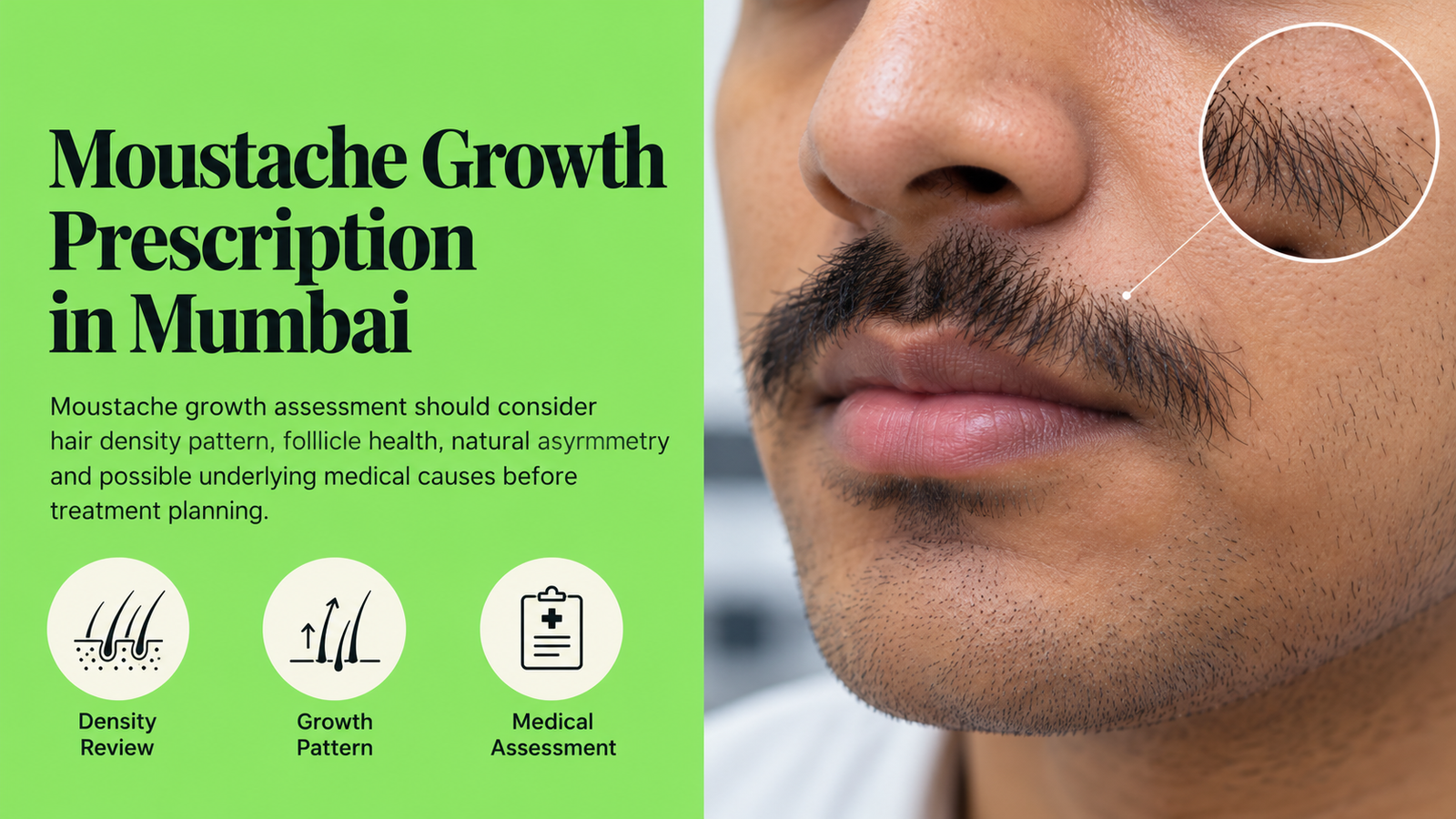
Moustache Growth Prescription in Mumbai
A thin, sparse, patchy or uneven moustache may develop naturally due to genetics and individual facial-hair patterns, or it may result from acquired hair loss, skin conditions or scarring.
At Anagen Hair Transplant Clinic, Mumbai, a Moustache Growth Prescription begins with examining upper-lip hair distribution, existing follicles and possible medical causes.
Where suitable functional follicles remain, selected prescription treatments may be considered under medical supervision. However, medicines cannot reliably restore hair in areas with permanent follicular loss.
A doctor-guided assessment helps determine whether observation, prescription management or moustache restoration should be considered.
Understanding Sparse, Patchy or Uneven Moustache Growth
Moustache density varies naturally. Some men develop a well-defined moustache during adolescence, while others develop finer, lighter or less extensive growth that continues to change during early adulthood.
A moustache may also appear uneven because the hair distribution differs between the right and left sides or because the central and lateral regions develop at different rates.
In other patients, previously established moustache hair may become sparse due to alopecia areata, inflammation, injury, scarring or another medical condition.
A Moustache Growth Prescription focuses on identifying the reason for limited or reduced moustache growth and determining whether supervised medical treatment may be appropriate.
The important question is not simply which medicine can make a moustache thicker.
It is whether functional follicles are present, whether the pattern is naturally occurring or acquired, and whether an underlying condition requires treatment.
Medication cannot reliably create new follicles in skin where functional follicles are genuinely absent.
Why Does Moustache Growth Vary Between Individuals?
A limited or uneven moustache is not automatically a medical problem.
Several factors influence its development and appearance.
1. Genetic Moustache Pattern
Genetics influences the number and distribution of moustache follicles, hair-shaft characteristics and individual follicular response to hormones.
Some men naturally have lighter moustache growth despite having satisfactory beard development elsewhere.
Others develop more hair centrally, while the lateral portions remain relatively sparse.
These variations can occur without any underlying disease.
2. Age and Facial-Hair Maturation
Facial-hair development does not occur at exactly the same rate in every individual.
Moustache density may continue changing as facial hair matures. In younger adults, a relatively sparse moustache may represent a developmental pattern rather than disease.
Clinical evaluation helps determine whether observation is more appropriate than treatment.
3. Natural Asymmetry
One side of the moustache may have slightly fewer hairs or a different growth direction.
Small asymmetries are common and do not necessarily require correction.
Concern becomes more clinically significant when asymmetry is new, progressive or accompanied by other changes in the skin or hair.
4. Alopecia Areata Affecting the Moustache
Alopecia areata can produce localized hair loss in facial-hair regions, including the moustache.
The patient may notice a new smooth area where established hair was previously present.
An acquired patch warrants assessment because treating an autoimmune disorder differs from attempting to improve a genetically sparse moustache.
5. Inflammation or Skin Disease
Dermatitis, follicular inflammation, certain infections and other skin conditions may affect moustache hair or the surrounding skin.
Symptoms such as scaling, redness, irritation, pustules or discomfort require evaluation.
Introducing an irritating growth product before diagnosing the skin condition may aggravate symptoms.
6. Previous Injury or Scarring
Accidents, surgery, burns, inflammatory conditions and other forms of trauma may produce localized moustache-hair loss.
Established scar tissue may have reduced or absent functional follicles, limiting the potential benefit of prescription growth treatment.
7. Medical or Endocrine Factors
A medical cause may be considered when moustache changes occur alongside other relevant symptoms.
However, isolated naturally sparse moustache growth does not establish a hormonal disorder.
Laboratory tests and specialist evaluation should be based on clinical findings rather than performed routinely for every patient.
How Doctors Assess Reduced Moustache Growth
A medical assessment should establish whether moustache growth has always been limited or whether established hairs have subsequently been lost.
This difference often determines the next stage of investigation.
A consultation may consider:
- The age at which moustache growth first developed.
- Whether density has remained stable or recently changed.
- Family patterns of facial-hair growth.
- Differences between central and lateral moustache regions.
- The presence of fine or short hairs within sparse areas.
- Localized patches of recent hair loss.
- Previous injuries, burns, surgery or scarring.
- Itching, redness, scaling or other skin symptoms.
- Associated beard, scalp or eyebrow changes.
- Relevant medical history and medication exposure.
Close inspection or dermoscopy may be used to examine existing hairs, follicular openings and abnormalities of the surrounding skin.
A smooth-looking hairless area does not necessarily confirm the absence of follicles. Additional assessment may be required.
Prescription Overview
Concern: Naturally sparse moustache, reduced upper-lip hair density, asymmetrical moustache growth, acquired patchiness or scar-associated loss.
Assessment Required: Facial-hair development history, examination of upper-lip hair distribution, evaluation of existing follicles and identification of dermatological or medical causes when indicated.
Possible Prescription Categories: Selected clinician-supervised topical treatment where appropriate, disease-specific dermatological treatment and management of confirmed underlying medical conditions.
Supportive Care: Gentle upper-lip skin care, treatment of irritation and avoidance of unnecessary aggressive grooming or unverified products.
Monitoring: Hair distribution, progression of acquired patches, skin condition, treatment tolerability and response to medical management.
Follow-Up: Individualized according to the diagnosis, medication prescribed and clinical course.
When Further Treatment May Be Considered: Stable structural gaps, scar-related hair loss or inadequate follicular coverage where medical management is unlikely to provide meaningful improvement.
Important: This page provides general prescription information and does not replace an individual clinical assessment. Prescription medicines, where indicated, should be selected according to the patient’s medical history, diagnosis and examination.
What Prescription Treatment May Be Considered for Moustache Growth?
There is no universal prescription that reliably produces a thicker or more symmetrical moustache.
The treatment decision depends on the underlying cause and the presence of functional follicles.
1. Clinician-Supervised Topical Treatment
In selected patients, a doctor may discuss whether a topical hair-growth treatment has an appropriate biological rationale.
Minoxidil has been studied for facial-hair growth, but evidence specific to the moustache is limited. Facial application is generally off-label and should not be treated as a standard approved indication.
The potential benefit, formulation, skin tolerance and risk of adverse effects require medical review.
No specific medicine, concentration, frequency or treatment duration should be selected solely from an online article.
2. Treatment of Moustache Alopecia Areata
If acquired moustache patches are caused by alopecia areata, a dermatologist may consider appropriate disease-directed therapy.
The objective is to manage the autoimmune process affecting hair follicles.
Depending on disease characteristics, management may involve observation, selected prescription treatment or clinician-administered procedures.
Response cannot be guaranteed, and the condition may recur.
3. Management of Skin Inflammation
When hair reduction is associated with inflammatory disease, dermatitis or infection, treating the underlying condition takes priority.
The clinician should determine whether the skin changes are reversible and whether inflammation has affected the follicles.
Applying multiple cosmetic hair-growth preparations to inflamed skin may worsen irritation without addressing the primary problem.
4. Treatment of Confirmed Medical Conditions
If relevant examination findings suggest nutritional, endocrine or another systemic disorder, diagnosis-specific treatment may be considered.
A naturally sparse moustache without other symptoms is not sufficient reason to begin hormonal treatment or routine supplementation.
5. Observation and Supportive Care
Some men with normal but limited moustache growth may not need prescription therapy.
Where the moustache is still developing or the pattern represents normal genetic variation, observation and reassurance may be clinically appropriate.
Avoiding unnecessary medication is part of responsible prescription management.
How Is a Moustache Growth Prescription Used?
A prescription should be used only according to the instructions supplied by the treating clinician.
The exact regimen depends on the diagnosis, treatment selected, condition of the upper-lip skin, relevant medical history and potential adverse effects.
Because the moustache lies close to the nose and mouth, the suitability and safe use of topical products require careful consideration.
Patients should understand which treatment area is intended, how to avoid unintended exposure and which symptoms require medical review.
Combining multiple hair-growth products without approval does not reliably increase efficacy and may increase irritation or other risks.
Patients should also inform the clinician about other topical medicines and skin products being used in the same region.
Can Existing Moustache Follicles Respond to Prescription Treatment?
The presence and condition of follicles influence the potential response to medical treatment.
Where fine hairs are visible, functional follicles may still be producing hair. Whether treatment can improve hair caliber or density depends on the biological cause and the evidence for the selected therapy.
Where hair has been lost due to a reversible medical or inflammatory condition, regrowth may be possible if follicles remain capable of functioning.
Where follicular structures have been destroyed by scarring, medication is much less likely to restore hair.
Areas that have been hairless throughout development may have limited potential for meaningful medication-induced growth, particularly if suitable follicles are lacking.
However, apparent absence of visible hairs is not itself proof of follicular absence.
What Improvement Can Be Expected From Moustache Prescription Treatment?
Treatment response is determined by the cause of reduced moustache density.
Where the problem is associated with a treatable dermatological condition, appropriate medical management may permit some recovery of hair growth.
Where the moustache is naturally sparse, growth-promoting therapy may offer limited or uncertain benefit.
Where there is established scarring or true absence of functional follicles, meaningful regrowth may not be achievable using medication alone.
Even when treatment is appropriate, individual response varies and there is no fixed timeline for developing a fuller moustache.
Any ongoing benefit from a medicine may depend on continued treatment. Patients should discuss stopping or changing medication with the prescribing clinician.
No prescription should be described as providing a guaranteed full moustache, perfect symmetry or permanent density.
When Is Moustache Transplantation More Appropriate Than Prescription Treatment?
Prescription management attempts to treat an identified condition or support existing follicles.
Moustache transplantation physically relocates donor follicles to selected areas of the upper lip.
A transplant assessment may be appropriate when:
- The moustache has stable structural gaps with inadequate follicular coverage.
- A mature scar has caused localized follicular loss.
- One lateral moustache region has longstanding limited coverage.
- Medical treatment is unlikely to address the desired structural change.
- The patient has realistic expectations and is medically suitable for surgery.
Transplantation involves decisions about donor hair suitability, hair direction, exit angle, recipient-site design and achievable density.
It is not a substitute for treating active alopecia areata or uncontrolled inflammatory disease.
For patients considering procedural restoration, the relevant Anagen pages are:
Moustache Hair Transplant — a dedicated explanation of surgical moustache restoration.
Moustache Density Enhancement — options for selected stable low-density regions.
Moustache Scar Repair — surgical considerations for suitable stable scar-associated deficiencies.
These surgical pages address follicle relocation and procedural planning, while the Moustache Growth Prescription page focuses on medical evaluation and non-surgical management.
Monitoring and Follow-Up After Moustache Prescription Treatment
A follow-up examination determines whether the selected treatment remains appropriate.
The doctor may evaluate:
- Changes in central and lateral moustache density.
- Whether previously acquired patches are progressing or stabilizing.
- Skin irritation, scaling or inflammatory symptoms.
- Treatment adherence and adverse effects.
- Whether an underlying dermatological condition remains active.
- Whether continued medication is justified.
- Whether a different management pathway requires consideration.
Standardized clinical photographs, when used with consent, may help evaluate changes in coverage.
Photographs should be taken under comparable lighting, camera angle, hair length and grooming conditions.
Differences in trimming or moustache styling can create the appearance of density changes even when actual follicular coverage has not changed.
Moustache Maintenance and Supportive Care
Maintenance depends on the original diagnosis.
For inflammatory or autoimmune disease, continued clinical monitoring may be necessary even after improvement.
For a genetically sparse moustache, no medicine may be required, and normal grooming may be sufficient.
Patients should generally avoid aggressive manipulation of fragile hairs, harsh chemical products and repeated application of irritant preparations to the upper-lip skin.
Supportive care is useful for skin health, but it does not replace disease-specific treatment or create follicles in areas of permanent loss.
Frequently Asked Questions About Moustache Growth Prescriptions
1. Why is my moustache naturally sparse?
Natural moustache density depends on genetics, follicular distribution, age and individual hormonal sensitivity. A sparse moustache does not necessarily indicate a medical condition.
2. Can prescription medicine make my moustache thicker?
Selected medical treatment may help some patients depending on the underlying cause and existing follicle activity. Evidence for general moustache enhancement remains limited, and results are not guaranteed.
3. Can medicine fill a completely hairless moustache area?
Not reliably if functional follicles are genuinely absent or permanently destroyed. Clinical examination is needed to establish why the area has little or no visible hair.
4. Why does one side of my moustache grow more than the other?
Mild asymmetry can be a normal genetic feature. New or progressive asymmetry may result from localized hair loss, skin disease, injury or scarring and should be assessed.
5. Does a thin moustache mean low testosterone?
Not necessarily. Moustache growth is influenced by several factors. Isolated low density is insufficient to diagnose testosterone deficiency or justify hormone treatment.
6. Is minoxidil suitable for moustache growth?
Minoxidil has been studied for facial-hair growth, but evidence specifically for moustache enhancement is limited and facial use is generally off-label. It should only be considered after medical review.
[MEDICAL REVIEW REQUIRED — CONFIRM INDICATION / OFF-LABEL STATUS BEFORE PUBLICATION.]
7. When should I consider a moustache transplant?
A transplant evaluation may be appropriate for stable structural gaps, scar-associated hair loss or longstanding low-density regions unlikely to improve adequately through medical management.
Moustache Growth Prescription Consultation at Anagen, Mumbai
Reduced moustache growth may reflect a normal developmental pattern, natural asymmetry, a treatable dermatological condition or structural absence of functional follicles.
A medical assessment can help distinguish these situations and determine whether observation, prescription treatment, management of an underlying disorder or surgical restoration is appropriate.
Arrange a Hair Prescription Consultation
Understand whether medical treatment has a reasonable role before beginning facial-hair products or considering a surgical procedure.