





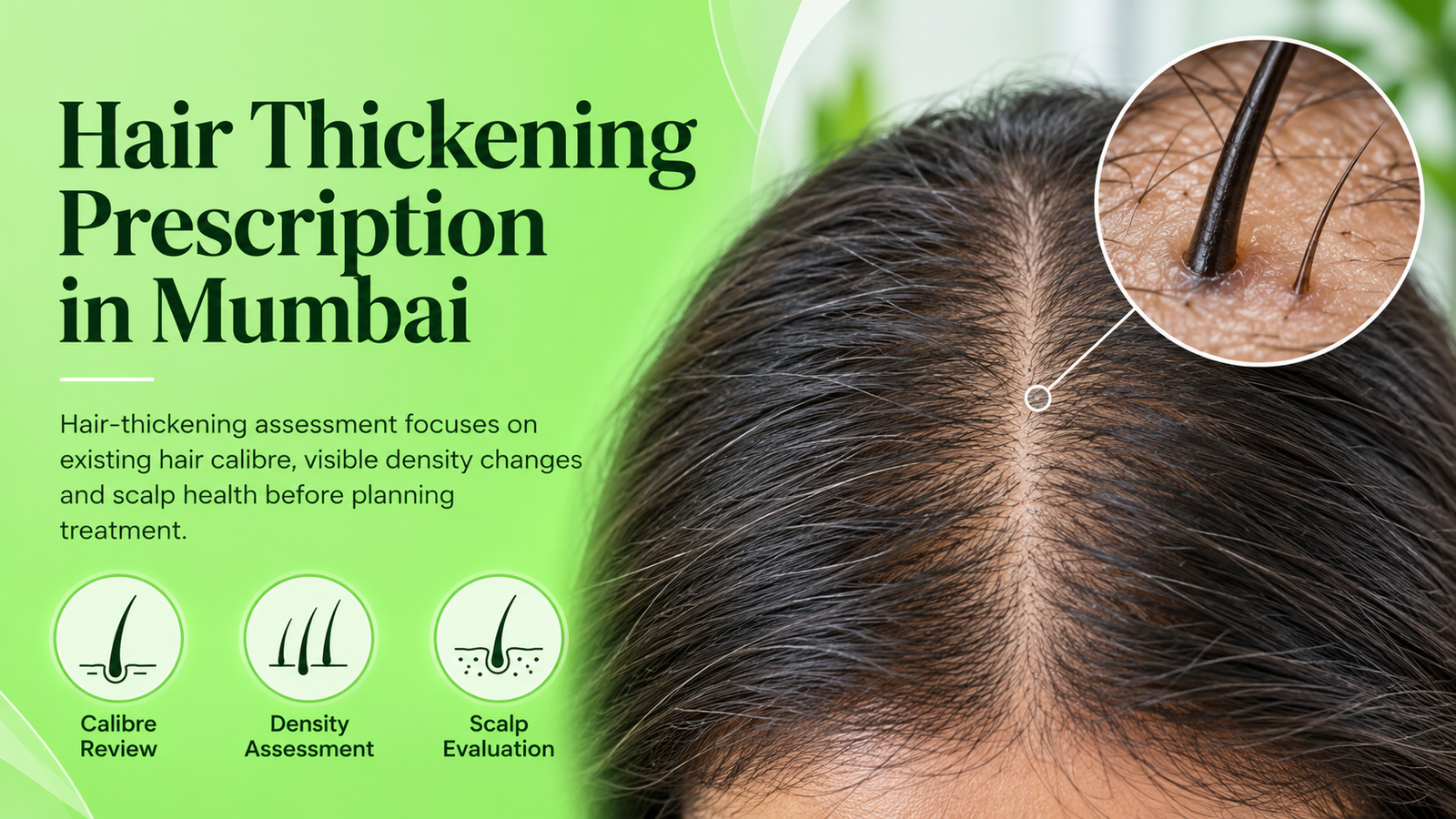
Hair Thickening Prescription in Mumbai
Hair may remain present across the scalp while gradually becoming finer, weaker-looking or less capable of providing the same visual coverage. Patients often notice a widening hair parting, reduced ponytail volume, increased scalp visibility or thinner hair around the frontal and crown regions.
A Hair Thickening Prescription focuses on assessing the condition of existing follicles and determining whether medically supervised treatment may help improve hair-shaft caliber, preserve density or limit further thinning.
At Anagen Hair Transplant Clinic, Mumbai, the prescription approach begins with identifying whether thinning is caused by follicular miniaturisation, increased shedding, hair-shaft breakage or another underlying condition.
These problems may look similar but require different management strategies.
Medical treatment may benefit some patients with functioning follicles. However, improving the thickness of existing hair is not the same as creating additional follicles, and prescription treatment cannot guarantee restoration of a patient’s original hair density.
Understanding Hair Thickening Prescription and Reduced Hair Density
Hair may remain present across the scalp while gradually becoming finer, weaker-looking or less capable of providing the same visual coverage. Patients often notice a widening hair parting, reduced ponytail volume, increased scalp visibility or thinner hair around the frontal and crown regions.
A Hair Thickening Prescription focuses on assessing the condition of existing follicles and determining whether medically supervised treatment may help improve hair-shaft caliber, preserve density or limit further thinning.
At Anagen Hair Transplant Clinic, Mumbai, the prescription approach begins with identifying whether thinning is caused by follicular miniaturisation, increased shedding, hair-shaft breakage or another underlying condition.
These problems may look similar but require different management strategies.
Medical treatment may benefit some patients with functioning follicles. However, improving the thickness of existing hair is not the same as creating additional follicles, and prescription treatment cannot guarantee restoration of a patient’s original hair density.
What Is the Difference Between Hair Thickness and Hair Density?
Hair thickness and hair density are related but distinct concepts.
Hair-shaft thickness refers to the diameter of an individual hair fiber. Thicker terminal hairs generally provide greater visual coverage than very fine hairs.
Hair density refers to the number of hairs within a measured scalp area. It can be affected by follicle distribution, the number of hairs emerging from follicular units and the proportion of follicles actively producing visible hair.
Visual density describes how full the hair appears. It depends on shaft diameter, hair count, color contrast, curl, length and styling.
A person with fine hairs may experience greater scalp visibility without having a completely bald area.
Treatment may improve visual coverage when existing follicles produce healthier or thicker hair shafts, but this does not necessarily mean the follicle count has increased.
What Causes Hair to Become Finer?
A prescription should not be selected until the clinician understands why visible hair thickness has changed.
1. Follicular Miniaturisation
In pattern hair loss, susceptible follicles progressively produce thinner and shorter hairs.
This process may cause increasing scalp visibility even while some hairs remain present.
Miniaturisation is an important clinical finding in androgenetic alopecia, but reduced hair caliber alone is not sufficient to establish the complete diagnosis.
2. Increased Hair Shedding
After illness, major physiological stress or certain other triggers, excessive shedding may temporarily reduce visible hair density.
In these cases, the primary issue may be a change in the number of hairs actively present rather than progressive thinning of every hair shaft.
3. Hair-Shaft Breakage
Frequent bleaching, chemical processing, excessive heat styling and mechanical traction may cause hair fibers to break.
A patient may describe this as thinning or poor hair growth even though the underlying follicle is still producing hair.
Prescription hair-growth medicine may not be the most appropriate solution to hair-shaft damage.
4. Nutritional or Medical Factors
Certain medical conditions and confirmed nutritional deficiencies can affect hair quality or growth.
Testing is guided by symptoms, diet, history and examination rather than routinely prescribing supplements to every patient.
5. Inflammatory or Scarring Scalp Disease
Inflammation may disrupt normal hair production. Some scarring disorders can irreversibly damage follicles.
Signs such as persistent redness, pain, scaling, pustules or loss of follicular openings require clinical evaluation.
How Doctors Assess Hair Thickening Potential
A medical assessment may include examination of hair caliber, scalp coverage and the distribution of affected hairs.
The clinician may consider:
- Whether thinning is generalized or concentrated in specific scalp regions.
- Changes in parting width or crown visibility.
- Hair-shaft diameter variation under magnification.
- Evidence of follicular miniaturisation.
- Recent excessive shedding.
- Hair breakage or damage from cosmetic practices.
- Skin inflammation or scarring.
- Family history and relevant medical factors.
- Previous treatment response.
Trichoscopy may help distinguish different patterns of hair caliber and follicular changes.
Standardized photographs can provide useful follow-up information, although differences in hairstyle, hair length and lighting must be considered.
Prescription Overview
Primary Concern: Existing scalp hair becoming finer, reduced visual density, follicular miniaturisation or persistent low hair volume.
Assessment Required: Hair-caliber examination, scalp-density assessment, diagnosis of underlying thinning and identification of breakage or excessive shedding.
Prescription Goal: Preserve existing follicles, support medically appropriate improvement in hair caliber and reduce further thinning where possible.
Possible Prescription Categories: Diagnosis-specific topical or oral treatment, management of underlying conditions and correction of confirmed deficiencies.
Supportive Care: Gentle hair handling, reduction of heat or chemical damage, suitable scalp care and appropriate nutritional support.
Monitoring: Hair-shaft caliber, visible parting width, density, ongoing shedding and treatment tolerability.
Follow-Up: Individualized according to diagnosis and response.
When Another Treatment May Be Considered: Progression despite appropriate management, inadequate follicular coverage or stable structural loss for which surgical restoration is clinically suitable.
Important: This page provides general prescription information and does not replace an individual clinical assessment. The medicine, dose, frequency and duration, where required, should be selected according to the diagnosis, medical history and clinical findings.
What Prescription Treatments May Improve Hair Thickness?
Medical treatment focuses on the cause of thinning rather than simply coating the hair shaft with a cosmetic product.
1. Topical Growth-Supporting Medicines
In certain forms of pattern hair loss, topical minoxidil may help maintain hair and improve growth from existing follicles.
A change in hair caliber or coverage may occur in some patients, but the response is variable.
The medication is not a universal treatment for all forms of fine or damaged hair.
2. Selected Oral Prescription Medicines
Where pattern hair loss or another medically treatable cause is diagnosed, oral medicines may be considered for suitable patients.
The prescribing decision may depend on sex-specific factors, pregnancy potential, cardiovascular health, other medications and relevant contraindications.
3. Managing an Identified Medical Condition
Where hair thinning is associated with a medical disorder, treating that condition may help support recovery.
A hair-thickening prescription should not replace necessary disease-specific treatment.
4. Correcting Confirmed Nutritional Deficiency
Appropriate nutritional correction may be included when a relevant deficiency is identified.
Unnecessary supplements do not reliably restore miniaturised follicles or reverse genetic hair loss.
5. Managing Hair-Shaft Damage
When a patient’s main problem is shaft breakage, adjustments to hair care and cosmetic practices may be more useful than growth-promoting medication.
Conditioners and other suitable hair-care products can improve manageability and the appearance of hair fibers, but they do not medically reverse follicular miniaturisation.
How Is Hair Thickening Monitored?
Treatment should be judged through changes that can be assessed reliably.
Useful measurements or observations may include:
- Variation in hair-shaft diameter.
- Changes in miniaturised hair proportions where measurable.
- Parting width under consistent conditions.
- Scalp visibility in established reference areas.
- Standardized photographs.
- Changes in shedding and hair breakage.
- Adverse effects and treatment adherence.
Cosmetic products may temporarily make hair feel thicker without changing follicular biology.
Hair Thickening vs Hair Growth vs Hair Transplantation
Hair thickening focuses on the caliber and coverage of existing hair.
Hair-growth management addresses broader follicular activity and long-term growth support after a diagnosis has been established.
Hair transplantation physically redistributes donor follicles to areas where adequate structural coverage is lacking.
These approaches are not interchangeable.
For a patient with many miniaturised but functioning follicles, prescription treatment may be clinically relevant.
For a patient with insufficient hair in an established bald region, medication may have a limited role in achieving the desired structural coverage.
For selected patients, PRP Hair Treatment or Advanced GFC Hair Treatment may also be discussed as separate procedural options, with uncertain and variable additional benefit.
They should not automatically be added to every prescription.
Realistic Results and Maintenance
A hair-thickening prescription may help selected patients maintain or improve coverage, particularly when follicles remain functional and the underlying condition is medically treatable.
Response may be limited in advanced miniaturisation or irreversible follicular loss.
Visible improvement can take time, and some conditions require ongoing treatment to maintain the achieved benefit.
Stopping an effective treatment for progressive pattern hair loss may allow thinning to continue.
Hair-shaft caliber, hair count and cosmetic appearance should be evaluated separately whenever possible.
Frequently Asked Questions
1. Can thin hair become thicker again?
Some patients may achieve improved hair caliber or visible density when follicles remain functional and the diagnosis is responsive to medical treatment. Complete restoration is not guaranteed.
2. What is follicular miniaturisation?
Miniaturisation is a process in which affected follicles progressively produce smaller, finer and often shorter hair shafts. It commonly occurs in pattern hair loss.
3. Does thicker-looking hair mean more follicles?
No. A thicker appearance may result from increased shaft diameter, reduced shedding or cosmetic factors without an increase in follicle number.
4. Can shampoo permanently thicken hair?
Some shampoos can improve the temporary appearance and feel of hair. They do not reliably reverse follicular miniaturisation or permanently increase follicle number.
5. How long does a hair-thickening prescription take?
Response varies according to diagnosis and treatment. Clinical reassessment over months may be necessary to determine whether meaningful changes are occurring.
6. Will I need maintenance treatment?
Some progressive conditions require ongoing treatment to preserve the benefit. Other causes may be temporary or reversible.
7. Is hair transplantation better than a thickening prescription?
Neither is universally better. They address different problems. Prescription treatment may support existing follicles, while transplantation relocates donor follicles where structural coverage is inadequate.
Hair Thickening Prescription Consultation at Anagen, Mumbai
Fine, miniaturised and visibly thinning hair should be assessed before choosing medication or procedural treatment.
A clinical evaluation can help determine whether the concern is follicular miniaturisation, increased shedding, hair-shaft damage or another condition requiring specific management.
Arrange a Hair Prescription Consultation
Understand the potential for preserving or improving existing hair coverage and whether further treatment is appropriate.