





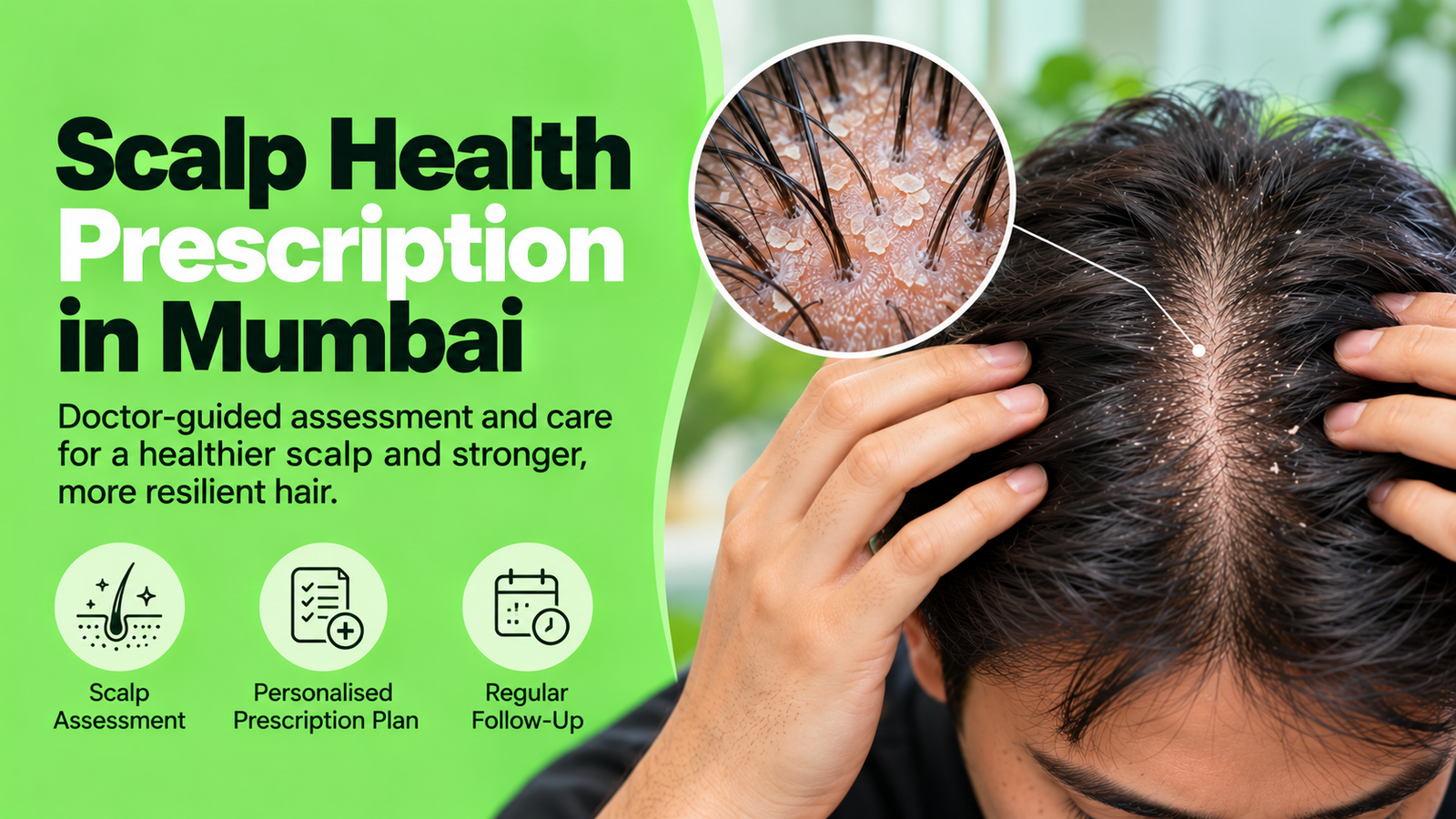
Scalp Health Prescription in Mumbai
An itchy, flaky, oily, irritated or uncomfortable scalp may affect daily comfort and make routine hair maintenance difficult. Some patients experience occasional dandruff, while others develop recurring redness, scaling, tenderness or reactions to hair products.
A Scalp Health Prescription focuses on identifying the cause of scalp symptoms and choosing medically appropriate treatment when required.
At Anagen Hair Transplant Clinic, Mumbai, scalp assessment involves examining the skin, hair follicles, symptom history and relevant factors such as cleansing practices, cosmetic products and previous treatment.
Not every flaky scalp has the same diagnosis. Dandruff, seborrheic dermatitis, eczema, psoriasis, contact reactions and infections can produce overlapping symptoms.
A prescription should therefore be directed at the diagnosed condition rather than treating every patient with the same medicated shampoo or scalp product.
The goal is to improve scalp comfort, control relevant inflammation or infection, maintain the skin barrier and support a sustainable scalp-care routine.
Understanding Scalp Health and Prescription-Based Scalp Care
An itchy, flaky, oily, irritated or uncomfortable scalp may affect daily comfort and make routine hair maintenance difficult. Some patients experience occasional dandruff, while others develop recurring redness, scaling, tenderness or reactions to hair products.
A Scalp Health Prescription focuses on identifying the cause of scalp symptoms and choosing medically appropriate treatment when required.
At Anagen Hair Transplant Clinic, Mumbai, scalp assessment involves examining the skin, hair follicles, symptom history and relevant factors such as cleansing practices, cosmetic products and previous treatment.
Not every flaky scalp has the same diagnosis. Dandruff, seborrheic dermatitis, eczema, psoriasis, contact reactions and infections can produce overlapping symptoms.
A prescription should therefore be directed at the diagnosed condition rather than treating every patient with the same medicated shampoo or scalp product.
The goal is to improve scalp comfort, control relevant inflammation or infection, maintain the skin barrier and support a sustainable scalp-care routine.
What Scalp Symptoms Should Be Assessed?
The type, location and duration of symptoms help guide treatment.
1. Flaking and Dandruff
Small visible flakes may occur with dandruff or other scalp conditions.
Dandruff is not necessarily caused by poor hygiene, and persistent flaking may require clinical assessment to establish the correct diagnosis.
2. Excess Scalp Oiliness
Sebum is a normal component of scalp biology.
Increased oiliness may accompany certain scalp conditions, but an oily scalp is not automatically unhealthy or infected.
Management should consider whether oiliness occurs with itching, scaling, inflammation or product buildup.
3. Itching and Irritation
Scalp itching may result from dermatitis, contact reactions, excessive dryness, infection or other conditions.
The clinician should determine whether symptoms are persistent, localized or related to recent product exposure.
4. Redness and Inflammation
Redness, tenderness and scaling may indicate inflammatory disease.
The appearance and distribution of inflammation can help differentiate potential diagnoses.
5. Reactions to Hair Products
Hair dyes, fragrances, styling products, shampoos and other preparations may cause irritant or allergic contact dermatitis in susceptible patients.
The diagnosis may require a detailed product history and, in selected cases, further dermatological evaluation.
6. Recurrent Scalp Discomfort
Repeated episodes of flaking or inflammation may require a maintenance approach rather than repeated unsupervised short-term treatment.
The correct long-term strategy depends on the condition involved.
Which Conditions May Cause Scalp Symptoms?
Dandruff
Dandruff commonly produces visible flakes and may be associated with itching.
It can often be managed with an appropriate scalp-care approach, but persistent or severe symptoms require reassessment.
For more detailed information, see Dandruff Treatment.
Seborrheic Dermatitis
Seborrheic dermatitis is an inflammatory condition commonly associated with flaking, redness and greasy scaling in areas rich in sebaceous glands.
It may recur and require ongoing maintenance.
The dedicated Seborrheic Dermatitis Management page explains the condition and its specific treatment considerations.
Contact Dermatitis
Contact dermatitis may occur when the scalp reacts to an irritant or allergen in a hair or skin product.
Symptoms may involve itching, burning, redness, scaling or discomfort.
Identifying and avoiding the responsible exposure is an important part of management.
Psoriasis and Other Inflammatory Disorders
Scalp psoriasis and certain other inflammatory diseases can produce persistent scaling and irritation.
Different conditions may require different prescription medicines.
Scalp Infection
Fungal or bacterial infections may cause inflammation, scaling, pustules or localized hair loss.
Some infections require systemic treatment. They should not be managed using cosmetic cleansing alone.
Scarring Alopecia
Some inflammatory disorders progressively damage hair follicles and cause irreversible loss.
Persistent pain, burning, pustules, scarring or disappearance of follicular openings may require prompt specialist assessment.
What May Be Included in a Scalp Health Prescription?
Treatment categories are selected according to the underlying condition.
1. Medicated Scalp Cleansing
Medicated shampoos may be appropriate for some conditions involving dandruff or seborrheic dermatitis.
Ketoconazole is an antifungal medicine used in some scalp conditions. Other products contain different active ingredients and have different clinical roles.
Selection and instructions depend on the diagnosis, formulation, age and skin tolerance.
Medicated shampoos should not be treated as interchangeable products suitable for every scalp complaint.
2. Anti-Inflammatory Scalp Treatment
Selected topical anti-inflammatory medicines may be used for diagnosed inflammatory conditions.
The appropriate agent and duration depend on the condition and potential adverse effects.
Unsupervised repeated use of topical corticosteroids is not appropriate because incorrect or prolonged use can cause problems.
3. Treatment of Confirmed Infection
Fungal or bacterial scalp infections require diagnosis-specific care.
Treatment may involve topical or systemic medication depending on the organism, location and severity.
A routine cosmetic shampoo cannot substitute for necessary medical treatment of a significant infection.
4. Scalp-Barrier Support
The scalp barrier may be affected by inflammation, over-cleansing, harsh products or contact reactions.
The management plan may include adjusting cleansing practices and avoiding suspected irritants or allergens.
Suitable supportive products may improve comfort but do not replace prescription treatment when a medical disorder is present.
5. Long-Term Control of Recurrent Conditions
Certain disorders, particularly seborrheic dermatitis, may recur even after symptoms improve.
A doctor may recommend a maintenance strategy based on the patient’s recurrence pattern and treatment response.
The exact medicine and schedule should be individualized.
How Should a Scalp Prescription Be Used?
A scalp prescription should specify the intended treatment area, medicine or product, correct method of application and relevant precautions.
Medicated shampoos and topical scalp preparations do not all follow the same instructions.
Patients should understand whether a prescribed product is meant for intermittent use, treatment of an active episode or ongoing maintenance.
Using several strong medicated products simultaneously without medical advice may increase irritation.
If treatment causes marked burning, swelling, rash or worsening symptoms, medical reassessment may be required.
Scalp Health and Hair Growth
Scalp disease and hair loss may occur together, but the relationship depends on the condition.
Some inflammatory diseases may contribute to temporary shedding or damage to follicles. Scarring disorders can cause permanent hair loss if inflammation destroys follicular structures.
However, a mildly oily or flaky scalp does not automatically explain genetic pattern hair loss.
Treating dandruff does not necessarily reverse androgenetic alopecia, and scalp cleansing should not be promoted as a way to create new follicles.
If significant hair shedding is also present, the broader Hair Fall Control Prescription pathway may be appropriate.
Scalp Maintenance and Prevention of Recurrence
Ongoing scalp care depends on the specific diagnosis.
Some patients need only adjustments to their cleansing routine and avoidance of irritating products.
Others may require recurring medical treatment for diagnosed inflammatory conditions.
A maintenance review may assess:
- How frequently symptoms recur.
- Whether scalp redness and flaking are controlled.
- Which medicines or products are well tolerated.
- Whether a triggering cosmetic product has been identified.
- Whether there are new signs of infection or hair loss.
- Whether treatment should be continued, modified or discontinued.
For routine buildup or cosmetic cleansing concerns, patients may review Scalp Detox Therapy. This is a separate supportive-care service and is not a substitute for treating scalp infections, psoriasis or inflammatory disease.
When Is Specialist Scalp Evaluation Necessary?
Medical reassessment is particularly important for persistent, worsening or unusual symptoms.
Signs warranting timely review include:
- Significant redness or swelling.
- Persistent pain or tenderness.
- Pustules, discharge or crusting.
- Localized patchy hair loss.
- Loss of follicular openings or suspected scarring.
- Extensive scaling not responding to appropriate initial care.
- A suspected allergic reaction to a product or medicine.
Persistent inflammatory conditions should not be repeatedly treated with different products without confirming the diagnosis.
For detailed condition-specific care, patients may also review Scalp Inflammation Treatment.
Frequently Asked Questions
1. Why is my scalp constantly itchy?
Scalp itching can occur with dermatitis, irritation, allergies, infection or other conditions. Persistent symptoms require assessment of the underlying cause.
2. Is dandruff the same as seborrheic dermatitis?
They are related but not identical clinical descriptions. Seborrheic dermatitis can involve more obvious inflammation, redness and recurrent scaling.
3. Can an unhealthy scalp cause hair fall?
Some inflammatory or infectious scalp conditions can affect hair growth or cause shedding. However, not all scalp symptoms are responsible for hair loss.
4. Do I need a medicated shampoo?
Only when appropriate for the condition. Different scalp problems require different treatments, and not every patient needs a medicated shampoo.
5. Can I use hair-growth medicine when my scalp is irritated?
The prescriber should review significant scalp irritation before continuing or introducing potentially irritating topical hair-growth products.
6. Can scalp symptoms return after treatment?
Yes. Some scalp disorders have a recurrent course and may require maintenance management.
7. Does scalp detox treatment cure dandruff?
Cosmetic cleansing does not replace diagnosis-specific medical treatment for dandruff, seborrheic dermatitis or other scalp disorders.
Scalp Health Prescription Consultation at Anagen, Mumbai
Scalp itching, flaking, redness and discomfort can arise from different medical and environmental causes.
A clinical assessment can help determine whether prescription medicine, changes in scalp-care practices, treatment of an underlying disorder or further dermatological evaluation is appropriate.
Arrange a Hair Prescription Consultation
Understand the cause of your scalp concern and discuss a suitable medical management plan.