





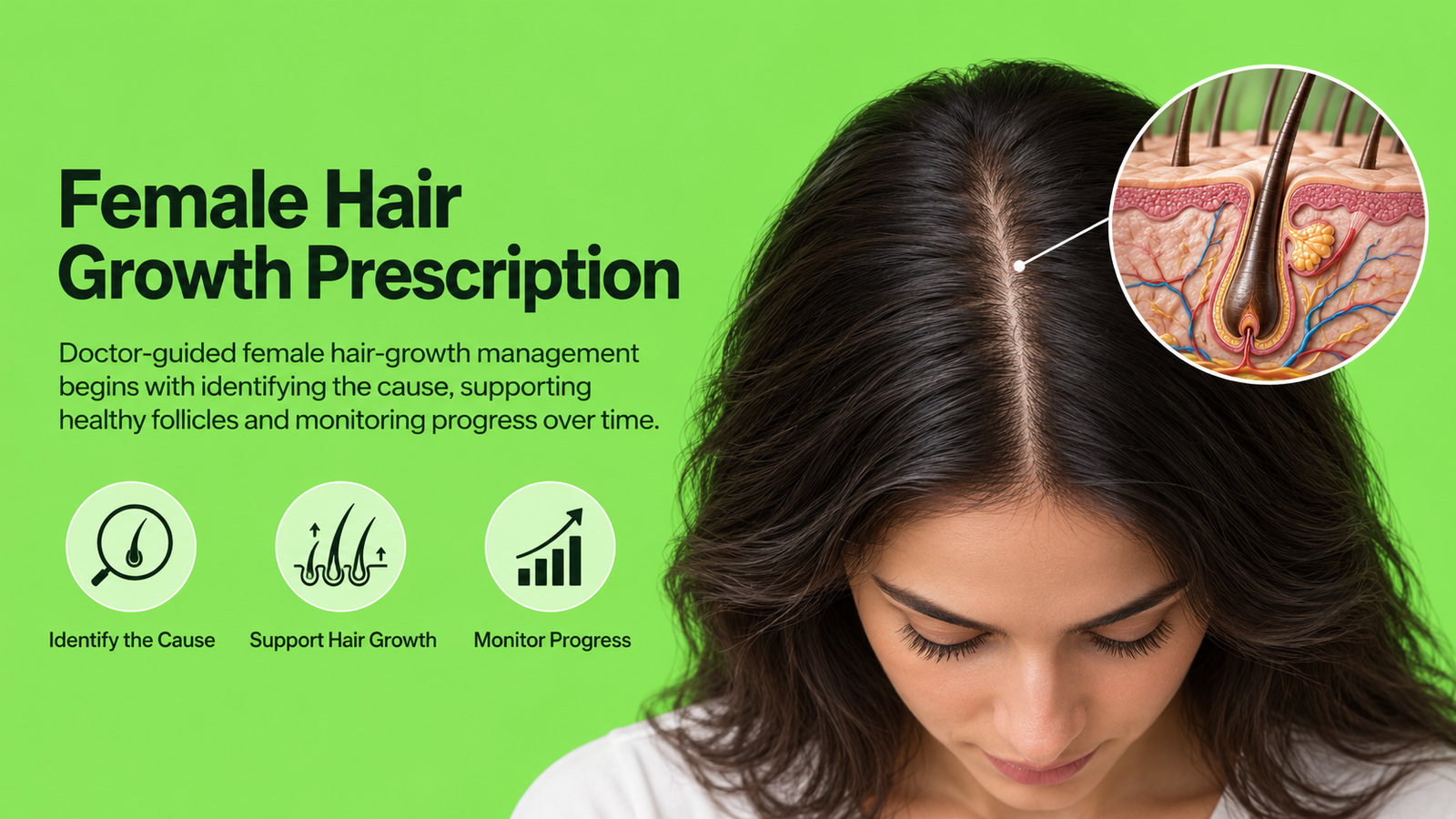
Female Hair Growth Prescription
Hair growth concerns in women may involve excessive shedding, slow visible recovery, progressive thinning or difficulty maintaining hair volume. Although these concerns are often described together, they do not necessarily have the same medical cause.
A Female Hair Growth Prescription is not a fixed combination of tablets, supplements and serums. It is a diagnosis-led plan that considers the scalp, hair-growth cycle, existing follicles, medical history and treatment suitability.
At Anagen Hair Transplant Clinic, Mumbai, female hair-growth assessment focuses on identifying the underlying reason for reduced growth or coverage before deciding whether medical therapy, correction of an underlying condition, monitoring or supportive treatment is appropriate.
Understanding Hair Growth in Women
Hair follicles move through cycles of active growth, transition, rest and shedding. Each follicle follows its own cycle, so a healthy scalp normally contains hairs at different stages.
Visible hair growth depends on follicular activity, hair-shaft production and how long individual hairs remain in the growing phase.
Hair may appear not to grow because the shafts are breaking, because shedding has increased or because follicles are progressively producing finer hairs.
These situations require different management.
Why Diagnosis Must Come Before a Hair-Growth Prescription
A woman with gradual central thinning may have female pattern hair loss. A woman who suddenly notices more hair on her pillow or while washing may have telogen effluvium. A woman with patchy loss or scalp inflammation needs another assessment.
Recent pregnancy, illness, medication changes, restricted diets, significant weight changes and menstrual or endocrine symptoms may be relevant.
A growth-promoting medicine cannot be assumed to address all of these possibilities.
What Does the Doctor Assess Before Prescribing?
A consultation may review the onset, duration and pattern of loss; the amount of shedding; medical and medication history; previous hair treatment; family history; dietary intake; and relevant reproductive or hormonal circumstances.
The scalp examination may assess density, hair-shaft diversity, signs of miniaturisation, hair breakage, inflammation and whether the pattern suggests a particular diagnosis.
Trichoscopy may help distinguish between follicular miniaturisation and other causes of reduced visible density.
Investigations are not automatic. Relevant investigations may be recommended when the history or examination suggests an underlying medical, nutritional or hormonal contributor.
Prescription Overview
Primary Concern: Reduced visible hair growth, increased shedding or unsatisfactory recovery of scalp coverage in women.
Assessment Focus: Hair-growth cycle, follicular activity, shedding pattern, breakage, scalp condition and underlying diagnosis.
Possible Contributing Factors: Female pattern hair loss, telogen effluvium, medical illness, nutritional factors, hormonal changes, medication effects or scalp disease.
Prescription Goal: Address the diagnosed cause, support responsive follicles and monitor improvement where biologically possible.
Possible Prescription Categories: Appropriate topical or oral treatment, correction of confirmed medical or nutritional contributors, treatment of scalp disorders and supportive hair care.
Supportive Care: Adequate nutrition, gentle hair handling, management of breakage and relevant scalp care.
Monitoring: Shedding history, standardised photographs, treatment tolerance and clinical reassessment.
Follow-Up: Determined by the diagnosis and prescribed treatment.
Pregnancy / Breastfeeding Considerations: Essential to medication selection when relevant.
When Further Investigation May Be Needed: Persistent or unexplained shedding, systemic symptoms, atypical patterns or poor recovery.
When Another Treatment May Be Considered: Selected procedural support after diagnosis, or transplant assessment where stable structural loss is established.
This page provides general prescription information and does not replace an individual clinical assessment. Treatment should be selected according to the diagnosis, medical history, reproductive status where relevant, examination and treatment goals.
What May Be Included in a Female Hair Growth Prescription?
Diagnosis-Appropriate Hair-Growth Medication
Topical minoxidil may be considered in appropriate cases of female pattern hair loss. Selected oral therapies may be considered for specific diagnoses under medical supervision.
However, minoxidil is not a universal treatment for every type of shedding or hair breakage. The formulation and appropriateness depend on the diagnosis, reproductive circumstances and potential adverse effects.
Management of an Underlying Medical Cause
When hair loss is linked to a medical condition, treating that condition may be more important than starting additional hair-growth products.
For example, a clinician may evaluate iron status when the history suggests iron deficiency, or consider thyroid testing when symptoms and examination support that possibility.
Our planned Thyroid & Hair Loss Prescription, Vitamin Deficiency Hair Loss Prescription and Telogen Effluvium Prescription pages explain these causes separately.
Correction of Confirmed Nutritional Deficiency
Nutrient deficiency can contribute to some forms of hair loss. However, taking supplements without evidence of deficiency does not necessarily improve hair growth and may create avoidable risks.
Supplement selection should reflect dietary and medical assessment, relevant investigations and the actual deficiency identified.
Treatment of Scalp Problems
Scalp inflammation, infection or other dermatological disorders may interfere with comfortable, healthy hair and scalp care. Some conditions require their own treatment before or alongside hair-growth management.
Supportive Hair Care
Reducing excessive heat, harsh chemical processing and tightly pulled hairstyles can help limit avoidable breakage. This improves retention of existing hair shafts but should not be confused with stimulating new follicles.
Female-Specific Medication Safety
Pregnancy, pregnancy planning and breastfeeding can materially change which hair-growth medications are appropriate.
Topical and oral minoxidil should not be casually recommended in these circumstances, and certain prescription anti-androgen medicines can pose fetal risks. Systemic medicines may also require cardiovascular or other monitoring.
Women should disclose relevant medical and reproductive information before starting or changing treatment.
How Is Hair-Growth Progress Monitored?
Assessment should distinguish changes in shedding from changes in density, shaft calibre and hair length.
Some causes of shedding improve after their trigger resolves. Chronic pattern hair loss may need ongoing treatment and regular review.
Progress may be documented through repeat photographs, scalp examinations, trichoscopy when indicated and discussion of adverse effects.
When Might Biologix Treatment or Hair Transplantation Be Considered?
Some women with confirmed hair-loss conditions may discuss supportive procedures such as PRP Hair Treatment, Advanced GFC Hair Treatment or Low Level Laser Therapy.
The evidence and appropriate role vary by modality and diagnosis. These treatments should not be substituted for necessary medical investigation or treatment.
Hair transplantation is a separate structural-restoration option for selected cases of stable loss with suitable donor hair. Temporary shedding, active diffuse loss or unresolved scalp disease should not automatically lead to surgery.
Realistic Expectations and Maintenance
Hair growth is a gradual biological process. Treatment response depends on the cause, whether follicles remain capable of producing hair and whether the underlying trigger has been controlled.
Not all forms of hair loss are reversible. Some require maintenance, while others improve after a temporary trigger resolves.
The objective is not to prescribe more products. It is to select the few interventions that are medically justified for the individual situation.
Frequently Asked Questions
1. What is included in a female hair growth prescription?
It may include diagnosis-specific treatment, management of underlying medical factors, supportive scalp care and monitoring. There is no single prescription appropriate for every woman.
2. Do all women need blood tests?
No. Investigations should follow the clinical history and examination rather than a mandatory universal panel.
3. Can hair-growth medicines be used during pregnancy?
Some common hair-loss medications are inappropriate during pregnancy or pregnancy planning. Any proposed treatment requires a clinician’s reproductive-safety review.
4. How long does it take to assess improvement?
Hair changes develop gradually. The appropriate review interval depends on the condition and therapy; several months may be needed to judge certain treatments.
5. Can supplements alone improve growth?
They may help when a relevant deficiency is identified, but routine supplementation does not reliably treat every form of hair loss.
6. Is hair growth the same as hair thickening?
No. Growth concerns involve follicular activity and hair-cycle performance. Thickening concerns focus more specifically on shaft calibre and the visible coverage of existing hair.
7. Can PRP or GFC be added?
Selected procedures may be discussed for suitable diagnoses, but benefits, limitations, risks and costs should be reviewed individually.
Plan Your Female Hair Growth Assessment
If your hair appears to be growing poorly, shedding excessively or losing coverage, the most useful first step is identifying what is affecting the hair-growth cycle or follicles.
Anagen’s Hair Prescription Consultation can help determine whether medical treatment, relevant investigations, supportive care or another strategy is appropriate.