Eyebrow hair transplantation is a surgical procedure in which carefully selected hair follicles are transferred from a suitable donor area to thin, sparse or absent areas of the eyebrows. Although the number of grafts required is much smaller than in a typical scalp hair transplant, eyebrow transplantation requires extremely precise planning.
Natural eyebrows are not simply two curved lines of hair. The direction, angle, density and overlap of individual hairs change continuously from the inner brow to the arch and tail. For this reason, a natural eyebrow transplant depends heavily on design, fine single-hair graft selection and implantation at very acute angles that follow the patient’s existing eyebrow pattern.
Published eyebrow-transplant literature identifies donor-hair selection, graft angle, direction and alignment as major determinants of the final result.
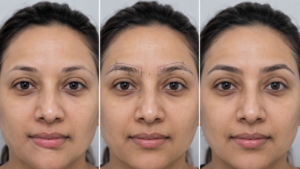
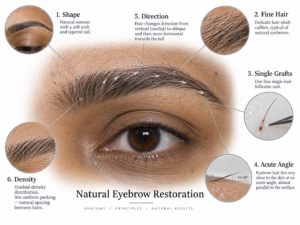
Illustration of eyebrow restoration planning and maturation.
Who May Consider an Eyebrow Transplant?
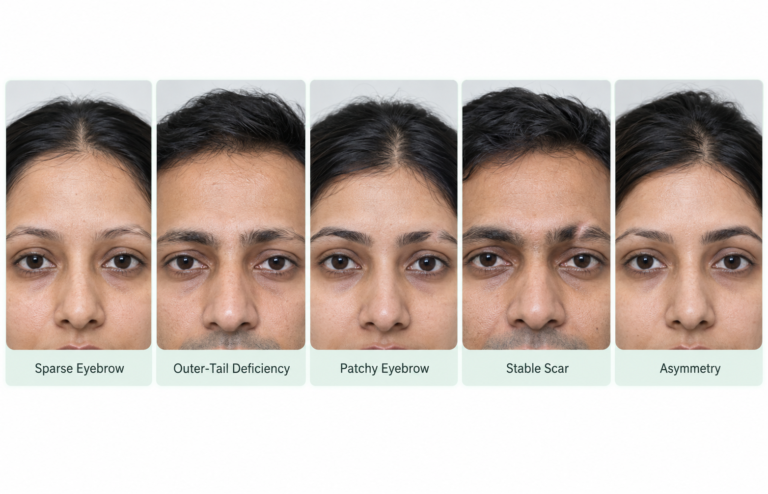
Eyebrow transplantation may be considered when eyebrow hair is permanently sparse or absent.
Possible situations include:
naturally thin or sparse eyebrows
congenital eyebrow deficiency
longstanding over-plucking
selected stable scars
previous injury or burns
selected surgical scars
asymmetrical eyebrow hair distribution
partial eyebrow loss where the underlying condition is stable
However, not every type of eyebrow loss should immediately be transplanted.
Sudden eyebrow loss, active alopecia areata, inflammatory skin disease or a suspected scarring alopecia should first be medically evaluated. The cause matters because transplanting into an area with active disease may not give a predictable long-term result. Eyebrow transplantation may be considered when eyebrow hair is permanently sparse or absent.
Possible situations include:
naturally thin or sparse eyebrows
congenital eyebrow deficiency
longstanding over-plucking
selected stable scars
previous injury or burns
selected surgical scars
asymmetrical eyebrow hair distribution
partial eyebrow loss where the underlying condition is stable
However, not every type of eyebrow loss should immediately be transplanted.
Sudden eyebrow loss, active alopecia areata, inflammatory skin disease or a suspected scarring alopecia should first be medically evaluated. The cause matters because transplanting into an area with active disease may not give a predictable long-term result.
Eyebrow loss should be assessed before surgical restoration.
Eyebrow Design Comes Before Graft Count
Eyebrow transplantation should not begin by deciding how many grafts to implant.
The first step is designing an eyebrow that suits the patient’s:
existing brow
facial proportions
orbital anatomy
eyebrow height
natural arch
brow thickness
medial and lateral endpoints
personal preferences
There is substantial natural variation in eyebrow shape.
Some patients prefer a flatter eyebrow, while others naturally have a stronger arch. The design should complement the face rather than copying one standard template. Both eyebrows should appear balanced, but making them mathematically identical can also look artificial because natural faces contain some asymmetry.
Eyebrow design should complement facial anatomy rather than follow one standard template.
The Direction of Eyebrow Hair Changes Across the Brow
This is one of the most important technical details.
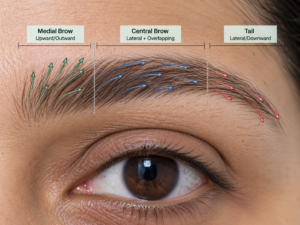
Eyebrow hairs do not all grow in the same direction. At the inner or medial portion of the brow, hairs may point more upward and outward. Across the body of the eyebrow, the upper and lower rows gradually change orientation and overlap. Toward the tail, the hairs become increasingly lateral and often slightly downward. Published surgical descriptions emphasise recreating these changing directional patterns rather than placing all grafts in parallel.
Natural eyebrow direction changes continuously across the brow.
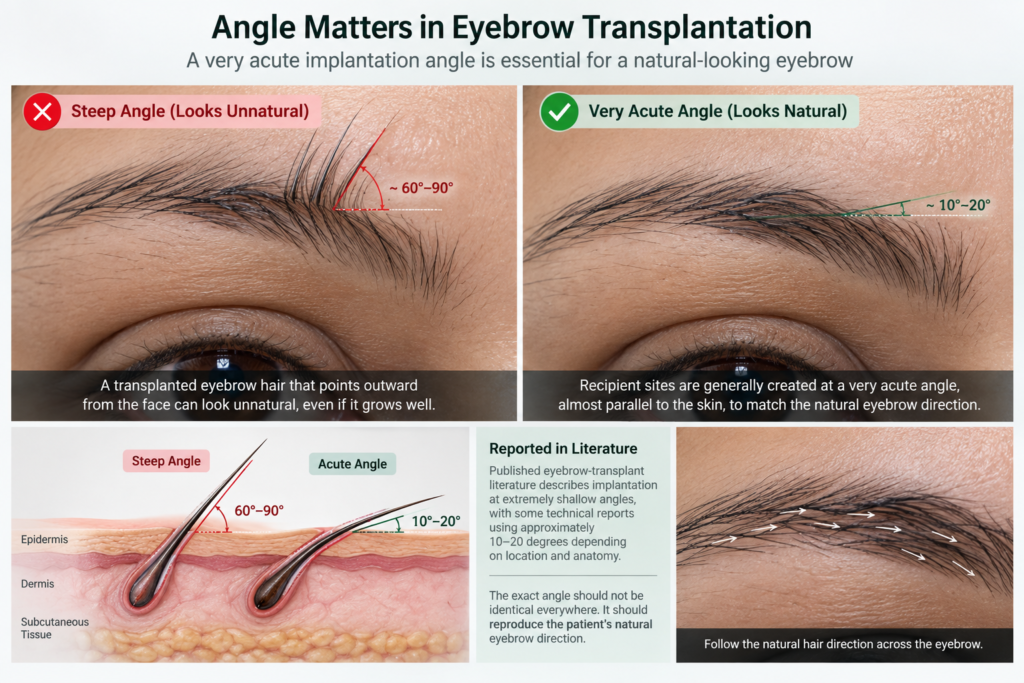
Eyebrow Hairs Must Be Implanted Almost Flat to the Skin
A transplanted eyebrow hair that points outward from the face can look unnatural even if it grows well. Therefore, recipient sites generally need to be created at a very acute angle, almost parallel to the skin.
Published eyebrow-transplant literature describes implantation at extremely shallow angles, with some technical reports using approximately 10–20 degrees depending on location and anatomy. The exact angle should not be identical everywhere. It should reproduce the patient’s natural eyebrow direction.
Why Single-Hair Grafts Are So Important
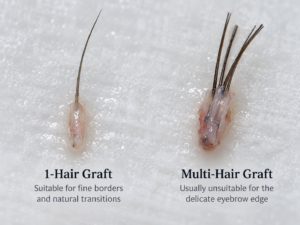
Eyebrows are viewed at very close range. Thick follicular groups containing several hairs can therefore create an unnatural plug-like appearance.
Fine single-hair follicular units are particularly important around the outline, head and tail of the eyebrow. Published reviews describe single-hair grafts as fundamental to aesthetic eyebrow restoration, although selected two-hair follicular units may sometimes be used within the central body depending on technique and desired density.
At Anagen, graft selection should be based on the specific eyebrow zone rather than trying to maximise the number of hairs in each graft.
Where Does the Donor Hair Come From?
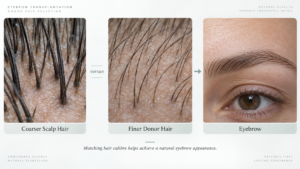
Donor hair is usually selected from the scalp. But the best scalp donor hair for an eyebrow is not necessarily the thickest available hair. Fine-calibre hair often produces a softer result.
Published FUE eyebrow techniques describe selecting finer hairs from areas such as the lower occipital, temporal or nape region when their characteristics are suitable.
Important donor characteristics include:
hair calibre
colour
curl
texture
growth characteristics
The goal is to select donor hair that blends as naturally as possible with the native eyebrow.
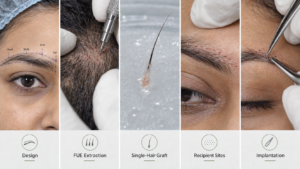
How Is an Eyebrow Transplant Performed?
1. Assessment
The cause and pattern of eyebrow loss are reviewed. Existing eyebrow hair, scars, skin condition and facial symmetry are assessed.
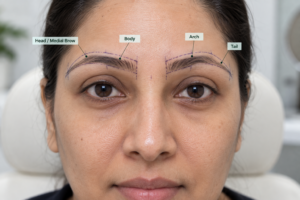
2. Eyebrow Design
The head, body, arch and tail are marked. The patient should review and approve the planned shape before surgery.
3. Donor-Hair Selection
Fine donor follicles that are appropriate for eyebrow restoration are identified.
4. FUE Extraction
Individual follicular units are carefully harvested from the selected donor region.
5. Graft Preparation
Grafts are inspected and predominantly suitable single-hair units are selected.
6. Recipient-Site Creation
Very small recipient sites are created according to the changing direction and acute angle required throughout the eyebrow.
7. Implantation
The selected grafts are carefully placed according to the planned orientation and distribution.
The procedure requires careful planning at every stage from design to implantation.
How Many Grafts Does an Eyebrow Transplant Need?
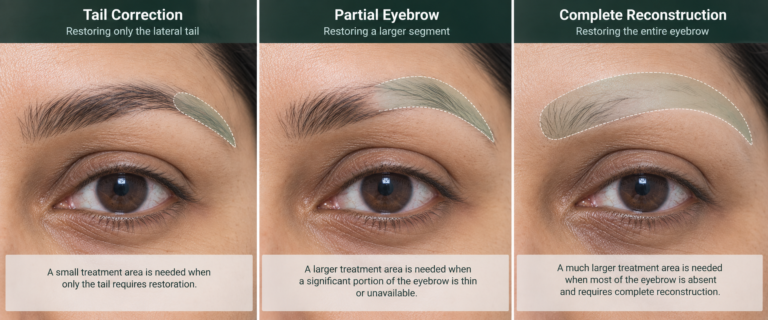
The number varies substantially. A small outer-tail correction needs far fewer grafts than complete reconstruction of both eyebrows.
One published review describes approximately 70–120 individual grafts for certain eyebrow reconstructions, while fuller restorations may require more depending on existing hair, desired width and whether one or both eyebrows are being treated.
For this reason, Anagen should not advertise one universal graft number.
The estimate should consider:
whether one or both eyebrows require restoration
existing native eyebrow hair
eyebrow length and width
desired density
scar tissue
donor-hair characteristics
Graft requirement depends on the area being restored.
Eyebrow Transplantation Into Scars
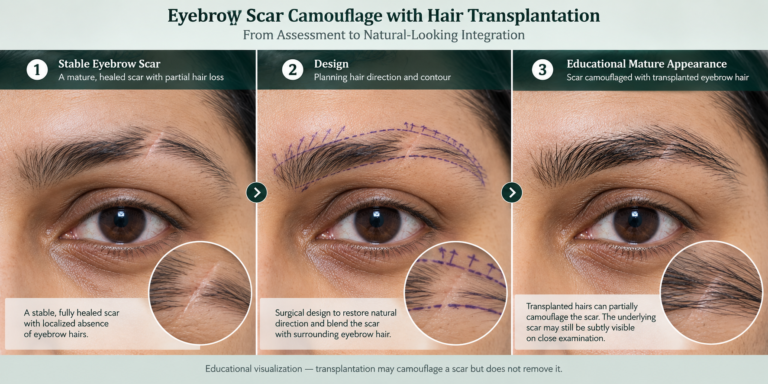
Hair follicles can sometimes be transplanted into stable eyebrow scars caused by trauma, surgery or burns.
However, scar tissue can differ from normal skin in:
blood supply
thickness
elasticity
surface contour
These differences can affect recipient-site creation and potentially graft growth. Published eyebrow-restoration literature specifically identifies local scarring and skin perfusion as factors influencing transplantation outcomes.
The objective should be explained realistically: hair may help camouflage the scar, but transplantation does not remove the scar itself.
Graft requirement depends on the area being restored.
Will Transplanted Eyebrow Hair Need Trimming?
Usually, yes. This is an important point patients should know before surgery.
When scalp hair is transplanted into the eyebrow, the follicles tend to retain much of their original scalp-hair growth behaviour. This means transplanted eyebrow hairs may grow longer than native eyebrow hair and require regular trimming and grooming.
The hairs can also be trained progressively with grooming as they mature. An eyebrow transplant should therefore be described as long-term hair restoration with ongoing grooming, not a completely maintenance-free procedure.
Transplanted hairs may grow longer and require periodic trimming.
What Happens After Eyebrow Transplantation?
Immediately after surgery, small graft sites and crusts may be visible. Temporary swelling or redness can occur.
The transplanted hair shafts commonly shed during the early weeks while the follicles remain beneath the skin. New growth then develops gradually over the following months.
The final appearance should not be judged during the early postoperative period because growth, direction and density continue to mature over time.
What Determines a Natural Eyebrow Transplant Result?
A natural result depends on several details working together.
Design:
The shape must suit the patient’s face and existing eyebrow anatomy.
Fine Donor Hair:
Hair that is excessively coarse may be difficult to blend naturally.
Single-Hair Grafts:
Fine individual follicular units help produce a softer appearance.
Acute Angles:
The hair should lie close to the skin rather than project outward.
Changing Direction:
The orientation must change from the head through the body, arch and tail.
Appropriate Density:
Maximum packing is not always the objective. The transplanted eyebrow needs to blend with native hair and surrounding facial anatomy.
Grooming:
Transplanted scalp hairs may require trimming over the long term.
Eyebrow Hair Transplant at ANAGEN Mumbai
At Anagen Hair Transplant Clinic in Andheri West, Mumbai, eyebrow transplantation can be considered for selected patients with sparse, absent or permanently damaged eyebrow hair.
The planning sequence should be:
identify the cause → design the eyebrow → select fine donor hair → choose appropriate single-hair grafts → recreate natural angle and direction → allow gradual growth and maturation.
The objective is not simply to produce a thicker eyebrow. It is to create an eyebrow in which transplanted hairs blend naturally with the face and existing eyebrow hair when viewed at close range.
For an initial assessment, patients can share clear photographs of:
Full Face — Front
Both Eyebrows — Close Front
Left 45°
Right 45°
If previous scarring or eyebrow hair is present, additional close-up photographs may be required. Final design and graft requirement should be confirmed after appropriate examination.
Individual suitability, graft growth and cosmetic results vary.