





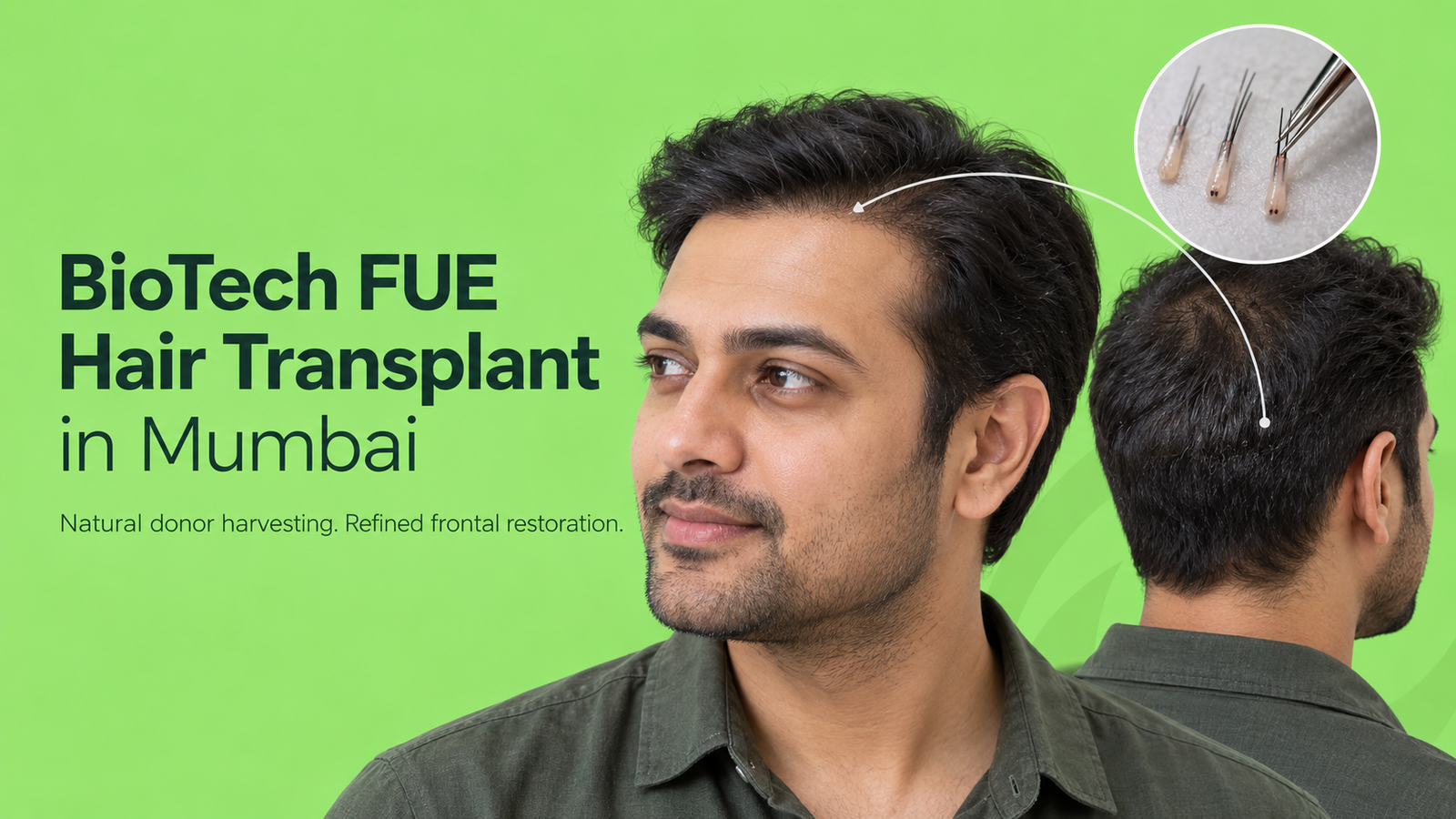
BioTech FUE Hair Transplant in Mumbai
BioTech FUE Hair Transplant at Anagen is a hair-restoration approach based on the established FUE method of extracting individual follicular units from the donor area and transplanting them into areas affected by hair loss.
The objective is not simply to transplant the maximum possible number of grafts. Proper hair restoration requires careful patient selection, donor management, graft handling, natural hairline planning, appropriate placement, post-procedure care, and realistic long-term planning.
At Anagen Hair Transplant Clinic, Mumbai, BioTech FUE is used as the name for Anagen’s FUE-based hair restoration protocol. The core surgical procedure remains Follicular Unit Extraction. Any additional biological or regenerative treatment included in an individual BioTech FUE plan should be discussed clearly during consultation.
Patients who are beginning their research can first read the complete guide to hair transplant in Mumbai to understand donor hair, grafts, suitability, results, and the overall transplantation process.
What Is BioTech FUE Hair Transplant?
BioTech FUE at Anagen is based on Follicular Unit Extraction, commonly known as FUE. In FUE, individual naturally occurring follicular units are extracted from an appropriate donor area, usually the back and sides of the scalp, and transplanted into areas where hair has thinned or been lost.
Unlike FUT or strip surgery, FUE does not require removal of a long strip of scalp. The individual follicular units are extracted through small circular openings and subsequently placed into the planned recipient area.
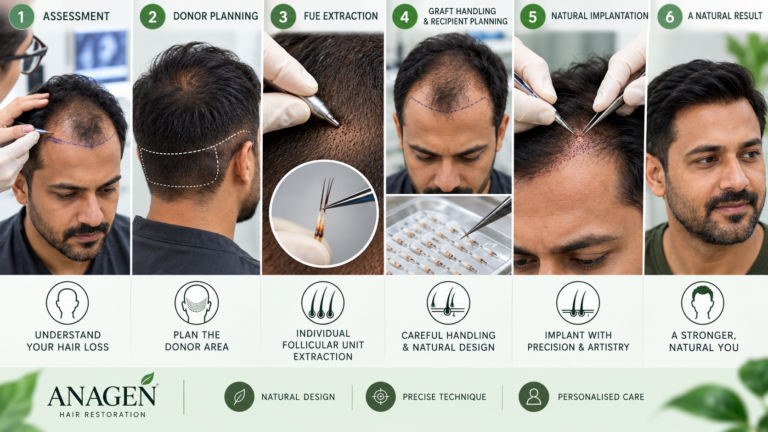
The BioTech FUE approach places particular emphasis on the complete graft journey:
- Patient and scalp assessment
- Donor-area planning
- Selection of suitable follicular units
- Careful graft extraction
- Appropriate graft handling
- Recipient-area design
- Hair direction and angle
- Density distribution
- Post-transplant care
- Long-term hair-loss management
Patients interested specifically in Anagen’s broader FUE approach can also learn about I-FUE hair transplant.
Is BioTech FUE the Same as Stem Cell Hair Transplant?
The terminology can be confusing for patients. BioTech FUE should primarily be understood as Anagen’s FUE-based hair transplant protocol. FUE itself involves physically transferring existing hair follicles from the donor area to the recipient area. It should not automatically be interpreted as a stem-cell procedure or as creating new unlimited hair follicles.
If any regenerative or biological adjunct is recommended as part of an individual’s treatment plan, patients should be told:
- What treatment is being used
- Why it is being recommended
- Whether it is surgical or non-surgical
- What evidence supports its use
- What realistic benefit is expected
- Whether it involves additional cost
This distinction is important because the actual transplanted hair in FUE comes from the patient’s available donor supply.
Who May Be Suitable for BioTech FUE?
BioTech FUE may be considered in appropriately selected patients who have established hair loss and sufficient donor hair.
Possible indications include:
- Receding frontal hairline
- Male pattern hair loss
- Frontal thinning
- Mid-scalp hair loss
- Crown thinning or baldness
- Selected female hair-transplant cases
- Hairline correction
- Selected previous transplant corrections
A hair transplant is not automatically the correct treatment for every person experiencing hair fall. Patients with active or diffuse hair loss may require diagnosis and medical management before surgery is considered.
Men experiencing progressive thinning can also review the options for male hair loss treatment in Mumbai.
Women experiencing diffuse thinning should generally undergo appropriate assessment before deciding on transplantation. More information is available on the female hair loss treatment page.
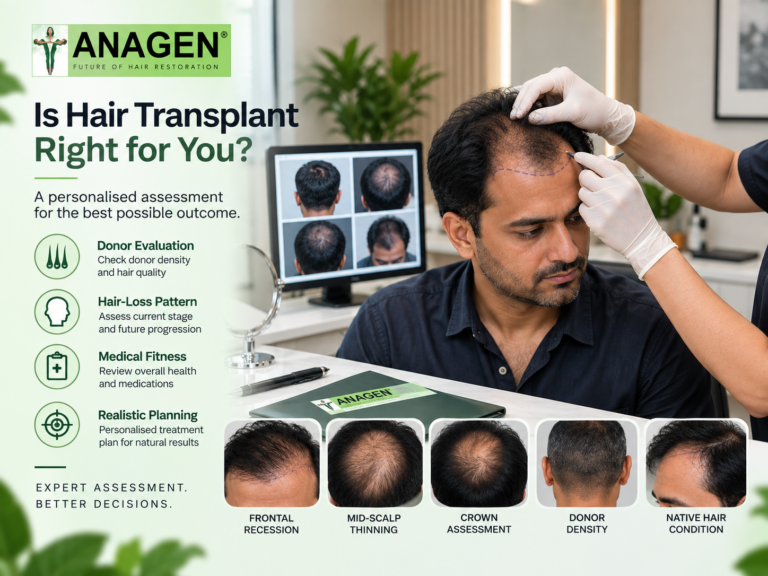
What Determines Whether You Are a Good Hair Transplant Candidate?
Suitability depends on much more than the size of the bald area.
Important factors include:
Donor Hair Availability
A hair transplant redistributes existing hair. The quality, density, and long-term stability of the donor area therefore determine how much coverage can realistically be achieved.
Pattern of Hair Loss
The location and progression of hair loss help determine whether transplantation is appropriate and which areas should receive priority.
Age and Future Hair Loss
Hair loss may continue after transplantation. The treatment plan should therefore consider how the patient’s hair may change in the coming years rather than concentrating only on the current bald area.
Hair Characteristics
Hair calibre, colour contrast, curl, number of hairs per follicular unit, and existing density can influence the visual coverage achieved from a given number of grafts.
Medical Fitness
A patient’s general medical history, medications, scalp condition, and other relevant factors need to be assessed before surgery.
Expectations
Hair transplantation can redistribute available donor hair but cannot reproduce unlimited natural density.
A responsible consultation should explain what can realistically be achieved with the available donor supply.
How Is BioTech FUE Hair Transplant Performed?
The exact treatment plan varies according to the patient, but the general process follows several stages.
Step 1: Hair Loss and Donor Assessment
The scalp is assessed to understand:
- Pattern of hair loss
- Existing hair density
- Donor availability
- Hair calibre
- Areas requiring restoration
- Previous hair transplant history
- Future hair-loss risk
A graft estimate can then be discussed.
Step 2: Hairline and Recipient-Area Planning
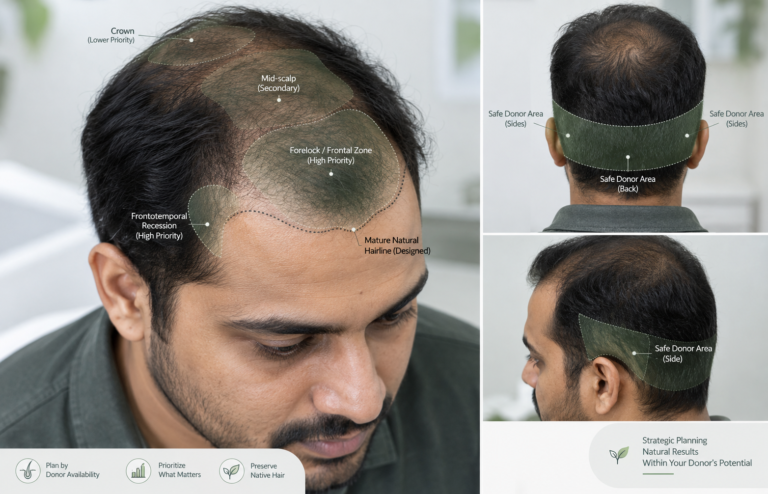
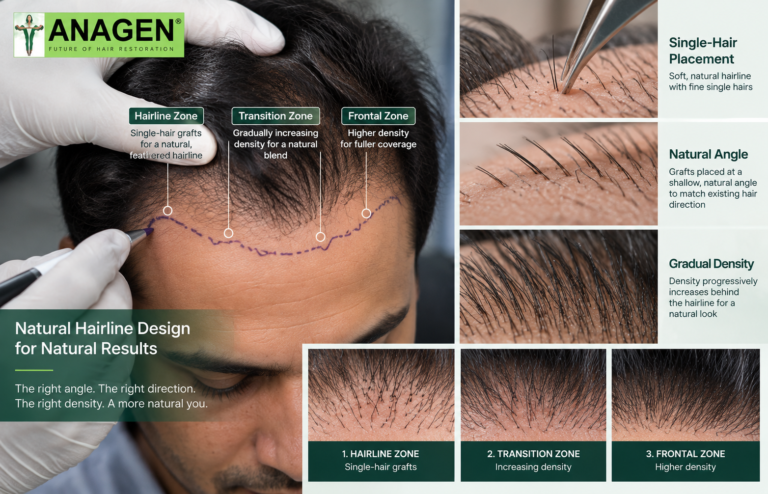
If the frontal region requires restoration, the proposed hairline is designed before implantation. A natural hairline should not simply be a straight line across the forehead.
Its position and shape need to consider:
- Age
- Facial proportions
- Existing hair
- Temporal recession
- Available grafts
- Long-term donor conservation
- Natural irregularity
- Hair direction
Patients interested in this part of the procedure can read more about creative hairline design in Mumbai.
Step 3: Donor-Area Preparation
The donor area is prepared according to the treatment plan. Depending on the procedure and patient requirements, trimming or shaving may be required.
The safe donor area must be identified carefully because excessive extraction can create visible thinning at the back or sides of the scalp.
Step 4: Local Anaesthesia
Local anaesthesia is used in the areas being treated.
Patients may feel temporary discomfort during administration of anaesthesia, but the purpose is to make the extraction and implantation stages more comfortable. Individual pain perception varies.
Step 5: Follicular Unit Extraction
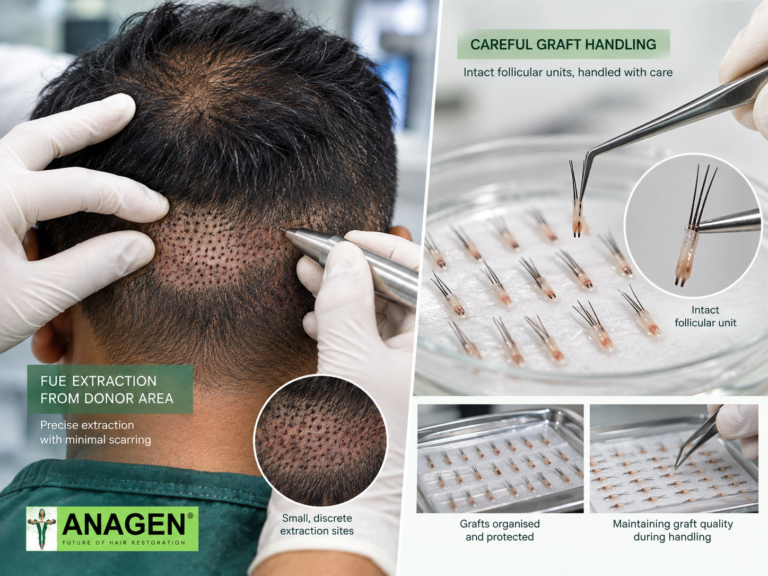
Individual follicular units are carefully extracted from the donor area using FUE instrumentation.
The objective is not simply rapid extraction. Good extraction requires attention to:
- Follicle direction
- Punch positioning
- Graft integrity
- Donor spacing
- Avoidance of unnecessary donor depletion
- Appropriate distribution of extraction
Preserving the donor area is particularly important because donor hair is a limited resource.
Step 6: Graft Handling and Preparation
After extraction, follicular units need to be handled carefully before implantation.
Factors that may influence graft quality include:
- Physical trauma
- Dehydration
- Temperature
- Handling
- Time outside the scalp
The treatment team therefore needs a structured system for graft handling throughout the procedure.
Why Does Graft Handling Matter?
Hair follicles are living tissue. Once extracted from the donor area, they temporarily remain outside their normal blood supply until they are implanted. For this reason, efficient handling and avoiding unnecessary delays are sensible parts of transplant workflow.
However, patients should be cautious of any claim that one single factor guarantees graft survival.
Final growth depends on multiple factors including:
- Extraction quality
- Graft handling
- Recipient-site preparation
- Implantation technique
- Patient biology
- Post-operative healing
Anagen also has a separate protocol called Instant FUE Hair Transplant, which focuses specifically on reducing the interval between extraction and implantation.
Recipient-Site Creation and Natural Hair Direction
Recipient-site planning determines where the transplanted follicles will grow.
The medical team considers factors such as:
- Hair direction
- Exit angle
- Existing native hair
- Planned density
- Hairline irregularity
- Crown pattern where applicable
- Distribution of available grafts
This stage strongly influences whether the final result looks natural when viewed from different angles.
Implantation of the Hair Grafts
The extracted follicular units are subsequently implanted into the planned recipient area. Different graft types may be distributed according to their intended visual role.
For example, finer single-hair grafts are particularly useful around the leading edge of a frontal hairline, while suitable multi-hair follicular units may contribute greater visual density behind it.
The objective is to use the available donor supply strategically rather than distribute every graft uniformly.
Does BioTech FUE Include PRP or Other Regenerative Treatments?
Regenerative treatments may sometimes be discussed alongside hair transplantation, but they should not be confused with the transplantation itself.
Treatments such as PRP or PRF use components derived from the patient’s own blood and are used in selected hair-loss and hair-restoration protocols. They do not replace the need for donor follicles when an established bald area requires surgical restoration.
Patients can read separately about PRP and PRF hair loss treatment in Mumbai to understand their role.
What Are the Potential Advantages of FUE-Based Hair Transplantation?
Depending on the individual case, FUE offers several practical advantages.
These can include:
- Individual follicular-unit extraction
- No linear strip scar
- Ability to distribute extraction across the donor area
- Flexibility in donor planning
- Suitable option for many frontal and crown restoration cases
- Potential use for selected beard, eyebrow, or corrective procedures
- Relatively small individual extraction sites
These advantages do not mean FUE is suitable for every patient.
The quality of the result depends heavily on planning, execution, donor management, and patient-specific factors.
What BioTech FUE Cannot Do?
Understanding limitations is as important as understanding benefits.
BioTech FUE cannot:
- Create unlimited donor hair
- Guarantee that every transplanted graft will grow
- Stop all future loss of existing non-transplanted hair
- Provide identical density for every patient
- Guarantee a specific cosmetic result
- Correct every advanced baldness case in a single session
Patients with extensive baldness and limited donor supply may need to prioritise certain areas or accept lower density.
For large restoration requirements, the clinic may also assess whether a Mega Session Hair Transplant is appropriate.
BioTech FUE vs Conventional FUE
The basic surgical principle remains the same: donor follicles are individually extracted and transplanted.
The difference is primarily in the way Anagen structures its BioTech FUE protocol around the transplant process and any clinic-specific adjunctive care.
| Conventional FUE | BioTech FUE at Anagen |
|---|---|
| Individual follicular-unit extraction | Individual follicular-unit extraction |
| Donor-to-recipient transplantation | Donor-to-recipient transplantation |
| Requires donor planning | Requires donor planning |
| Requires careful graft handling | Emphasises structured graft handling and overall protocol |
| Results depend on multiple surgical and patient factors | Results also depend on multiple surgical and patient factors |
| Additional biological treatments vary between clinics | Biological/regenerative adjuncts may form part of the Anagen treatment plan where indicated |
BioTech FUE should therefore not be presented as a completely different method of creating hair follicles. The fundamental transplant remains FUE.
How Many Grafts Are Required?
There is no fixed graft number for BioTech FUE.
The requirement depends on:
- Degree of baldness
- Size of the treatment area
- Existing hair density
- Desired coverage
- Hairline position
- Crown involvement
- Donor density
- Hair calibre
- Number of hairs per graft
- Previous transplantation
- Long-term treatment strategy
Two patients with apparently similar baldness can require different plans.
The appropriate graft estimate should therefore be based on photographs and, ideally, direct donor and scalp assessment.
BioTech FUE Recovery
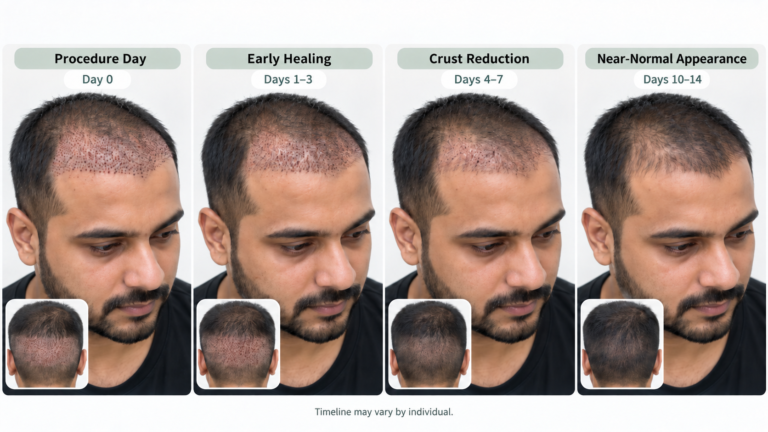
Immediately after transplantation, patients may notice:
- Redness
- Small crusts around transplanted follicles
- Mild swelling
- Temporary donor-area sensitivity
- Short-term numbness or tightness
These generally settle gradually during recovery.
The transplanted area should not be scratched or unnecessarily disturbed during the early healing period. Medication, washing instructions, sleeping position, exercise restrictions, and other post-operative precautions should be followed according to the medical team’s advice.
Patients preparing for transplantation can review Anagen’s hair transplant post-operative care information.
When Will BioTech FUE Results Become Visible?
Hair transplantation does not produce final cosmetic density immediately.
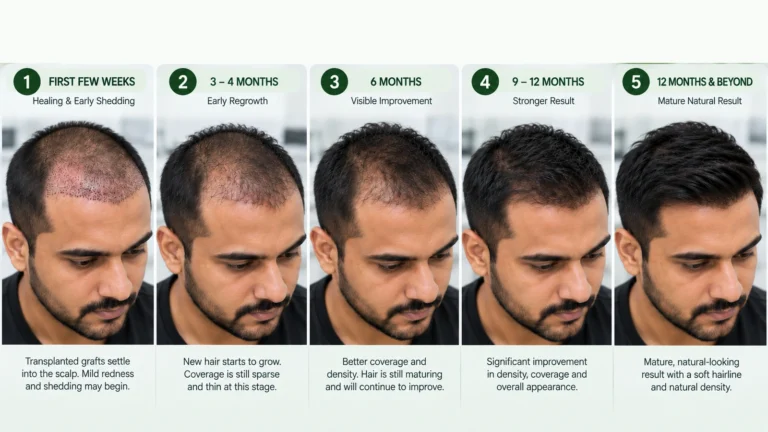
First Few Weeks
Some transplanted hair shafts may shed during the early post-transplant period. This does not necessarily mean that the transplanted follicle has been lost.
Around 3–4 Months
Early new growth may begin becoming noticeable in some patients.
Around 6 Months
More visible growth and coverage may start developing.
Around 9–12 Months
Hair density and appearance generally become progressively more established.
12 Months and Beyond
Further maturation may continue, particularly depending on the treated area and individual growth pattern. The timeline varies between patients. Factors affecting the final appearance include donor characteristics, graft growth, hair calibre, hair length, native hair, treatment area, ongoing hair loss, and individual healing.
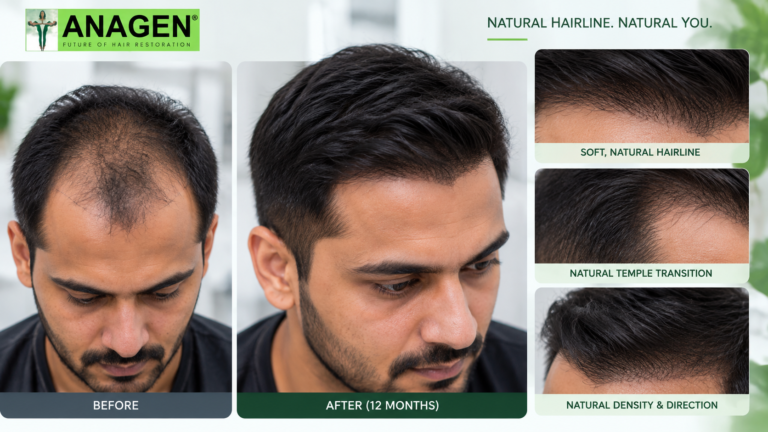
Patients considering surgery should review genuine clinical outcomes rather than relying only on promotional simulations. Anagen’s hair transplant results in Mumbai provide a dedicated section for treatment outcomes.
Will the Result Look Natural?
Naturalness depends on considerably more than the extraction technique.
Important factors include:
- Appropriate hairline position
- Soft single-hair placement at the front
- Micro-irregularity
- Macro-irregularity
- Natural hair direction
- Correct implantation angle
- Gradual density
- Appropriate temple planning
- Blending with existing hair
- Conservative donor management
A technically successful transplant can still look unnatural if these aesthetic principles are ignored.
That is why hairline design and recipient-site planning are central to the treatment rather than an afterthought.
Can BioTech FUE Stop Future Hair Loss?
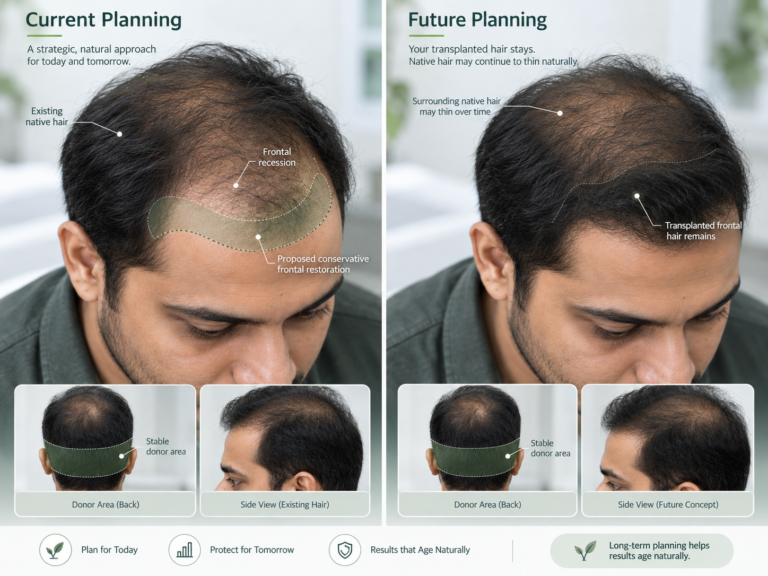
No hair transplant automatically stops progressive loss of the patient’s existing non-transplanted hair. This is an important point, particularly for younger patients.
A long-term plan may therefore include assessment of ongoing hair loss and appropriate non-surgical management where indicated. The goal is to avoid creating a transplanted island of hair surrounded by progressively thinning native hair.
BioTech FUE Hair Transplant Cost in Mumbai
The cost cannot be accurately determined from the name of the technique alone.
Factors influencing treatment cost may include:
- Number of grafts required
- Size of the treatment area
- Donor complexity
- Number of procedure sessions
- Previous hair transplant history
- Additional donor sources where appropriate
- Individual treatment complexity
- Additional adjunctive treatments if chosen
A proper graft estimate and treatment plan should come before final costing.
Questions to Ask Before Choosing BioTech FUE
Before proceeding with any hair transplant, patients should understand:
- Why am I suitable for transplantation?
- How many grafts are recommended?
- Which areas will receive priority?
- What is the quality of my donor area?
- What happens if my existing hair continues to thin?
- Who performs the important medical and surgical steps?
- What does BioTech FUE include in my specific case?
- Are any biological adjuncts optional or included?
- What recovery should I realistically expect?
- What results are realistic with my donor supply?
A good consultation should answer these questions rather than focusing only on the number of grafts.
Patients comparing treatment options can also review Anagen patient reviews and the clinic’s broader hair transplant FAQs.

BioTech FUE Hair Transplant Consultation at Anagen
The first step is not choosing a technique. It is determining the cause and extent of hair loss, assessing the donor area, and understanding what can realistically be achieved.
During consultation, the treatment plan can be based on:
- Current hair-loss pattern
- Donor density
- Hair characteristics
- Required coverage
- Hairline planning
- Medical history
- Previous treatments
- Long-term expectations
Once these factors are assessed, the team can explain whether BioTech FUE, another hair transplant approach, medical treatment, or a combined plan is appropriate.
Contact Anagen Hair Transplant Clinic in Mumbai to discuss your hair-loss pattern, donor area, graft requirement, and suitable treatment options.