






Male Hair Loss Treatment in Mumbai: Causes, Patterns and Stages
Hair loss in men is extremely common. Many men begin noticing some degree of hair thinning, a receding hairline or reduced density as they grow older. In some men, however, hair loss can begin much earlier. There are several possible causes of hair loss in men. However, the most common is a hereditary condition known as male pattern baldness, or androgenetic alopecia.
Understanding the cause and pattern of hair loss is important before deciding on any treatment. Men looking for male hair loss treatment in Mumbai should ideally begin with an assessment of their hair-loss pattern, degree of thinning and donor area before choosing the next step.

What Does Male Pattern Baldness Look Like?
Male pattern baldness usually follows a recognizable pattern. It commonly begins around the temples and frontal hairline. In some men, thinning may also begin at the crown. The hair follicles around the temples, frontal scalp and crown are more sensitive to the effects of dihydrotestosterone, commonly known as DHT.Because the hair loss usually progresses in a characteristic pattern, the condition is known as male pattern baldness.
Common Signs of Male Pattern Baldness
When male pattern baldness is responsible for hair loss, some common signs may include:
- gradual recession of the hairline
- an M-shaped appearance of the frontal hairline
- thinning of hair at the crown
- existing hair becoming progressively finer and shorter
- increasing scalp visibility in affected areas
- gradual progression of thinning across the top of the scalp
As hair loss becomes more advanced, the frontal and crown areas may eventually join together, leaving a characteristic horseshoe-shaped area of hair around the back and sides of the scalp.
Other Causes of Hair Loss in Men
Not every type of hair loss in men is caused by male pattern baldness.
Certain patterns of hair loss may indicate another underlying condition. These can include:
- sudden or excessive shedding
- patchy hair loss
- diffuse thinning across the scalp
- breakage of hair shafts
- hair loss associated with redness
- scaling of the scalp
- scalp discomfort or pain
- unusually rapid progression
Hair loss of this type may be associated with medical conditions, nutritional problems, certain medications, stress or other factors.
If hair loss appears suddenly or is associated with scalp symptoms, proper medical evaluation is advisable before starting treatment.
What Causes Male Pattern Baldness?
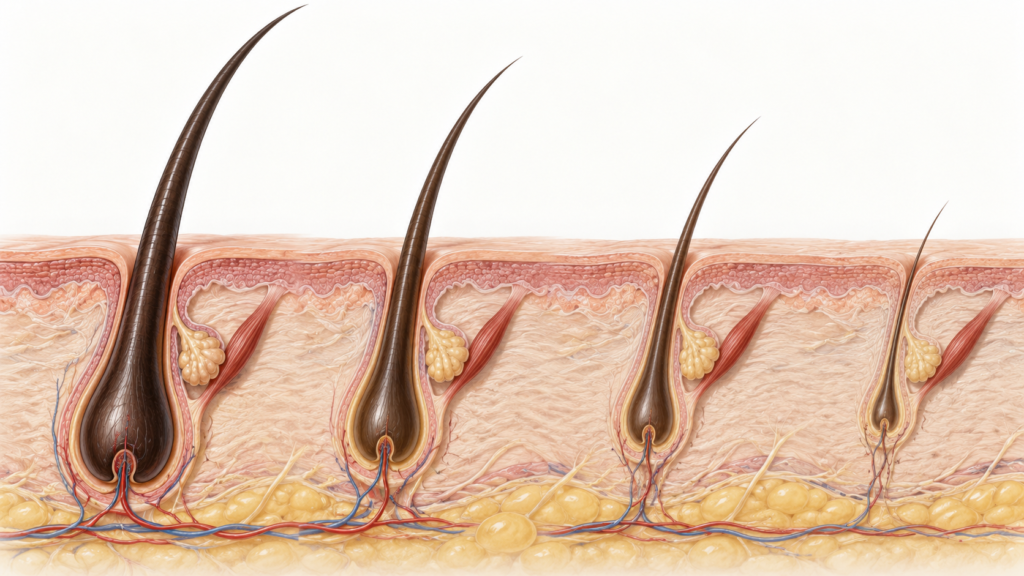
The main hormone associated with male pattern baldness is dihydrotestosterone (DHT). DHT is produced from testosterone through the action of an enzyme called 5-alpha reductase.
In genetically susceptible individuals, certain scalp hair follicles are more sensitive to DHT. Over time, this sensitivity causes the affected follicles to become progressively smaller. This process is known as hair follicle miniaturization.
The follicles located at the front, top and crown of the scalp are generally more susceptible to this process than follicles located at the back and sides. This difference explains the typical pattern seen in male pattern baldness.
The Miniaturization of Hair Follicles
Hair follicle miniaturization is one of the most important processes involved in androgenetic alopecia. Normally, healthy scalp follicles produce thick, mature hairs known as terminal hairs.
When follicles become sensitive to DHT, the growth phase of the hair cycle gradually becomes shorter. With each successive growth cycle, the hair produced by the follicle may become:
- shorter
- thinner
- finer
- less visible
Over time, these hairs may become extremely fine and provide very little visible scalp coverage. This explains why a thinning area may still contain hair follicles even though the scalp appears noticeably less dense. Eventually, severely miniaturized follicles may stop producing cosmetically useful hair.
Why Do Some Men Develop Male Pattern Baldness?
Genetics play an important role in determining a person’s susceptibility to androgenetic alopecia. Both the sensitivity of individual hair follicles to DHT and the pattern of future hair loss can be influenced by inherited factors.
The tendency toward male pattern baldness can come from either side of the family. Therefore, men with close relatives who have experienced significant hair loss may have a higher likelihood of developing a similar pattern. However, the age at which hair loss begins and the speed at which it progresses can vary considerably between individuals.
Classification of Hair Loss in Men
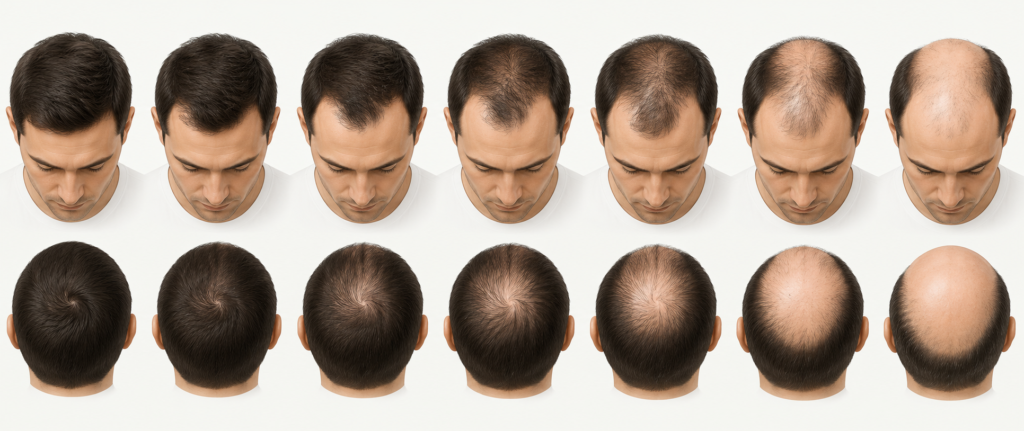
The Norwood classification is one of the most commonly used systems for describing the progression of male pattern hair loss. It helps doctors assess the pattern and extent of baldness.
Norwood Class I
This usually represents a youthful or adolescent hairline with little or no significant recession. It generally does not represent established male pattern baldness.
Norwood Class II
The hairline begins to mature, with mild recession around the temples. This stage does not necessarily indicate significant baldness.
Norwood Class III
More noticeable recession develops around the temples. This is generally considered one of the earliest clear stages of male pattern hair loss.
Norwood Class III Vertex
Hair loss becomes noticeable around the crown or vertex of the scalp. Frontal recession may also be present.
Norwood Class IV
Hair loss becomes more pronounced in the frontal region and crown. However, a band of hair generally remains between the frontal and crown areas.
Norwood Class V
The frontal and crown areas continue to enlarge. The band of hair separating them becomes thinner and less dense.
Norwood Class VI
The bridge of hair separating the frontal and crown areas disappears. This creates one larger area of baldness involving much of the front and top of the scalp.
Norwood Class VII
This represents advanced male pattern baldness. Only a relatively narrow band or horseshoe-shaped area of hair remains around the back and sides of the scalp.
Norwood Class A Pattern
The Norwood Class A pattern progresses somewhat differently from the standard Norwood pattern. Instead of developing significant frontal and crown hair loss separately, the hairline tends to recede progressively from front to back. These patients usually have less crown involvement compared with men who follow the regular Norwood pattern. Because the hair loss is concentrated at the front, even relatively early hair loss can create a noticeably bald appearance. Proper assessment of the hair-loss pattern and donor area is therefore important before planning hair restoration.
Diffuse Patterned Alopecia
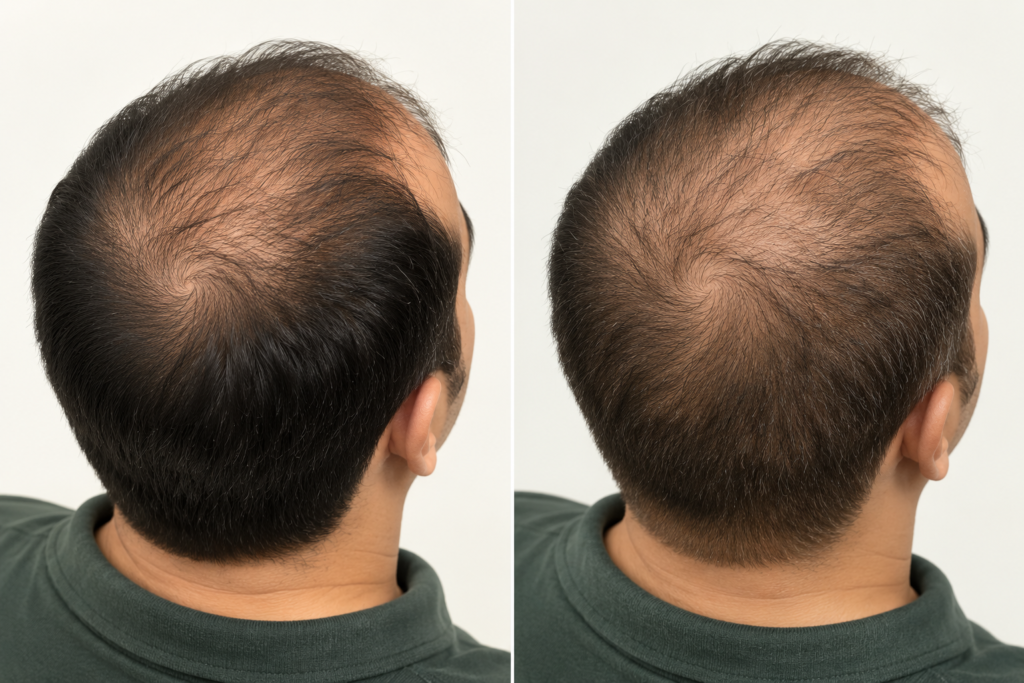
Diffuse Patterned Alopecia (DPA) is another form of androgenetic hair loss. Instead of following the typical Norwood stages, the hair across the front, top and crown becomes diffusely thinner. However, the permanent donor zone around the back and sides of the scalp generally remains relatively stable. Recognizing this pattern is important when evaluating a patient for future hair restoration.
Diffuse Unpatterned Alopecia
Diffuse Unpatterned Alopecia (DUPA) is different because thinning can also affect the hair around the back and sides of the scalp. This means that the supposedly permanent donor area may itself be affected by miniaturization. This distinction becomes particularly important when assessing whether a patient may be suitable for surgical hair restoration. A stable donor area is essential when considering hair transplantation. Therefore, distinguishing DPA from DUPA is an important part of proper hair-loss evaluation.
Why Proper Hair Loss Assessment Matters
Two men may appear to have similar levels of baldness but may have very different patterns of follicular miniaturization, donor density and future hair-loss progression. Therefore, simply looking at the visible bald area is not enough.
A proper evaluation should consider:
- the pattern of hair loss
- degree of follicular miniaturization
- frontal hairline recession
- crown involvement
- donor-area quality
- rate of progression
- family history
Understanding these factors helps determine the current stage of hair loss and the most appropriate approach.
Male Hair Loss Treatment in Mumbai
The appropriate treatment for male hair loss depends primarily on the cause, pattern and stage of hair loss. Male pattern baldness requires a different approach from patchy, sudden or diffuse hair loss caused by another condition.
For this reason, a treatment plan should ideally be based on an individual scalp and hair assessment rather than simply choosing a treatment based on the amount of visible hair loss.
At Anagen Hair Transplant Clinic in Mumbai, the hairline, frontal scalp, mid-scalp, crown and donor area can be assessed to understand the pattern and extent of hair loss. Based on these findings, an appropriate hair-restoration plan can then be discussed.
Get Your Hair Loss Assessed
If you have started noticing a receding hairline, thinning crown, increasing scalp visibility or progressive male pattern baldness, it may be useful to determine your current hair-loss stage before the condition progresses further.
For an initial assessment, you can visit Anagen Hair Transplant Clinic, Andheri West, Mumbai.
You can also share clear photographs of your:
- front hairline
- top of the scalp
- crown
- back donor area
This can help provide an initial understanding of your hair-loss pattern before an in-person consultation.
The first step in choosing the right male hair loss treatment in Mumbai is identifying exactly what type and stage of hair loss you have.