





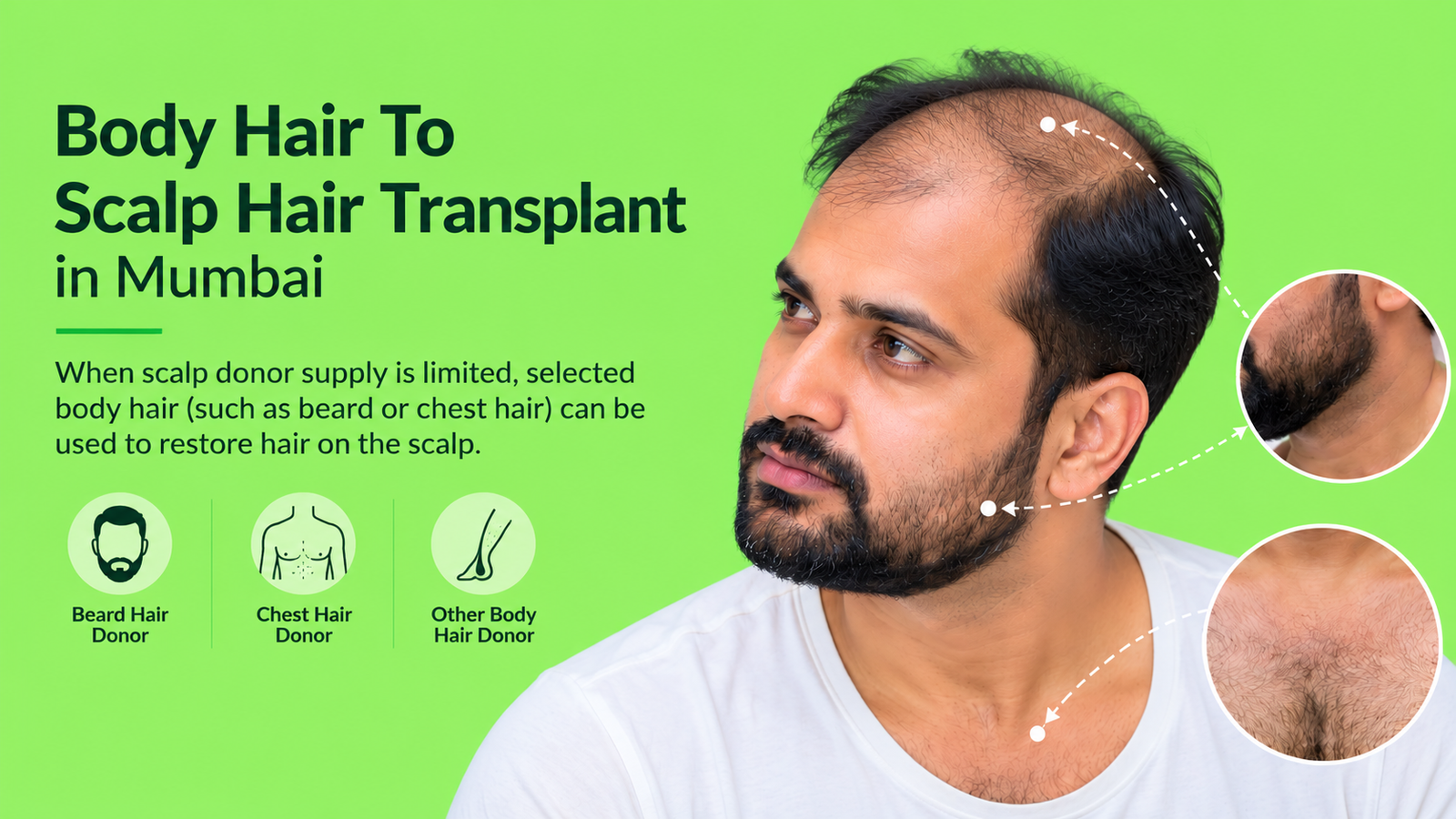
Body Hair To Scalp Hair Transplant in Mumbai
Body Hair To Scalp Hair Transplant is a specialised form of follicular-unit transplantation in which suitable non-scalp follicles are harvested and transplanted into selected scalp areas.
It may be considered when conventional scalp donor hair alone cannot safely provide enough follicles for the intended restoration.
The procedure does not mean that every body hair can be transplanted successfully, nor does it mean that body hair behaves exactly like scalp hair.
Donor selection, graft sorting and recipient-zone planning are therefore central to the procedure.
What Is a Body Hair To Scalp Hair Transplant?
In standard hair transplantation, suitable follicles are usually harvested from the scalp donor region.
In selected patients, additional follicles may potentially be obtained from areas such as:
- beard
- chest
- other carefully selected body regions
The useful donor source differs between patients.
Scalp donor hair remains preferred for scalp restoration where it is safely available.
Body follicles are primarily considered when additional donor resources are genuinely needed and their characteristics are appropriate for the intended recipient area.
When Might Body Hair Be Considered?
Body-to-scalp transplantation may be discussed in patients with:
- advanced hair loss
- limited scalp donor reserves
- previous FUE procedures
- overharvested donor areas
- repair requirements
- a large difference between recipient demand and safe scalp supply
If the problem is specifically limited donor availability, see Limited Donor Area Hair Restoration.
Which Body Hair Can Potentially Be Used?
Beard Hair
Beard hair often has a thicker calibre than scalp hair and may provide useful visual bulk in suitable patients.
Because it can be coarser, it needs strategic placement.
Read Beard To Scalp Hair Transplant for the dedicated discussion.
Chest Hair
Chest hair can be considered selectively when its calibre, growth and donor density make it worthwhile.
It should not automatically be treated as equivalent to scalp or beard hair.
Read Chest Hair To Scalp Hair Transplant for detailed planning.
Other Body Sites
Other body areas require greater selectivity.
Availability alone does not make a follicle a useful cosmetic donor.
How Does Body Hair Differ From Scalp Hair?
Different donor follicles can vary in:
- thickness
- curl
- colour
- texture
- maximum visible length
- follicular-unit characteristics
- growth-cycle behaviour
That is why a body graft cannot automatically be counted as cosmetically equivalent to a scalp graft.
The objective is to use each donor type where it can contribute appropriately.
Where Should Body Hair Be Placed on the Scalp?
Recipient-zone planning is more important than simply maximising the total number of extracted follicles.
Frontal Hairline
Fine scalp single-hair grafts are particularly valuable at the leading edge of a natural hairline.
Coarse beard hair should not automatically be placed in the first rows.
Behind the Hairline
Selected thicker follicles may be blended behind the soft frontal transition where their calibre can contribute visual coverage.
Mid-Scalp
The mid-scalp may accommodate strategic mixing in suitable cases.
Crown
The crown can require a large number of grafts because of its surface area and whorl pattern.
In a limited-donor patient, aggressive crown restoration can consume follicles that may have greater cosmetic value in the front and mid-scalp.
How Is Body Hair To Scalp Hair Transplant Performed?
Step 1: Hair-Loss Assessment
The pattern, recipient surface area, native hair and expected progression are reviewed.
Step 2: Scalp Donor Assessment
Safe usable scalp follicles are evaluated first.
Step 3: Body Donor Assessment
Beard, chest or other selected donor sources are assessed only where clinically useful.
Step 4: Donor Combination Planning
The surgeon decides how much restoration can reasonably be supported by scalp versus supplementary donor hair.
Step 5: Recipient-Zone Planning
Hairline, frontal scalp, mid-scalp and crown priorities are mapped.
Step 6: Local Anaesthesia
Donor and recipient areas are anaesthetised appropriately.
Step 7: FUE Extraction
Selected grafts are individually harvested. Body-hair extraction can be technically more demanding because hair exit angle and skin characteristics vary by donor region.
Step 8: Graft Inspection and Sorting
Grafts are classified according to donor origin and follicular characteristics.
Step 9: Recipient-Site Creation and Implantation
Sites are planned according to direction, angle, calibre and desired visual distribution.
Step 10: Post-Procedure Care
The patient receives care instructions for each donor site and the scalp recipient area.
Recovery
Different donor areas may heal differently.
Temporary redness, small crusts, tenderness or visible extraction points may occur.
Postoperative instructions need to account for both the scalp recipient site and whichever donor regions were used.
Transplanted hair growth develops gradually rather than immediately.
Initial implanted shafts may shed before later growth develops.
Timing and final cosmetic contribution vary between patients and donor sources.
What Results Can Be Expected?
Body hair may expand restoration possibilities when conventional scalp donor supply is limited.
However, results depend on:
- scalp donor reserve
- quality of the selected body donor
- recipient-area size
- graft growth
- calibre and texture
- strategic distribution
- previous surgery
- future hair loss
Body hair should not be judged only by the number of grafts harvested.
Limitations
Body Hair To Scalp Hair Transplant cannot guarantee:
- that every available body follicle is suitable
- that body hair will behave like scalp hair
- complete scalp coverage
- identical density across all regions
- scar-free extraction
- a fixed survival percentage
- that one procedure will be sufficient
Cost of Body Hair To Scalp Hair Transplant
Cost depends on the individual surgical plan.
Relevant factors can include:
- scalp graft requirement
- number and type of body donor regions
- beard grafts
- chest grafts
- extraction difficulty
- recipient surface area
- previous surgery
- repair requirements
- one-stage versus staged restoration
- total procedural complexity
Frequently Asked Questions
Does body hair turn into scalp hair?
No. It generally retains important donor characteristics.
Which body hair is best for the scalp?
There is no universal answer. Scalp remains preferred where safely available; supplementary sources are selected individually.
Can beard hair be used in the frontal hairline?
Very coarse beard hair is generally better blended behind a soft frontal edge rather than routinely used in the leading rows.
Can chest hair grow long on the scalp?
Its growth characteristics can continue to differ from scalp hair, and maximum useful length varies.
Can body hair replace an overharvested scalp donor?
It may expand available options in selected patients but does not reverse damage to the scalp donor region or create unlimited donor supply.
Body Hair To Scalp Consultation in Mumbai
A useful consultation should answer:
- How strong is your remaining scalp donor?
- Which supplementary donor areas are actually useful?
- Which scalp zones should be prioritised?
- What degree of density is realistic?
- Should treatment be staged?
- How much donor supply should remain untouched?
Send clear front, top and back/donor photographs for an initial assessment.
Patients with substantial beard or body donor considerations may also be asked for additional donor photographs.
Use Anagen’s Contact page for a formal consultation.