





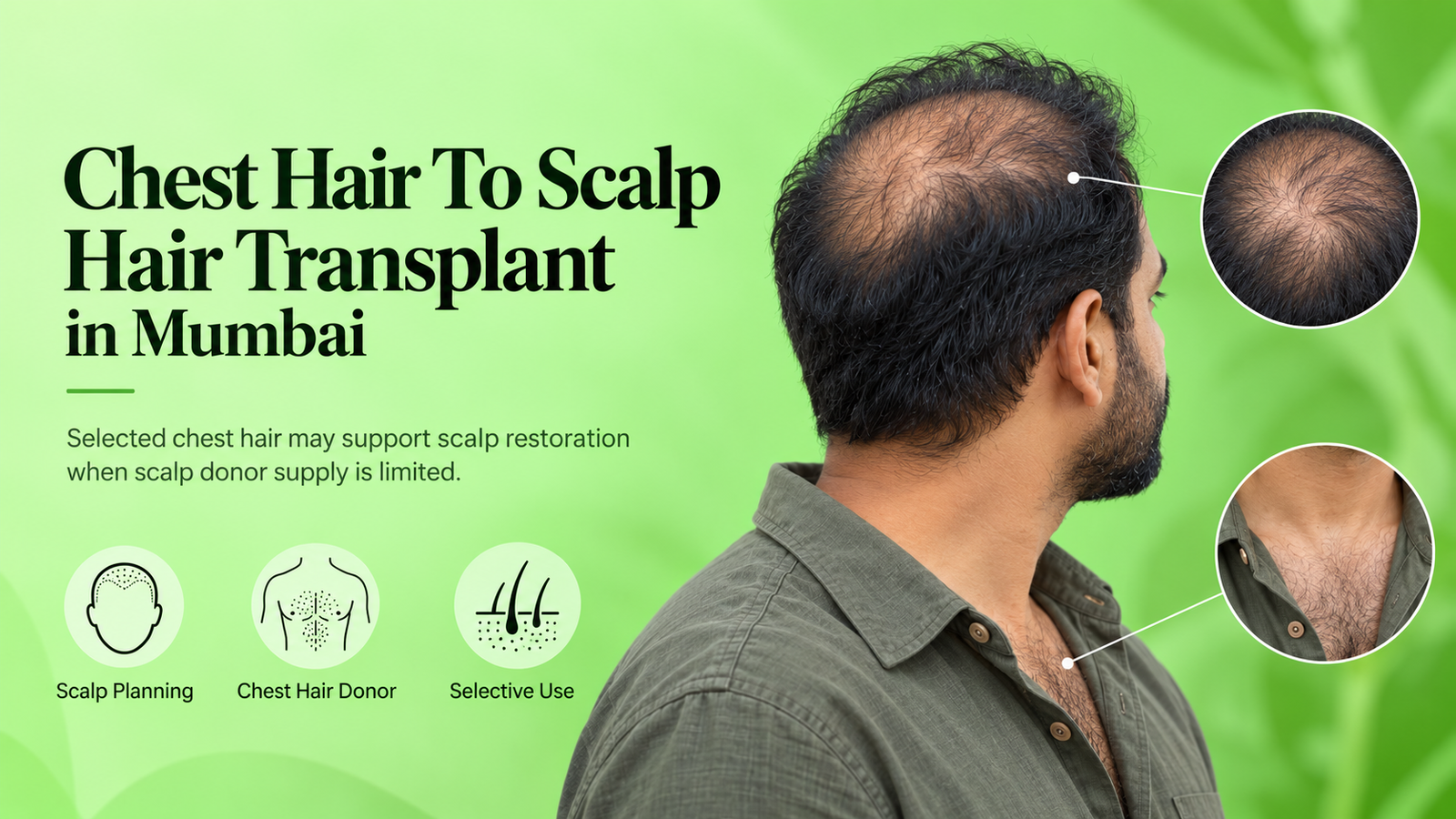
Chest Hair To Scalp Hair Transplant in Mumbai
Chest hair may provide supplementary donor follicles for scalp restoration in carefully selected patients.
It is generally a more selective donor source than conventional scalp hair and should not automatically be treated as equivalent to beard or scalp follicles.
The usefulness of chest hair depends on its density, calibre, curl, visible growth length, growth pattern and how closely it can blend with the intended scalp recipient area.
When May Chest Hair Be Considered?
Chest follicles are generally considered only when:
- scalp donor supply is restricted
- additional follicles are needed
- chest hair has potentially useful characteristics
- donor visibility is acceptable
- expected cosmetic benefit justifies extraction
Having chest hair does not automatically make someone a good chest-to-scalp candidate.
Why Is Chest Hair More Selectively Used?
Chest hair commonly differs from scalp hair in several ways.
Depending on the individual, it may be:
- finer
- curlier
- shorter in visible growth
- less dense
- distributed irregularly
- more variable in cosmetic contribution
Because of these differences, chest follicles need to be evaluated as a distinct donor type rather than simply added to a total graft count.
Chest Donor Assessment
A useful assessment looks at more than whether chest hair is present.
The clinician evaluates:
- density
- shaft calibre
- curl
- colour
- distribution
- skin response
- donor-area visibility
- whether enough suitable follicles exist to justify surgery
Where Might Chest Hair Be Used on the Scalp?
Chest hair is usually supplementary.
Its recipient placement depends on how well its characteristics match surrounding hairs.
It should not automatically be used to construct the visible first rows of a frontal hairline.
Where appropriate, selected chest follicles may contribute to less visually critical areas or be blended with stronger scalp or beard donor hairs.
The exact distribution requires individual planning.
For the overall non-scalp donor procedure, see Body Hair To Scalp Hair Transplant.
Why Chest Graft Numbers Are Not Equivalent to Scalp Graft Numbers
Two patients can receive the same numerical number of grafts and obtain very different visual coverage.
The result depends on:
- hair calibre
- hairs per follicular unit
- curl
- visible growth length
- colour-to-skin contrast
- growth behaviour
- distribution
Chest grafts should therefore not be marketed as a simple one-for-one replacement for scalp donor grafts.
How Is Chest Hair To Scalp Hair Transplant Performed?
Step 1: Scalp and Hair-Loss Assessment
Recipient demand and existing donor supply are measured.
Step 2: Conventional Scalp Donor Assessment
Usable scalp donor hair is prioritised.
Step 3: Chest Donor Assessment
Chest characteristics are examined for suitability.
Step 4: Donor-Combination Planning
The surgeon determines whether chest hair can add worthwhile cosmetic value.
Step 5: Recipient-Zone Planning
The intended scalp distribution is mapped.
Step 6: Local Anaesthesia
The relevant donor and recipient sites are numbed.
Step 7: Selective FUE Extraction
Chest follicles are individually harvested while accounting for variable exit angles and skin characteristics.
Step 8: Graft Inspection and Sorting
Chest grafts are kept distinguishable from other donor sources.
Step 9: Strategic Implantation
Selected grafts are implanted according to the recipient plan.
Step 10: Post-Procedure Care
Both chest donor and scalp recipient areas require specific postoperative care.
Chest Donor Recovery
Small extraction sites need time to settle.
Temporary redness, pigmentation changes, crusting or small visible extraction marks can occur.
Healing response differs between patients and skin types.
FUE should not be described as scar-free.
What Results Can Chest Hair Provide?
Chest hair can provide supplementary follicles in selected patients, but its growth characteristics may differ substantially from scalp hair.
Its cosmetic contribution therefore varies between patients.
A successful strategy may involve combining chest hair with other donor sources rather than expecting chest hair alone to reproduce normal scalp density.
Original patient cases should be shown through Anagen’s Results section rather than duplicated here.
Limitations
Important limitations include:
- inadequate chest density
- unsuitable hair calibre
- short visible growth
- texture mismatch
- curl differences
- pigmentary changes at donor sites
- technically challenging extraction
- variable visual contribution
- need for multiple donor sources
Cost of Chest Hair To Scalp Transplant
Pricing should follow individual assessment.
Factors can include:
- number of selected chest grafts
- additional scalp or beard grafts
- extraction difficulty
- donor-area characteristics
- recipient area
- previous surgery
- number of sessions
- total surgical complexity
Frequently Asked Questions
Can every man with chest hair use it for scalp transplantation?
No.
Will chest hair grow exactly like scalp hair?
No. Important donor characteristics can remain different.
Can chest hair be used for the first hairline rows?
It is generally not the automatic first choice where finer scalp follicles are available.
Does chest extraction leave marks?
Small extraction scars or pigmentary changes are possible.
Can chest hair replace thousands of missing scalp grafts?
It should not be assumed. The useful supply and cosmetic contribution vary widely.
Chest Hair To Scalp Consultation in Mumbai
An assessment should establish whether the chest donor source adds enough benefit to justify using it.
Send clear scalp donor photographs first. Where chest donor assessment is relevant, the clinical team can request appropriately framed donor photographs.
Use Anagen’s Contact page for formal consultation.