





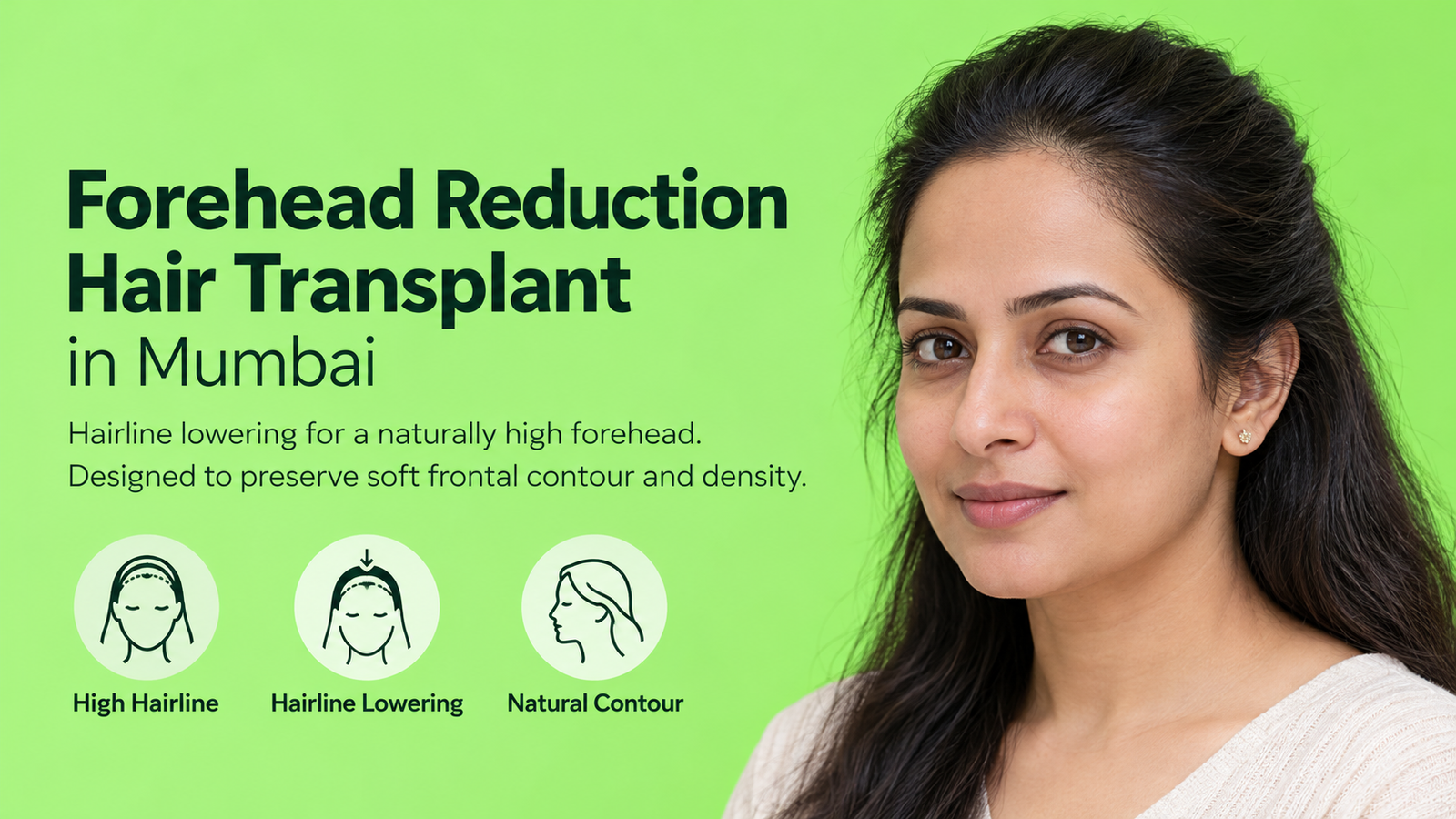
Forehead Reduction Hair Transplant in Mumbai
A naturally high forehead can affect facial proportions even when there is no active hair loss.
For selected women, follicular hair transplantation can be used to create a new frontal hairline at a lower position, making the visible forehead appear shorter while preserving a natural transition between the forehead, hairline and temples.
This is different from restoring a hairline that has receded because of hair loss.
The treatment objective is not simply to place the hairline as low as possible.
It is to design a position that suits the patient’s facial proportions, donor supply, existing temporal anatomy and long-term appearance.
What Is Forehead Reduction With Hair Transplantation?
Forehead reduction with hair transplantation lowers the visual position of the frontal hairline by implanting follicular units into a carefully designed zone below the existing hairline.
The newly created frontal edge is then integrated with the patient’s existing hairline and temples.
Unlike scalp-advancement surgery, this approach does not physically advance a flap of hair-bearing scalp.
Instead, follicles are transplanted into the planned hairline-lowering zone.
The amount of lowering that is sensible depends on facial proportions, donor availability and the density required to make the new area look natural.
Who May Consider Hairline Lowering?
Selected women may consider transplantation-based forehead reduction when they have:
- A naturally high frontal hairline
- A forehead that appears disproportionately tall
- A stable hairline without active recession
- Adequate donor density
- Suitable hair calibre
- Realistic expectations
- A desire for gradual follicular lowering rather than surgical scalp advancement
A patient whose hairline has become high because of recession or hair loss may require a different assessment.
Hairline Lowering Versus Female Hairline Restoration
The distinction is important.
Forehead Reduction Hair Transplant is primarily for a woman whose natural hairline has always been relatively high.
Female Hairline Restoration is primarily for a woman whose frontal or temporal hairline is deficient, thinned, irregular or recessed.
The final design may use similar principles, but the reason for treatment is different.
How Much Can the Hairline Be Lowered?
There is no universal number.
The planned position depends on:
- Forehead height
- Facial proportions
- Existing frontal contour
- Temple relationship
- Hair calibre
- Donor density
- Graft availability
- Density required in the new zone
- Long-term donor preservation
Trying to lower the hairline too aggressively can create an unnatural position and substantially increase graft requirements.
The design should therefore be conservative enough to remain proportionate as the patient ages.
Facial Proportions Matter
The proposed hairline should be assessed as part of the entire face rather than as an isolated measurement.
The forehead, eyebrows, temples, facial width, hairline curvature and overall vertical facial proportions all contribute to the visual result.
There is no single ideal female forehead height that suits every patient.
Designing the New Female Hairline
A lowered hairline should still look like a naturally occurring female hairline.
Important design elements include:
- Appropriate central height
- Smooth but non-mechanical contour
- Natural frontal corners
- Fine irregularity at the leading edge
- Temple integration
- Low exit angles
- Proper hair direction
- Gradual density increase
- Fine single-hair grafts where appropriate
The objective is not to create a solid wall of dense hair.
Existing Hairline Versus Proposed Hairline
The new zone needs enough density to blend with the native hair behind it.
If the newly created strip is too sparse, the contrast between the transplanted area and the original hairline may remain visible.
If it is overpacked indiscriminately, donor grafts may be used inefficiently.
The width and surface area of the new zone therefore have a direct effect on graft requirement.
Why Temple Integration Matters
Lowering only the central forehead without considering the temporal regions can make the new hairline appear disconnected.
At the same time, extending temple points too aggressively can make the face look unnaturally narrow or over-framed.
Temple design should therefore be individualised and conservative.
How Is Forehead Reduction Hair Transplantation Performed?
Step 1: Hairline and Facial Assessment
The existing frontal height, contour and facial proportions are evaluated.
Step 2: Donor Assessment
Donor density, calibre and long-term availability are assessed.
Step 3: Proposed Hairline Design
The new frontal position and temple transitions are marked.
Step 4: Local Anaesthesia
Local anaesthesia is administered according to the treatment plan.
Step 5: Follicular Unit Extraction
Suitable follicular units are harvested from the donor area.
Step 6: Graft Sorting
Fine single-hair grafts are identified for visible frontal transition areas where appropriate.
Step 7: Recipient-Site Creation
Sites are created within the lowering zone according to direction, angle, spacing and density gradient.
Step 8: Implantation
Grafts are placed from the proposed leading edge backward toward the existing hairline.
Step 9: Early Post-Procedure Care
The patient receives washing, scalp-care, activity and follow-up instructions.
How Many Grafts May Be Required?
Graft requirement depends substantially on how far the hairline is being lowered and how wide the treatment zone is.
Important variables include:
- Amount of planned lowering
- Width of the forehead
- Temple involvement
- Required frontal density
- Hair calibre
- Existing frontal density
- Donor density
- Whether more than one stage may be useful
Lowering a broad hairline can consume considerably more grafts than a small frontal adjustment.
Recovery and Growth
Initial redness, crusting and temporary shedding can occur after treatment.
The newly transplanted hairs may shed before progressive new growth becomes visible.
Hairline maturation occurs gradually.
Because the treatment creates a completely new frontal zone, final evaluation should consider not only whether hair grows, but whether the contour, angle and density blend naturally with the original hairline.
Forehead Reduction Hair Transplant Results
The amount of visual forehead reduction achievable with transplantation depends on the planned hairline position, donor supply and required density.
Relevant hairline results can help demonstrate different restoration patterns.
Cost of Forehead Reduction Hair Transplantation
Cost depends on:
- Width of the new frontal zone
- Amount of lowering
- Graft requirement
- Temple integration
- Hair calibre
- Donor density
- Required density
- Whether one or more sessions are planned
The treatment should not be quoted solely according to forehead height without graft planning.
Frequently Asked Questions
Can a hair transplant make my forehead look smaller?
Yes, selected patients can have the frontal hairline lowered with follicular transplantation, which can reduce the visible height of the forehead.
Is this the same as forehead-reduction surgery?
No. This page refers to transplantation-based hairline lowering. Surgical scalp advancement is a different operation.
How low can my hairline be placed?
The safest and most natural position depends on facial proportions, donor supply, density requirements and long-term planning.
Will the transplanted hairline look natural?
Natural appearance depends on design, use of appropriate follicular units, low exit angles, irregularity and gradual density transition.
Are the temples also treated?
They may be integrated when required, but temple lowering should remain conservative.
Can a high forehead be treated if I am not losing hair?
Yes. A naturally high but stable hairline can be treated in selected patients with suitable donor characteristics.
Want to Know How Much Your Hairline Can Be Lowered?
The answer cannot be determined from forehead height alone.
Anagen first needs to assess:
- Your existing hairline
- Facial proportions
- Temple anatomy
- Donor density
- Hair calibre
- The width of the proposed lowering zone
For an initial assessment, send clear photographs of:
Front • Right Oblique • Left Oblique • Both Sides • Back/Donor Area
A personalised design can then help determine whether transplantation-based hairline lowering is suitable and how conservative the new hairline should be.