





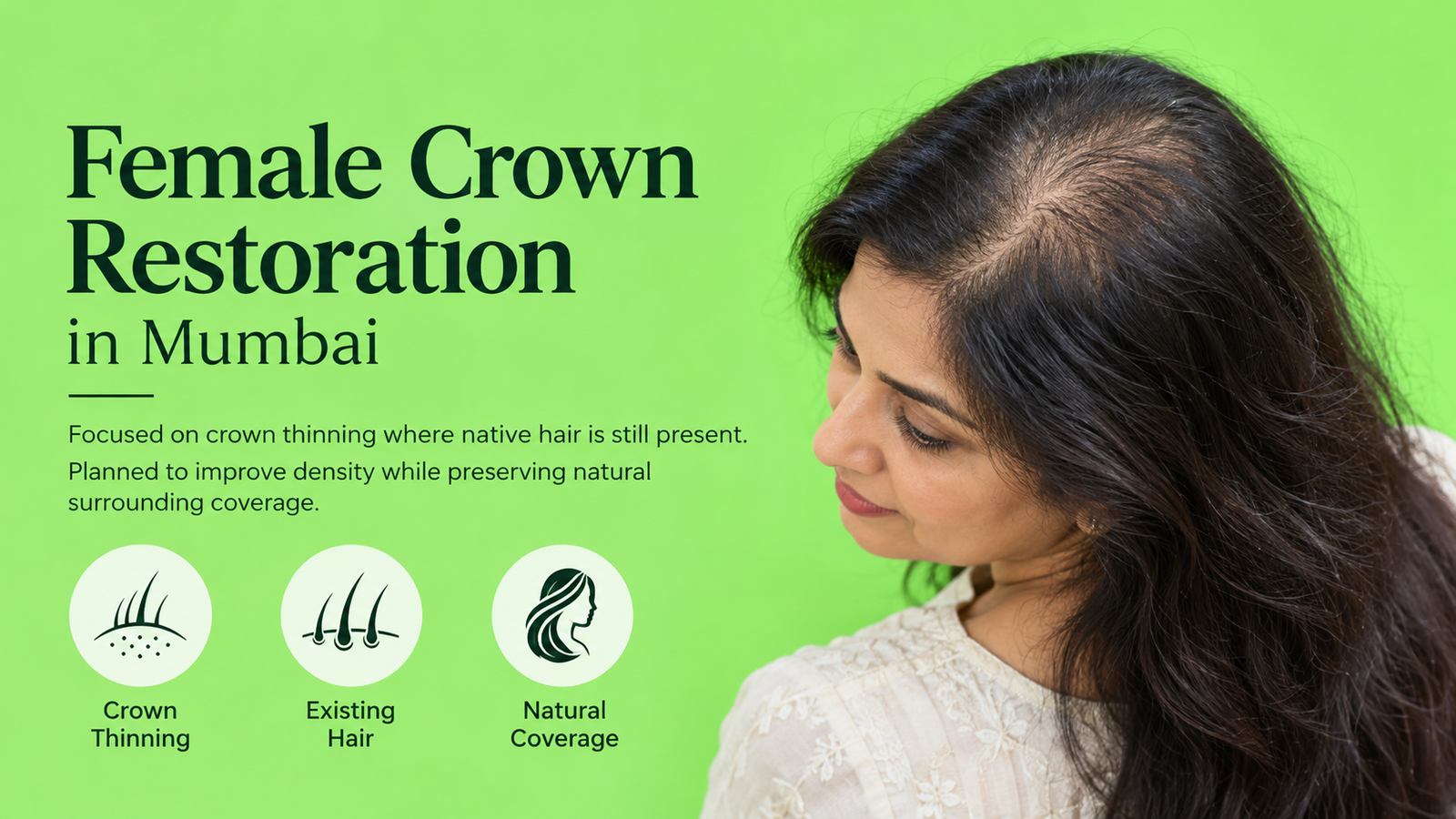
Female Crown Restoration in Mumbai
Crown thinning in women can gradually make the scalp more visible from above even while substantial surrounding hair remains.
Unlike a frontal hairline, the crown covers a relatively broad surface area.
That makes donor planning, existing native hair and strategic density particularly important.
A female crown transplant is therefore not simply a matter of filling every visible gap with grafts.
The first question is whether the crown thinning is stable and appropriate for surgical restoration.
What Does Female Crown Thinning Look Like?
Women may notice:
- Increased scalp visibility from above
- Reduced density around the crown
- A wider central part extending posteriorly
- Reduced volume when styling the hair
- Progressive central scalp thinning
The exact pattern should be diagnosed rather than assumed.
Why Crown Restoration Requires Careful Planning
The crown can consume a large number of grafts because it may cover a substantial surface area.
Trying to create high density throughout a large crown can use donor reserves rapidly.
Planning therefore considers:
- Size of the thinning area
- Existing native hair
- Hair direction
- Hair calibre
- Donor density
- Expected progression
- Other scalp areas that may need treatment later
Existing Hair Must Be Protected
Female crown thinning often occurs within an area that still contains significant native hair.
Recipient sites therefore need to be placed with awareness of those follicles.
The goal is strategic enhancement without unnecessarily disturbing surviving hair.
Crown Hair Direction
Hair direction in the crown is not uniform.
The surrounding hairs may curve or rotate through the region.
Transplanted follicles should be placed according to the patient’s natural pattern rather than in straight parallel rows.
Female Crown Restoration Versus Density Enhancement
A small selected low-density area may fit within general female density enhancement.
A broader crown/vertex problem has additional considerations because of:
- Surface area
- Directional pattern
- Graft consumption
- Native hair distribution
- Long-term donor allocation
Female Crown Thinning and Pattern Hair Loss
Some crown thinning forms part of female pattern hair loss.
In those cases, donor miniaturisation and future progression must be considered before surgery.
When Surgery May Not Be the First Step
Transplantation may be premature when:
- Crown thinning is actively progressing
- Diffuse shedding is present
- Donor hair is significantly miniaturised
- A medical or hormonal cause requires treatment
- Existing follicles may still respond to medical management
- The expected graft requirement exceeds responsible donor availability
How Is Female Crown Restoration Performed?
Step 1: Crown Assessment
The size, density and pattern of thinning are evaluated.
Step 2: Donor Assessment
Donor stability and available follicular supply are assessed.
Step 3: Crown-Zone Planning
The region is divided according to visual priority, existing hair and expected benefit.
Step 4: Local Anaesthesia
Anaesthesia is administered to the relevant areas.
Step 5: Follicular Unit Extraction
Suitable grafts are selectively harvested.
Step 6: Graft Sorting
Follicular units are organised according to planned placement.
Step 7: Recipient-Site Creation
Sites are created according to existing crown direction and native hair distribution.
Step 8: Implantation
Grafts are strategically distributed through the selected crown zones.
Step 9: Early Post-Procedure Care
Post-treatment instructions are provided.
How Many Grafts May Be Required?
Crown graft requirement varies significantly.
Important factors include:
- Crown diameter
- Surface area
- Existing native density
- Hair calibre
- Hair direction
- Donor supply
- Desired visual coverage
- Future hair-loss risk
- Whether frontal areas also require treatment
Large crown regions can consume significant donor resources.
This is why graft allocation may need to be conservative.
Recovery and Growth
Early healing follows the same broad biological stages as other transplanted scalp regions.
Some transplanted hairs may shed before new growth appears.
Visible improvement occurs gradually.
Crown maturation may take time to become visually meaningful because the area is broad and viewed from above.
Female Crown Restoration Results
Crown restoration results vary according to the size of the thinning area, existing native hair and available donor grafts.
Explore relevant crown restoration results to understand realistic treatment outcomes.
Cost of Female Crown Restoration
Cost depends on:
- Crown surface area
- Graft requirement
- Existing hair
- Donor density
- Hair calibre
- Other treatment priorities
- Number of stages
Frequently Asked Questions
Can women have a crown hair transplant?
Yes, selected women with stable crown thinning and suitable donor hair may be candidates.
Why does the crown need many grafts?
The crown can cover a broad surface area, so meaningful visual coverage may require substantial graft allocation.
Can native crown hair continue to thin?
Yes. Transplantation does not prevent progression of untreated native follicles.
Is a completely bald crown required before surgery?
No. Many female crown patients retain substantial native hair.
Can medical treatment be tried first?
Yes, particularly when thinning is active or potentially responsive to medical management.
Can the crown and frontal scalp be transplanted together?
Sometimes, but donor availability and treatment priorities need to be assessed carefully.
Is Your Crown Becoming More Visible?
A crown transplant should not be planned from the top-view photograph alone.
Anagen first evaluates:
- Crown surface area
- Existing native hair
- Hair direction
- Donor density
- Donor miniaturisation
- Future progression
- Whether medical management should come first
For an initial assessment, send clear photographs of:
Top • Crown • Front • Back/Donor Area