





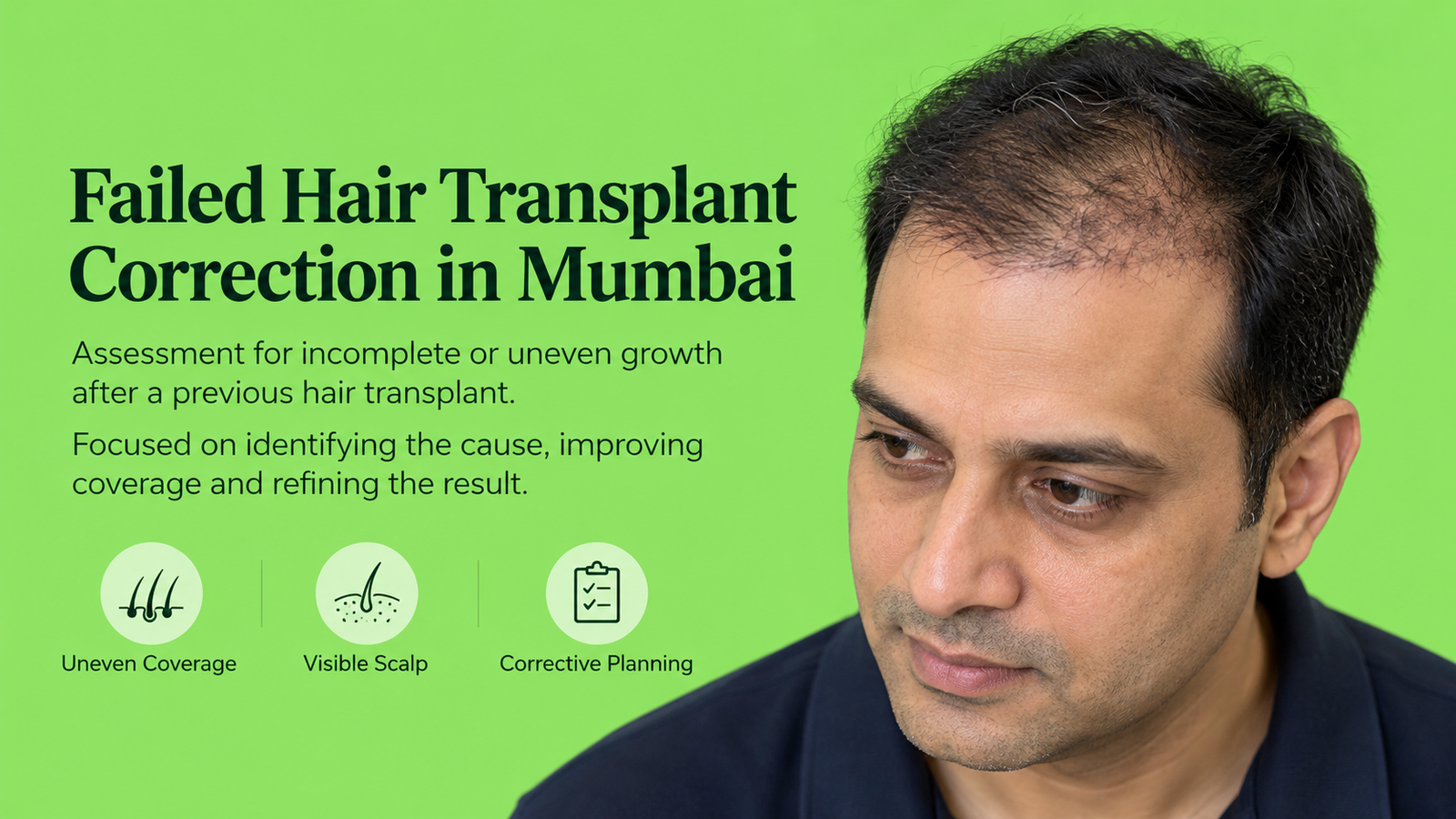
Failed Hair Transplant Correction in Mumbai
A failed hair transplant correction is a specialised restoration approach for patients who have undergone a previous hair transplant but are dissatisfied because of poor hair growth, inadequate density, patchy coverage or an unexpectedly limited improvement.
For many patients, the main concern is straightforward: they underwent surgery, waited several months and did not obtain the coverage they expected.
However, an unsatisfactory hair transplant result does not always mean that the transplanted follicles failed to survive.
The appearance may also be affected by continued loss of surrounding native hair, insufficient original graft numbers, poor density distribution or unrealistic coverage planning.
At Anagen Hair Transplant Clinic in Mumbai, corrective planning should therefore begin with identifying why the result appears unsuccessful rather than automatically recommending another large transplant.
What Is Considered a Failed Hair Transplant?
The term failed hair transplant is commonly used when the final visible result is substantially below the patient’s expectations.
However, different problems can produce a similar appearance.
A transplant may show limited growth because fewer grafts survived than expected. It may also look sparse because the original graft count could not provide adequate coverage across the selected region.
In other cases, successfully growing transplanted hair may be surrounded by native hair that has continued to thin.
These situations require different corrective approaches.
The clinician must establish the cause before deciding whether surgery, medical treatment or observation is most appropriate.
Why Might a Previous Hair Transplant Show Poor Growth?
Inadequate Graft Growth
Some transplanted follicular units may fail to produce useful visible hair. The reason is not always identifiable after the procedure.
Continued Native Hair Loss
Androgenetic alopecia may continue affecting non-transplanted hair around the reconstructed area.
Insufficient Original Graft Numbers
The graft count may have been inadequate for the recipient area, expected coverage or hair calibre.
Poor Graft Distribution
Grafts may have grown but been distributed in a way that creates areas of inadequate visual density.
Donor Hair Characteristics
Fine hair, low follicular-unit hair counts or unsuitable donor selection may produce less coverage than originally expected.
Recipient Scarring or Scalp Disease
Previous surgery, tissue injury or an active dermatological condition may affect suitability and growth.
Other Technical and Patient-Related Factors
Extraction trauma, graft handling, implantation injury, recipient-site preparation, healing complications, medical conditions and other factors can influence outcomes.
Importantly, an unsuccessful appearance is not by itself proof of negligence or a particular technical error.
How Do We Determine Why a Hair Transplant Appears Unsuccessful?
The assessment begins with the history of the previous procedure and the pattern of current hair loss.
Important information includes the date of surgery, number of procedures, approximate graft counts, treated regions and any known postoperative complications.
Previous photographs can help compare the original hair-loss pattern with the present condition.
Recipient Scalp Examination
The clinician examines existing transplanted follicles, visible density, miniaturisation, scalp inflammation and potential scarring.
Donor Examination
The donor region is assessed for remaining density, extraction patterns, miniaturisation and signs of depletion.
Hair-Loss Progression
Current loss of native hair must be distinguished from inadequate growth of previously implanted follicles.
Medical Review
Dermatological disease, relevant systemic conditions, medication history and scalp health may need assessment.
A diagnosis based only on one frontal photograph may be incomplete.
How Long Should I Wait Before Calling My Transplant a Failure?
Hair transplantation requires time for follicles to recover, shed their original shafts and produce new growth.
Many patients begin to see early growth around three to four months, with gradual improvement over the following months.
At six months, the result may still be immature.
Assessment is often more meaningful around twelve months, although crown restoration and some complex cases may continue to mature beyond that period.
An apparently poor result at three or four months should not automatically be labelled a failed transplant.
If there is severe inflammation, unexpected tissue change, progressive shedding or another concerning symptom, medical review should occur earlier rather than waiting for the final growth assessment.
Can Patchy Growth Be Corrected?
Selected patients with persistent patchy growth may benefit from additional graft placement.
However, the surgeon first needs to determine whether the patch represents insufficient graft survival, inadequate original coverage, native hair miniaturisation or an underlying scalp condition.
The corrective plan may include targeted density restoration, broader coverage redistribution or medical treatment.
Adding grafts without understanding the problem may waste limited donor hair.
Why Is Donor Hair Assessment Critical After a Failed Transplant?
A patient who has already undergone transplantation may have substantially fewer available scalp donor grafts than before the original surgery.
The number of previously extracted follicular units, their distribution and the remaining donor density all influence the possibility of correction.
A patient with extensive previous FUE harvesting may require a conservative plan.
Using too many additional grafts could create visible donor depletion without producing proportionate recipient improvement.
For patients with limited reserves, Advanced Donor Management and Limited Donor Area Hair Restoration the importance of safe lifetime planning.
Can Beard or Body Hair Help When Scalp Donor Hair Is Limited?
Alternative donor hair may be considered in selected cases where available scalp follicles are insufficient.
Beard hair can have different calibre, growth behaviour and cosmetic characteristics from scalp hair.
Chest and other body hair may differ further in length, texture and growth cycle.
These characteristics influence where alternative donor hair can be used effectively.
For example, coarse beard hair may be better considered for selected areas requiring additional bulk rather than automatically substituting it for the fine single hairs needed at a delicate frontal leading edge.
Anagen’s Body to Scalp Hair Transplant page discusses alternative donor sources.
What Are the Available Correction Options?
The treatment depends on the cause of the disappointing outcome.
Additional Graft Placement
Suitable when an area has inadequate lasting coverage and donor supply remains sufficient.
Density Redistribution
Selected areas may be prioritised to provide a more useful visual improvement than uniformly increasing graft numbers.
Medical Treatment for Native Hair Loss
When ongoing androgenetic alopecia is contributing to the result, a medically supervised hair-loss treatment plan may be appropriate.
Male Pattern Baldness Prescription and Post Hair Transplant Maintenance Prescription are relevant for patients with continued native hair thinning.
Hairline or Technical Repair
When the main problem is an unnatural hairline or incorrectly directed grafts, Repair Hair Transplant addresses aesthetic correction in greater detail.
Staged Restoration
Patients with limited donor hair, extensive baldness or scarred tissue may require a conservative staged plan.
How Is Failed Hair Transplant Correction Performed?
Step 1: Previous Procedure Review
The clinician reviews the original surgery date, graft estimates, treated regions and available operative documentation.
Step 2: Growth and Scalp Assessment
Existing graft growth, recipient density, scalp condition and signs of continued native hair loss are evaluated.
Step 3: Donor Capacity Assessment
The remaining safe donor supply, previous extraction patterns and alternative donor suitability are examined.
Step 4: Establishing the Main Cause
The surgeon determines whether inadequate growth, insufficient planning, progressive native hair loss or other factors best explain the appearance.
Step 5: Corrective Treatment Design
A practical plan is developed based on achievable coverage and remaining donor resources.
Step 6: Medical Preparation and Anaesthesia
The patient undergoes appropriate medical evaluation, treatment planning and local anaesthesia where surgery is indicated.
Step 7: Additional Follicular Unit Extraction
Suitable grafts are harvested from carefully selected donor regions if additional transplantation is appropriate.
Step 8: Recipient-Site Creation and Implantation
Grafts are placed into planned zones while preserving existing follicles and accounting for any previous scarring.
Step 9: Recovery and Long-Term Assessment
Postoperative care, medical maintenance where appropriate and follow-up are arranged to evaluate healing and the developing result.
What Is Recovery Like After a Corrective Transplant?
Recovery depends on the number of additional grafts, recipient tissue condition and previous scarring.
Redness, crusting, swelling, tenderness, temporary shedding and donor-site changes may occur.
When new grafts are implanted, early visible growth may begin around three to four months.
Improvement often develops gradually over six to twelve months, and some areas require longer before a meaningful outcome assessment.
Patients should not assume that revision surgery will produce faster results simply because some transplanted hair already exists.
What Are the Risks of Another Hair Transplant?
Further surgery can cause additional donor scarring, donor thinning, shock loss, infection, bleeding, recipient injury and incomplete graft growth.
The risks may be greater where previous surgery has left poor tissue quality or severely depleted donor resources.
Not every disappointing transplant can be corrected adequately with additional grafts.
In some circumstances, medical management, cosmetic camouflage or accepting a conservative coverage objective may be more appropriate than further surgery.
Failed Hair Transplant Correction Cost in Mumbai
Cost depends on the diagnosed problem, remaining donor supply, number of additional grafts, recipient scarring, alternative donor requirements and whether staged treatment is necessary.
A previous large transplant does not automatically mean that another large procedure will produce satisfactory coverage.
The correct plan should be established before a personalised quotation is prepared.
Failed Hair Transplant Correction Results
A disappointing previous result can have several causes, including limited graft growth, continued native hair loss, inadequate initial graft numbers or donor limitations.
Correction outcomes therefore depend on identifying the actual problem and developing a realistic treatment plan.
View repair hair transplant results
Frequently Asked Questions
Why did my previous hair transplant not grow properly?
Possible explanations include graft-related factors, recipient-tissue conditions, ongoing native hair loss or inadequate original coverage. A clinical assessment is needed to distinguish them.
How long should I wait before deciding that my transplant failed?
A meaningful assessment is often possible around twelve months, although some cases continue maturing beyond that. Early poor density does not automatically indicate failure.
Can another transplant improve a low-density result?
Sometimes, provided sufficient donor hair remains and the recipient tissue is suitable.
Can I reuse hair from the previously transplanted area?
Selected transplanted grafts may sometimes be relocated during corrective surgery, but safe recovery and regrowth cannot be guaranteed.
What if my donor area has already been overharvested?
Further scalp extraction may need to be limited or avoided. The clinician can assess medical management, alternative donor options or more conservative objectives.
Will my previous successful grafts be damaged during correction?
The team should minimise injury to existing follicles, but operating within previously transplanted hair carries risks.
Book a Failed Hair Transplant Correction Consultation in Mumbai
If your previous transplant has produced limited growth, patchy coverage or disappointing density, the first step is to determine why.
Anagen can evaluate the recipient scalp, existing transplanted hair, progressive native hair loss and remaining donor availability before recommending further treatment.
Please share clear current photographs of the front, top, crown and rear donor region.
Also provide the approximate date of your previous surgery, the number of procedures, the graft count if known and any available earlier photographs.
Contact Anagen Hair Transplant Clinic to discuss your corrective options.